

Saving for your first home can feel like a mountain to climb, but the First Home Super Saver Scheme (FHSSS) is a seriously powerful tool designed to get you to the summit faster. Think of it as a dedicated, high-powered savings account that lives inside your super, built specifically to help you hit your home ownership goals sooner.
Understanding the First Home Buyer Super Saver Scheme
Let’s try a simple analogy. Imagine you're filling a bucket with water (that’s your home deposit). A regular savings account is like a standard garden hose – it gets the job done, but it has a few leaks along the way (we call that income tax). You lose a fair bit of water, and filling the bucket takes ages.
The First Home Super Saver Scheme is like swapping that leaky hose for a high-pressure, firefighter’s hose. It lets you channel extra contributions into the low-tax world of your superannuation, meaning much more of your hard-earned cash actually makes it into the bucket.
This government initiative is all about letting you save for your first home deposit inside your super fund. You can make extra contributions from your pre-tax or post-tax income, let them grow, and then pull them out – along with the earnings – when you’re ready to buy. It’s a structured and seriously tax-effective way to build a deposit.
To give you a quick snapshot, here are the key features of the scheme.
First Home Super Saver Scheme At a Glance
| Feature | Description |
|---|---|
| Maximum Voluntary Contributions | You can contribute up to $15,000 per financial year. |
| Total Withdrawal Limit | The total amount you can save and withdraw is capped at $50,000. |
| Contribution Types | Both concessional (pre-tax) and non-concessional (post-tax) contributions are eligible. |
| Tax Benefits | Contributions and earnings are taxed at a lower rate, accelerating your savings. |
| Eligibility | You must be 18 or over, have never owned property in Australia, and intend to live in the property. |
This table shows just how the scheme is structured to give you a real leg-up.
How Does It Give You an Edge?
The real magic of the FHSSS is all in the tax benefits. Money inside your super is taxed at a much lower rate than what you’d pay on your regular income. This simple difference is what puts your savings into overdrive.
We'll get into the specific numbers and how it all works later, but the main idea is straightforward.
By using the concessionally taxed superannuation system, you can boost your savings potential far beyond what a typical bank account can offer. This helps you save a deposit faster and get into the property market sooner.
And it’s clear aspiring homeowners are catching on. The scheme has become a go-to strategy across Australia. Data from the Australian Taxation Office shows that requests for FHSSS determinations exploded from around 10,000 in 2018-19 to a massive 49,300 in 2023-24. That tells you just how important it's become in today’s market. If you're interested in the data, you can check out the growth on the ATO's official statistics page.
Ultimately, the first home buyer super saver scheme is a strategic financial tool. It’s not just about putting money aside; it’s about making your savings work much harder for you.
How the FHSSS Supercharges Your Savings

The real magic behind the First Home Super Saver Scheme isn't complicated—it’s all about using the low-tax world of superannuation to get your deposit growing faster. Think about it: every dollar you put into a normal savings account has already had a big chunk taken out by the taxman. The FHSSS lets you get ahead of that.
It’s this simple difference that can shave months, or even years, off the time it takes to save for your first home. You’re not earning more; you’re just saving smarter.
Pre-Tax vs. Post-Tax: How Your Contributions Work
To really get how this works, you need to understand the two ways you can get money into the scheme: using pre-tax (concessional) or post-tax (non-concessional) contributions.
- Pre-Tax Contributions (Salary Sacrificing): This is the classic "set and forget" method. You simply ask your employer to divert a slice of your paycheque straight into your super before any income tax is calculated. That money is then taxed at the super rate of just 15%, which is a massive discount for most people compared to their usual tax rate.
- Post-Tax Contributions (Personal Contributions): This is where you put money into your super from your regular bank account—money you’ve already paid tax on. The clever part? You can then claim a tax deduction for that contribution when you do your tax return, which essentially turns it into a pre-tax contribution and gives you the same great tax benefit.
Both paths lead to the same destination, but salary sacrificing is often easier because it just happens automatically in the background. Plus, it lowers your taxable income right away, giving you an immediate win.
A Real-World Savings Scenario
Let's break this down with a real example. Say you earn $80,000 a year and want to put an extra $10,000 towards your deposit this year.
Scenario 1: Using a Standard Savings Account
If you save that cash in a regular bank account, it comes out of your take-home pay. On an $80,000 salary, your marginal tax rate is 34.5% (including the Medicare levy). To end up with $10,000 in your hand, you actually needed to earn about $15,267 before tax. The other $5,267 went straight to the ATO. Ouch.
Scenario 2: Using the FHSSS
Now, let's imagine you salary sacrifice that same $15,267 into your super instead. It gets taxed at only 15%, which works out to just $2,290 in tax.
The result? You’re left with $12,977 to put towards your deposit from the exact same amount of gross earnings. That’s an extra $2,977 in your pocket in just one year. That's the power of the tax advantage in action.
This is why the government estimates the FHSSS can boost your savings by 30% or more compared to a standard bank account. Over a few years, that difference really starts to add up.
How This Gets Your Deposit Growing Faster
It's a powerful one-two punch: you pay less tax on the money going in, and then that bigger starting amount gets to earn investment returns inside your super fund. It creates a compounding effect that puts your deposit savings on the fast track.
This strategy isn’t about finding extra cash to save. It’s about making the money you already earn work much, much harder for you.
For first-home buyers, this can be the difference-maker that gets you into the property market sooner. While you're building your deposit, it also pays to be aware of other tools that can help. Some buyers use things like deposit bonds, which you can learn about in our guide explaining what a deposit bond is.
Ultimately, the FHSSS provides a structured, tax-friendly highway to homeownership. By using your super as a powerful savings vehicle, you can make your dream of buying a home happen a lot quicker than you might think.
Understanding Eligibility and Contribution Rules
Before you start funnelling extra cash into your super, let's get the groundwork right. The First Home Super Saver Scheme (FHSSS) has some clear rules, and knowing them upfront is the key to using it effectively.
Think of these rules not as hurdles, but as the bumpers on a bowling lane—they’re there to keep your savings on the straight and narrow, heading directly for your first home deposit. Getting a handle on who can use the scheme and how much you can put in gives you the confidence to start saving smart from day one.
Are You Eligible for the Scheme?
The ATO designed the eligibility criteria to make sure the scheme helps genuine first-home buyers. It’s pretty straightforward, but you need to tick every box.
Here’s a simple checklist of what it takes:
- You have to be at least 18 years old to request a withdrawal.
- You must have never owned property in Australia before. This is a big one and includes everything from an investment unit to a block of vacant land.
- You need to intend to live in the home you buy for at least six of the first 12 months after you own it.
- You can't have already requested a release under the scheme. It’s a one-shot deal for each person.
These rules are firm, so it pays to be absolutely certain you qualify before you start making any extra super contributions.
Navigating the Contribution Limits
Once you’ve confirmed you’re eligible, the next piece of the puzzle is understanding the contribution limits. These caps define how much you can tuck away each year and in total. Knowing the numbers is crucial for planning your savings and getting the maximum bang for your buck without accidentally overstepping the mark.
The limits are designed to give your deposit a serious boost, while still being flexible enough for different saving styles.
Under the First Home Super Saver Scheme, you can make voluntary contributions of up to $15,000 in any single financial year. The total amount you can contribute and eventually withdraw is capped at $50,000 per person across all years.
It’s vital to remember that only your voluntary contributions count. The compulsory super your employer pays doesn’t qualify and can't be touched. This means you need to actively decide to put extra money in, either through a pre-tax salary sacrifice arrangement or by making personal post-tax contributions.
A Powerful Strategy for Couples
Here’s where the FHSSS gets really powerful. It’s an individual scheme, which means if you and your partner are both eligible, you can each use it. This effectively doubles your savings power and can slash the time it takes to get your deposit together.
Let’s break it down:
- You could each contribute the $15,000 maximum per year.
- As a couple, that’s a combined $30,000 annually, all growing in the tax-friendly environment of super.
- Over time, you could each hit the $50,000 lifetime cap, allowing you to pool a massive $100,000 (plus the earnings on top) from the scheme towards your deposit.
This combined approach can be a game-changer. It turns a smart individual savings tool into a formidable joint strategy, fast-tracking your entry into the property market and making homeownership feel that much closer.
Your Step-By-Step Guide to Withdrawing Funds
You’ve put in the hard work, making those extra contributions and watching your deposit grow inside your super fund. Now for the exciting part—getting that money out so you can finally buy your first home. The process for pulling your funds from the First Home Super Saver Scheme is a straightforward, two-stage journey, all managed through the ATO.
Think of it like ordering something valuable. First, you get a quote to see exactly what you’ve got and what it’s worth. That’s your ‘determination’. Then, you place the final order to have it delivered. That’s your ‘release request’. Nailing these steps ensures your funds arrive smoothly and without any last-minute drama.
This flowchart breaks down the core principles of using the scheme, from checking your eligibility to combining funds with a partner.
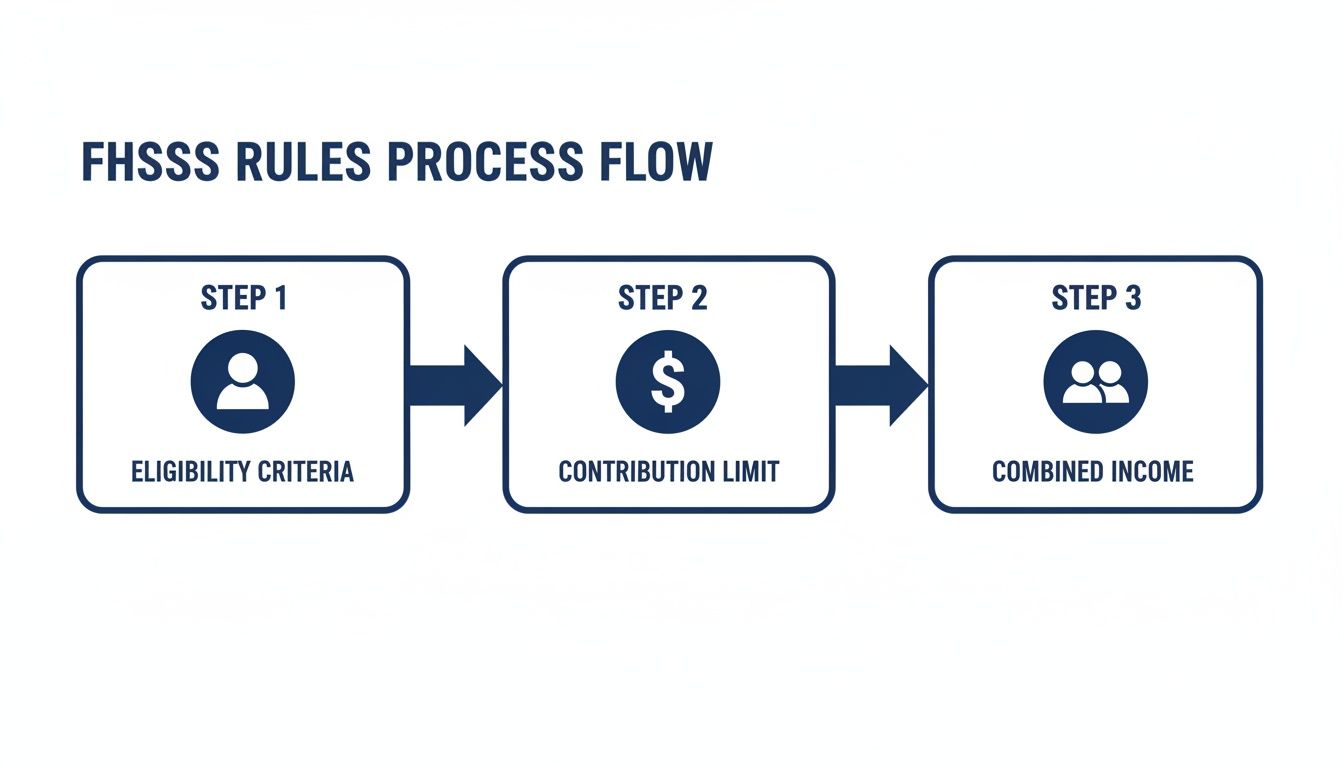
As the visual shows, it all comes down to individual eligibility, sticking to the contribution limits, and the powerful option for couples to pool their savings together.
Stage One: Requesting Your FHSSS Determination
Before you do anything else—and I mean anything—you need to request an FHSSS determination from the ATO. This is a non-negotiable first step. A determination is simply the ATO’s official calculation of the maximum amount you’re allowed to withdraw under the scheme.
This figure is a combination of:
- Your eligible voluntary pre-tax (concessional) contributions.
- Your eligible voluntary post-tax (non-concessional) contributions.
- The associated earnings calculated on both types of contributions.
The great thing is, you can request as many determinations as you like via your myGov account linked to the ATO. This is fantastic for tracking your progress. It gives you a real-time snapshot of your growing deposit, helping you know exactly what you have to work with when you start hitting open homes.
Critical Tip: Do not sign a contract to buy a property before you have received at least one official FHSSS determination. If you sign first, you could be ruled ineligible to withdraw your funds, which would be a devastating blow to your home-buying plans.
Stage Two: Lodging a Release Request
Once you have your determination in hand and you're ready to make a move, the next step is to formally ask for the release of your funds. You do this through myGov as well. When you submit this request, the ATO issues a ‘release authority’ to your super fund (or funds, if you’ve used more than one).
Your super fund then sends the money to the ATO. The ATO handles the tax side of things before sending the final balance directly to your bank account. The whole process typically takes between 15 and 25 business days, so it’s vital to factor this timeline into your settlement plans.
Understanding the Tax on Your Withdrawal
When your FHSSS funds are released, they are taxed, but this is where the scheme’s major advantage kicks in. The taxable part of your withdrawal—that’s your pre-tax contributions and all the earnings—is taxed at your marginal rate, but with a 30% tax offset.
Let's break that down. If your marginal tax rate is 32.5%, the tax on your withdrawal is just 2.5% (32.5% – 30%). This huge tax discount is what makes the First Home Super Saver Scheme so powerful. It ensures more of your hard-earned savings end up in your pocket for your deposit. The ATO takes care of this automatically, so the amount that lands in your account is yours to use.
How Lenders View Your FHSSS Deposit
One of the biggest worries we hear from first-home buyers using the super saver scheme is pretty simple: will the bank actually accept this money? It’s a totally valid question. After all that hard work saving, the last thing you want is a lender getting funny about your deposit.
Well, the good news is overwhelmingly positive. The vast majority of Australian lenders—from the big four banks right through to smaller credit unions—recognise funds from the First Home Super Saver Scheme as a legitimate part of your deposit. They see it for exactly what it is: your own hard-earned savings.
Proving Your Deposit Is Genuine Savings
When you apply for a home loan, lenders need to see proof of genuine savings. This is their way of making sure you have a solid history of financial discipline and haven't just been gifted a large, one-off sum of money right before applying.
Using the FHSSS is actually a massive green flag for lenders. It proves you’ve planned ahead and consistently put money aside over time, which can seriously strengthen your application. It’s a powerful signal that you’re a responsible borrower.
To make the whole process a breeze, you just need to have the right paperwork ready to go. Lenders will ask for a few specific documents to verify where your FHSSS funds came from before they tick off on your loan.
When you present your FHSSS funds to a lender, you're not just showing them money; you're providing proof of your commitment and financial discipline. It's a powerful signal that you are a reliable and well-prepared borrower ready for the responsibility of a mortgage.
Your Essential Documentation Checklist
Being organised is your best friend when it comes to getting a fast and smooth mortgage approval. When you tell your mortgage broker that part of your deposit is coming from the FHSSS, they’ll know exactly what proof the lender needs.
Having these documents ready from the get-go will prevent any annoying delays and show the bank you’re on top of your finances. It helps them tick their boxes quickly and push your application forward.
To help you prepare, we've put together a simple checklist of the documents lenders will typically ask for when assessing your FHSSS funds.
Lender Documentation Checklist for FHSSS Users
| Document | Purpose |
|---|---|
| FHSSS Determination Letter | This is the official letter from the ATO confirming the maximum amount you're eligible to withdraw from your super. |
| Release Request Confirmation | This shows you’ve officially asked the ATO to release your funds to buy your first home. |
| Bank Statements | You’ll need to provide the statement showing the FHSSS funds landing in your bank account from the ATO. |
| Superannuation Statements | These statements prove your history of voluntary contributions, giving the lender extra evidence of your consistent savings habit. |
Getting this paperwork sorted ahead of time is a simple but super effective way to make sure your home loan application goes off without a hitch.
While the FHSSS is a fantastic tool for saving, understanding the entire mortgage process is just as important. For a deeper look, our guide on how to obtain a home loan offers valuable insights to get you ready for every step.
Ultimately, lenders are very familiar with the first home buyer super saver scheme and they view it favourably. As long as you provide clear documentation, your FHSSS deposit will be recognised as the genuine savings it is, putting you in a fantastic position to secure your first home loan. You can walk into that meeting with confidence, knowing your smart savings strategy is a major asset.
Common Pitfalls and How to Avoid Them
Navigating the First Home Super Saver Scheme can feel like a dream come true, but a few simple missteps can quickly turn it into a source of stress. Knowing the common tripwires ahead of time is the best way to ensure your path to homeownership is smooth and successful.
These aren't complex traps; they're often simple timing or administrative errors. The good news is they are all easily avoidable with a little forward planning, ensuring your savings work for you, not against you.
Signing a Contract Too Soon
This is the most critical mistake you can make, and it’s surprisingly common. The rules are crystal clear: you must have an official FHSSS determination from the ATO in hand before you sign a contract of sale for a property. If you sign first, you could lose the ability to withdraw your funds entirely.
Imagine you find the perfect apartment and, caught up in the excitement, you sign the contract straight away. If you then apply for your FHSSS determination, the ATO may reject your release request. This leaves your deposit locked in super and you in a very difficult financial position.
- How to Avoid It: Always request and receive your FHSSS determination via myGov before you even think about making an offer or signing a contract. It's a non-negotiable first step.
Miscalculating Contribution Caps
The FHSSS has strict limits: $15,000 in voluntary contributions per financial year, and a total lifetime cap of $50,000. Accidentally going over these caps won't boost your deposit. Any excess contributions are simply not counted towards your FHSSS balance and can't be released under the scheme.
For example, if you contribute $18,000 in one financial year, only the first $15,000 will count. The extra $3,000 will be treated as a standard super contribution, meaning it stays locked away until you retire.
It's essential to track your voluntary contributions throughout the financial year. Overcontributing doesn't fast-track your deposit; it just locks extra cash away that you might have needed for other purchasing costs like stamp duty or legal fees.
Underestimating the Release Timeline
Another common oversight is not factoring in how long it actually takes to get your money out. Once you lodge a release request, it can take anywhere from 15 to 25 business days for the funds to be processed, sent to the ATO, and finally land in your bank account.
This timeline is crucial. If your settlement period is short—say, 30 days—a delay in receiving your FHSSS funds could put your entire property purchase at risk.
To avoid this headache, you need to plan ahead:
- Apply Early: Lodge your release request as soon as you have that signed contract.
- Keep Everyone in the Loop: Let your conveyancer and mortgage broker know about the expected timeline so they can manage expectations.
- Build in a Buffer: If you can, negotiate a slightly longer settlement period. That little bit of extra time provides a valuable safety net.
By sidestepping these common pitfalls, you can use the first home buyer super saver scheme confidently and effectively, turning it into the powerful stepping stone it’s designed to be.
Answering Your FHSSS Questions
Even with a great plan, the finer details of the First Home Super Saver Scheme can throw up a few tricky questions. Let's tackle some of the most common ones that pop up for first-home buyers.
What if I Withdraw My Funds but Don’t End up Buying a Home?
This is a common worry, but thankfully, the process is pretty forgiving. If you get your FHSSS funds released and your property plans fall through, you won't be penalised. You just need to let the ATO know what you're doing.
You've got two main choices:
- Put the money back: You can re-contribute the released amount (minus the tax they withheld) into your super fund. This is treated as a non-concessional contribution.
- Keep the money: If you decide to hold onto the funds, it will be taxed with a special ‘FHSS tax’, which effectively cancels out the tax benefits you received in the first place.
The main thing to remember is you have 12 months from the release date to sign a contract to buy or build your home. If you run into delays, you can usually apply for a 12-month extension.
Can I Use the FHSSS for an Investment Property?
The rules on this are crystal clear: no. The First Home Super Saver Scheme is strictly for buying a home you genuinely plan to live in. It’s not a tool for building an investment portfolio.
To be eligible, you must intend to live in the property for at least six of the first 12 months once it's ready to move into. This requirement ensures the scheme sticks to its core purpose of helping Australians get into their own homes.
How Does It Work if I’m Buying With Someone Who Isn't a First-Home Buyer?
Buying with a partner who’s already owned property doesn’t stop you from using the scheme. The FHSSS is assessed on an individual basis, so your eligibility is completely separate from your partner's.
You can still make your own voluntary contributions, let them grow with the tax benefits, and pull them out to put towards your share of the joint purchase. Your partner’s property history has zero impact on your personal first home buyer super saver scheme entitlement.
What Are the Key Deadlines I Need to Know?
Timing is absolutely crucial with the FHSSS. Getting the sequence wrong can cause serious headaches, so keep these key timeframes front of mind:
- Contribution Deadline: You need to get your voluntary contributions into your super before you ask for a release. Remember, the cap is $15,000 per financial year.
- Get a Determination: You must request an FHSSS determination from the ATO before you sign a contract of sale for a property. This is non-negotiable.
- One-Shot Release: You only get one chance to request a release in your lifetime.
- The 12-Month Clock: Once your funds are released, you have 12 months to sign a contract to buy or build.
Keeping these dates on your radar will make the whole process a lot smoother.
Navigating the world of home loans and government schemes can feel overwhelming, but you don't have to figure it all out on your own. The expert brokers at Diamond Lending are here to guide you through every step, making sure your application is strong and your path to owning a home is as seamless as possible. To see how we can help you hit your property goals, get in touch with our team.