

When it comes to securing a home loan in Australia, lenders are really trying to answer two simple questions: can you repay the debt, and are you a reliable borrower? It all comes down to showing you have a stable income, a good handle on your expenses, and have managed to save a decent deposit.
Think of this guide as your roadmap, taking you from that first thought of buying a home right through to settlement day.
Your Home Loan Journey From Start to Finish
Getting a home loan can feel like a massive undertaking, but it’s actually a pretty structured process that makes a lot more sense when you break it down. At its heart, the whole thing is about lenders assessing your financial health to figure out how much risk is involved in lending you a large sum of money.
The journey starts long before you even think about filling out an application. It begins with your savings habits and financial discipline. Lenders love to see a consistent history of genuine savings because it proves you can live within your means and put money aside a great indicator that you can handle ongoing mortgage repayments.
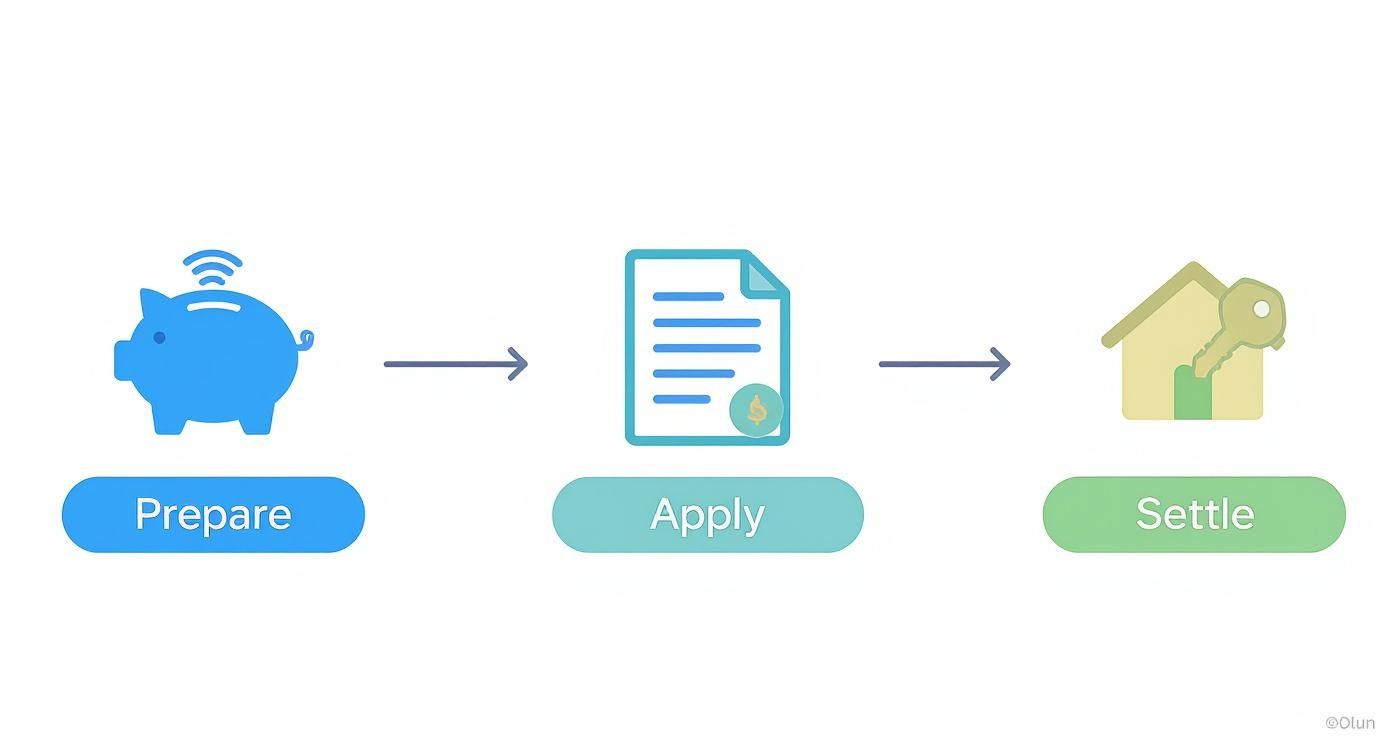
As you can see, solid preparation is the key to a smooth application and, ultimately, a successful settlement.
The Key Financial Pillars Lenders Look At
To get your loan across the line, you’ll need to have a few key things in order. These are the non-negotiables that every single lender will scrutinise:
- Your Deposit: This is the cash you bring to the table. A bigger deposit means less risk for the lender, which can help you avoid extra costs and potentially secure a better deal.
- Your Income and Employment: Lenders need to see stable, consistent income. They want the confidence that you have a reliable way to cover your repayments for the life of the loan.
- Your Expenses and Existing Debts: They’ll take a close look at your spending habits and any other financial commitments you have, like car loans or credit card debt. This helps them calculate your real capacity to repay a mortgage.
One of the biggest myths is that you absolutely must have a 20% deposit. While hitting that magic number helps you avoid Lenders’ Mortgage Insurance (LMI), it’s not a deal-breaker. Your overall financial picture is what truly counts.
Traditionally, lenders preferred a 20% deposit to steer clear of LMI. These days, though, many are happy to offer loans with deposits as low as 5%. This is especially true with government schemes like the First Home Guarantee, which helps eligible buyers get into the market without that extra insurance cost.
For a deeper dive into the numbers, you can check out more home loan statistics and insights from Finder’s detailed analysis.
To give you a clearer picture of the road ahead, here’s a quick overview of the entire process.
Home Loan Journey Snapshot
| Stage | Key Action | Primary Goal |
|---|---|---|
| Preparation | Saving a deposit, checking your credit score, and reducing debts. | To build a strong financial profile and increase borrowing power. |
| Pre-Approval | Submitting initial documents to a lender for a conditional approval. | To get a clear idea of your borrowing capacity and bid with confidence. |
| Property Search | Finding a home that fits your budget and loan conditions. | To locate and make an offer on your ideal property. |
| Formal Application | Providing the contract of sale and finalising all documentation. | To secure unconditional loan approval from the lender. |
| Settlement | Final legal checks, funds transfer, and official ownership change. | To complete the property purchase and get the keys to your new home. |
This table maps out the key milestones you’ll encounter. Our guide will walk you through each of these elements, providing a clear path forward on your journey to homeownership.
How Lenders Calculate Your Borrowing Power
Before you get lost in property listings and start daydreaming about open homes, it’s crucial to understand exactly how a lender sees your financial situation. Your borrowing power isn’t just a simple calculation based on your income; it’s a deep dive into your ability to manage debt, both now and in the future. This number determines the real budget you have to work with when you start your property search.
Thinking like a lender means looking way beyond your weekly paycheque. Their focus is on serviceability your capacity to comfortably make repayments on the loan without financial stress, even if interest rates go up or your circumstances change.

The Lender’s Stress Test Explained
A core part of any loan assessment is the “stress test.” Lenders don’t just calculate your repayments based on today’s interest rates. They add a buffer to make sure you can still manage if rates climb. Think of it as a crucial safety net for both you and the bank.
Lenders typically apply a serviceability buffer of around 2 – 3 percentage points above the current interest rate. So, if the going variable rate is 6.5%, a lender will assess your ability to repay at 8.5%. This higher figure reveals if your budget has enough breathing room to handle future rate rises.
It’s a growing challenge for many. Recent analysis shows that first home buyers now need a household income of about $180,000 to service a typical loan, which is significantly higher than the national average.
Your Debt-to-Income Ratio Matters
One of the most important metrics lenders look at is your Debt-to-Income (DTI) ratio. This is a straightforward comparison of your total monthly debt commitments against your gross monthly income. A high DTI suggests you might be overextended, making you a riskier borrower in their eyes.
To work it out, simply add up all your monthly debt payments (credit cards, car loans, any other liabilities) and divide that total by your gross monthly income. Lenders generally prefer a DTI ratio below 36%, although some may go higher depending on your overall financial profile.
Actionable Steps to Boost Your Borrowing Power
The good news is that your borrowing power isn’t set in stone. With some strategic financial housekeeping in the months before you apply, you can seriously improve what a lender is willing to offer.
Here are a few practical ways to strengthen your application:
- Reduce Credit Card Limits: Lenders assess your potential debt, not just what you currently owe. An unused credit card with a $10,000 limit is seen as a potential $10,000 liability, which can slash your borrowing capacity by as much as $50,000. Consider lowering the limits on cards you don’t use or closing them altogether.
- Minimise Discretionary Spending: For the three to six months before you apply, be mindful of your spending. Lenders will comb through your bank statements. Frequent purchases from online gambling sites, numerous food delivery services, or Afterpay can raise red flags about your financial discipline.
- Build a Consistent Savings History: Demonstrating a pattern of regular savings is incredibly powerful. It shows you can manage your money and live within your means exactly what a lender wants to see.
Expert Tip: Don’t just focus on your income. Reducing your liabilities often has a much bigger and faster impact on your borrowing power than trying to get a pay rise. Cleaning up your debts is one of the most effective strategies you can use.
The Role of Your Credit Score
Your credit score is a numerical snapshot of your credit history, and it plays a huge role in your home loan application. A higher score signals to lenders that you are a reliable borrower who pays their debts on time, which can lead to better interest rates and more loan options.
Scores in Australia typically range from 300 to 850. A score above 700 is considered strong, while anything over 750 is excellent and will open doors to the most competitive loan products on the market. You can check your score for free with services like Equifax, Illion, or Experian. If it’s lower than you’d like, focus on paying all your bills on time and reducing existing debts to give it a boost.
Getting a clear picture of your borrowing capacity is the first real step on your journey. A great way to get a personalised estimate is by using our borrowing power calculator, which can give you a solid foundation for planning your next move.
Preparing Your Documents for a Seamless Application
A well-prepared home loan application is a fast-tracked one. You’d be surprised how often delays aren’t due to complex finances, but simply because of missing paperwork. Getting everything a lender needs before you apply shows you’re an organised, serious borrower and helps your application sail through the system.
Think of your document file as the complete story of your financial life. Lenders use it to verify who you are, confirm your income, understand your spending habits, and get a clear picture of your overall financial standing. Having this ready to go is a crucial step towards a stress-free home loan experience.
The Core Document Checklist
While lenders might have slightly different requirements, nearly every application will ask for documents from four main categories. Organising these first will cover most of what any lender needs.
- Proof of Identity: This is the easy part. Lenders need to verify who you are to meet their legal obligations. You’ll typically need to provide 100 points of ID, which can include your driver’s licence, passport, Medicare card, or birth certificate.
- Proof of Income: If you’re a PAYG (Pay As You Go) employee, this usually means your two most recent payslips plus your latest group certificate or tax return. This confirms to the lender that your income is stable and consistent.
- Your Financial Position: This gives the lender a snapshot of your assets and liabilities. You’ll need bank statements for the last three to six months for all your accounts, which show your savings history and daily spending. You’ll also need statements for any existing debts like credit cards, car loans, or your HECS-HELP debt.
- Property Details: Already found a place? Perfect. You’ll need a copy of the signed contract of sale. This is essential for the lender to order a valuation and move towards unconditional approval.
Pro Tip: Set up digital folders on your computer for “ID,” “Income,” and “Bank Statements” before you even talk to a broker. It’s a small bit of organising that will save you hours of stress and back-and-forth emails later. Trust me, it pays off.
Documentation for Self-Employed Applicants
Things get a bit more detailed if you work for yourself. Without regular payslips, lenders need to see a longer-term view of your business’s financial health to feel confident you can service the loan. This is where many entrepreneurs hit a roadblock.
For a standard application, you’ll generally be asked for:
- Tax Returns: Lenders typically want to see the last two years of both your personal and business tax returns.
- Financial Statements: This includes your profit and loss statements and balance sheets for the last two financial years.
- Business Activity Statements (BAS): Your last four quarters of BAS help demonstrate consistent business turnover.
Pulling all this together can be a big ask, especially for newer businesses or those with income that ebbs and flows. But don’t worry, this is exactly where specialised loan products come into their own.
What Are Low-Doc Loan Pathways?
For business owners who can’t supply the standard two years of financials, a low-documentation (low-doc) loan can be a brilliant alternative. Instead of digging up full tax returns, these loans let you verify your income using other documents, like a letter from your accountant or your recent BAS statements.
While they are a fantastic solution, it’s worth noting that low-doc options can sometimes come with slightly higher interest rates or fees to balance the lender’s perceived risk. This is a specialised area of lending where getting expert guidance is invaluable.
At Diamond Lending, we specialise in finding the right fit for our self-employed clients. We make sure you’re matched with a lender who actually understands your business and sees its potential.
Choosing the Right Home Loan Product for You

Not all home loans are created equal. Far from it. The product you choose will have a massive impact on your financial future, and picking the right one is about so much more than just chasing the lowest interest rate.
It’s about matching the loan’s features and structure to your real-life goals. Get this right, and you could save tens of thousands of dollars and gain crucial flexibility over the decades you’ll be paying it off. Making a smart decision starts with understanding the basic building blocks of Australian home loans.
Fixed Versus Variable Interest Rates
The first big decision you’ll face is whether to lock in your interest rate or let it ride the market waves. Each path has clear benefits depending on your appetite for risk and what’s happening in the broader economy.
A variable rate loan is exactly what it sounds like – the interest rate can move up or down over time. It’s influenced by the Reserve Bank of Australia’s decisions and your lender’s own funding costs. This means your repayments can change, offering potential savings if rates drop but less certainty for your budget.
On the flip side, a fixed-rate loan locks in your interest rate for a set period, usually between one and five years. This gives you perfectly predictable repayments, making it a dream for budget-conscious homeowners. The catch? You won’t benefit if rates fall, and breaking a fixed term early can come with some hefty fees.
For those who want the best of both worlds, a split-rate loan lets you fix a portion of your mortgage and keep the rest on a variable rate. It’s a great hybrid option that gives you some stability while still letting you catch a break if rates are cut.
Unlocking Powerful Loan Features
Beyond the rate, certain loan features can supercharge your mortgage and help you smash it out sooner. Two of the most valuable are offset accounts and redraw facilities. They sound similar, but they operate in very different ways.
An offset account is a simple transaction account linked to your home loan. Whatever money you have in that account is “offset” against your loan balance, meaning you only pay interest on the difference. For instance, with a $500,000 loan and $50,000 sitting in your offset, you’ll only be charged interest on $450,000.
A redraw facility, on the other hand, lets you pull out any extra repayments you’ve made on your loan. It also helps you pay less interest over time, but when you withdraw that money, it’s added back to your loan balance. Plus, some lenders have limits or fees on redraws.
The real power of an offset account lies in its flexibility. Because it functions like a regular bank account, you can use your salary and savings to reduce your interest payments daily without losing access to your cash for everyday expenses.
Loan Feature Comparison: Offset Account vs. Redraw Facility
Choosing between an offset and a redraw facility depends entirely on how you manage your money. An offset offers maximum flexibility, acting like a high-powered savings account, while a redraw is a more straightforward way to access prepaid funds. Here’s a quick breakdown to help you decide.
| Feature | Offset Account | Redraw Facility |
|---|---|---|
| How It Works | A separate transaction account linked to your loan. Balance reduces interest payable. | Allows you to access extra repayments made on your loan. |
| Access to Funds | Instant access via debit card, online banking, or ATM. Works like an everyday account. | May require an application or transfer request. Some lenders have limits/fees. |
| Interest Savings | Calculated daily, reducing the principal on which interest is charged. | Reduces the loan balance, so you pay less interest on the lower amount. |
| Flexibility | Very high. Your money remains separate from the loan and is easily accessible. | Lower. Withdrawn funds become part of the loan again, and access can be slower. |
| Best For | Disciplined savers who want to use their everyday cash to minimise interest costs. | Borrowers who make lump-sum extra payments and only need occasional access. |
Ultimately, if you want your salary and savings to work harder for you every single day, the offset account is usually the superior choice.
Repayment Strategies: Principal and Interest vs. Interest-Only
The way you structure your repayments is another critical piece of the puzzle. Most people buying a home to live in will opt for a principal and interest (P&I) loan. With every repayment, you’re chipping away at both the loan balance (the principal) and the interest being charged.
The alternative is an interest-only (IO) loan, where for a set period usually up to five years you only cover the interest charges. This keeps your initial repayments much lower, but your loan balance doesn’t shrink. IO loans are a popular tool for property investors looking to maximise cash flow or claim interest as a tax deduction.
The purpose of your property heavily influences which loan products are available to you. Lenders view owner-occupiers as a lower risk than investors, and this is reflected in their rates and criteria. Recent data from the Australian Bureau of Statistics shows that while lending to both groups is growing, owner-occupiers often get more favourable terms. You can dig into these trends in more detail by looking at reports on Australian home loans.
At Diamond Lending, our job is to cut through the noise. We’ll show you which features will actually make a difference to your bottom line and find a loan that’s perfectly aligned with your financial strategy—whether you’re buying your first home or your tenth investment property.
Getting Your Home Loan Across the Finish Line
You’ve done the hard yards. You’ve built up your savings, polished your financial profile, and now you’re heading into the most exciting part of the home loan journey. This is where all that preparation pays off, turning you from a hopeful house hunter into a confident buyer with a clear budget.
The path from getting pre-approved to finally holding the keys involves a few critical steps. Knowing what to expect makes all the difference, transforming a potentially stressful process into a smooth one. Let’s walk through how you take your borrowing potential and turn it into a done deal.

The Real Power of Pre-Approval
Getting pre-approval (sometimes called conditional approval) is one of the smartest first moves you can make. It’s a formal signal from a lender saying, “Based on what we see, this is how much we’re prepared to lend you.” But it’s so much more than just a number. It’s a powerful negotiation tool.
When you put an offer on a property, pre-approval tells the seller you’re a serious, qualified buyer. In a competitive market, this can be the very thing that puts your offer at the top of the pile. It also means you can house hunt with real confidence, knowing exactly what you can afford and avoiding the heartbreak of falling for a home that’s just out of reach.
How to Compare Loans (Beyond the Obvious Interest Rate)
Once you’ve found a property and you’re ready to get formal approval, you’ll start seeing actual loan offers. It’s incredibly tempting to just grab the one with the lowest advertised interest rate, but that can be a very expensive mistake down the track. The real story is always in the details.
To properly compare loans, you need to look at the comparison rate. This figure is legally required to be shown next to the interest rate, and for good reason it bundles in most of the loan’s upfront and ongoing fees. This gives you a much more honest picture of the true cost over time.
Beyond the rates, make sure you dig into these factors:
- Upfront and Ongoing Fees: Keep an eye out for application fees, valuation fees, and any annual package fees. They can easily add hundreds, or even thousands, of dollars to your costs.
- Loan Features: Does the loan have an offset account or a flexible redraw facility? The right features can save you a huge amount of interest over the life of the loan.
- Flexibility: What’s the lender’s policy on making extra repayments? Can you switch between fixed and variable rates if your situation changes? A loan that can adapt with you is invaluable.
This is where a mortgage broker really proves their worth. A good broker can dissect complex loan offers, flag hidden costs, and translate all the lender jargon into plain English. It ensures you don’t get tripped up by the fine print. At Diamond Lending, we work with a massive panel of lenders, giving you more choice and a far better chance of finding a loan that’s a perfect fit.
The Timeline From Unconditional Approval to Settlement
Once you’ve signed a contract of sale for a property, you’ll send it to your lender to get unconditional approval. This is the final green light, where the lender confirms they’re happy with both you and the property you’ve chosen.
From this point, a clear sequence of events kicks off, usually taking around four to six weeks.
1. The Property Valuation: The lender organises an independent valuation of the property. They need to make sure it’s worth what you’re paying for it this protects their investment and, importantly, yours too.
2. Loan Documents Arrive: Once the valuation checks out, the lender sends you the formal loan offer and mortgage documents. This is a hefty, legally binding document. It’s absolutely vital to go through it carefully with your conveyancer or solicitor.
3. Signing on the Dotted Line: You’ll sign the documents and send them back to the lender, formally accepting their loan offer.
4. Booking Settlement: Your legal team gets to work, coordinating with the lender and the seller’s team to lock in a date and time for settlement. They run final title searches and check all the financial figures to make sure everything lines up perfectly.
5. Settlement Day: This is the big day! Your legal and financial reps meet to exchange the final documents and transfer the funds. Your lender pays the seller, the property title is officially transferred into your name, and you can finally pick up the keys. Congratulations you’re officially a homeowner. 🏡
Common Questions About Getting a Home Loan
Navigating the home loan process always sparks a few specific questions. To clear up some of the common uncertainties we hear from aspiring homeowners, we’ve put together some straight-to-the-point answers.
How Long Does Pre-Approval Last?
In Australia, your home loan pre-approval (sometimes called conditional approval) is typically valid for 90 days.
If you haven’t found the right place and signed a contract within that window, you’ll likely need to go through the application process again with your lender. It’s crucial to remember that pre-approval isn’t a final guarantee of finance; it’s a very strong indication. The lender still needs to sign off on a valuation of the property you choose. They’ll also double-check your financial situation, so if anything changes like a new job or a new car loan—you have to let them know immediately.
What Is Lenders’ Mortgage Insurance (LMI) and Can I Avoid It?
Lenders’ Mortgage Insurance, or LMI, is a one-off premium that protects the lender not you if you can’t make your repayments. You’ll usually face LMI if you borrow more than 80% of the property’s value, which happens when your deposit is less than 20%.
The easiest way to sidestep LMI is to save up that 20% deposit. But we all know that’s a huge task. Thankfully, there are other ways around it:
- Government Schemes: Programs like the First Home Guarantee are a game-changer, allowing eligible buyers to get into the market with a much smaller deposit without copping the LMI bill.
- Professional Waivers: Some lenders are willing to waive LMI for certain low-risk professionals, like doctors, lawyers, and accountants.
Can I Get a Home Loan if I’m Self-Employed?
Absolutely. Being your own boss doesn’t lock you out of the property market, but the application is definitely more involved. Instead of handing over simple payslips, you need to show the lender a stable and consistent income over a longer period.
Generally, you’ll be asked for two years of business and personal tax returns, plus your financial statements. For business owners who can’t provide all this paperwork, “low-doc” loans are a great alternative. They let you verify your income with less documentation, though they might come with slightly higher interest rates or fees.
A savvy mortgage broker is a massive advantage for self-employed applicants. We know which lenders have favourable policies for business owners and can steer you towards the product that actually fits your circumstances.
What Are the Main Upfront Costs Besides the Deposit?
Your deposit is the big one, but it’s far from the only cost you’ll face. Forgetting to budget for everything else can cause some serious last-minute stress. A good rule of thumb is to set aside an extra 3-5% of the purchase price to cover these items.
Here’s a quick rundown of what else you’ll need to budget for:
- Stamp Duty: A significant state government tax on the property purchase.
- Conveyancing and Legal Fees: The cost for a solicitor or conveyancer to handle all the legal transfer work.
- Loan Establishment Fees: Some lenders charge a fee just to set up your mortgage.
- Building and Pest Inspections: An absolute must-do. You need to know the property is structurally sound before you commit.
Factoring these costs in from day one makes that final stretch to getting the keys so much smoother.
Getting your head around how to obtain a home loan is much easier when you have an expert in your corner. At Diamond Lending, we specialise in finding the right solutions for everyone, from first-home buyers to seasoned investors and self-employed professionals.
Start your journey with a quick, no-obligation chat by visiting us at https://diamondlending.com.au.
Article created using Outrank