

So, what exactly is a deposit bond? Think of it as a smart financial tool used in Australian real estate that stands in for a cash deposit when you exchange property contracts.
Essentially, it’s a guarantee from an insurer, promising the seller that the full deposit amount will be paid when the sale settles. This lets you secure a property without having the full 10% in cash ready to go right at the beginning.
A Simpler Way to Secure Your Property
Imagine you've found your dream home, but your savings are tied up in a term deposit or some other investment. Instead of rushing to pull that money out and maybe copping a penalty fee, a deposit bond offers a much smoother path. It’s basically a certificate of trust you give the seller, assuring them the funds are guaranteed.
The main job of a deposit bond is to bridge the gap between signing the contract and the final settlement day. No actual cash changes hands when you sign. Instead, you pay a one-off, non-refundable fee to the bond provider, which is usually just a small percentage of the total deposit amount. That fee is your only upfront cost for the guarantee.
The Financial Promise Explained
So, how does this all work in practice? Instead of handing over a 10% cash deposit, you give the seller a deposit bond certificate. This certificate is a rock-solid guarantee from an insurance company that if you, the buyer, fail to complete the purchase for some reason, the seller will still receive their deposit money.
This setup gives you incredible financial flexibility. Your full deposit is only due on settlement day, along with the rest of the purchase price. It gives you valuable time to get your finances in order without the pressure of finding a huge chunk of cash overnight. You can find out more about how these financial guarantees work on rayne.finance.
A deposit bond lets you use the promise of future funds to lock in a property today. It gives you the power to act fast in a competitive market, even if your capital isn't sitting in a bank account ready to go.
Deposit Bond vs Cash Deposit At a Glance
To make it clearer, let's break down the key differences between using a deposit bond and paying a traditional cash deposit.
| Feature | Deposit Bond | Cash Deposit |
|---|---|---|
| Upfront Cost | A small, one-off fee (usually 1.2% – 1.5% of the deposit amount). | The full 10% of the purchase price is paid upfront. |
| Cash Flow Impact | Frees up your cash, allowing it to stay invested or in savings until settlement. | Ties up a significant amount of cash for the entire settlement period. |
| Accessibility | Perfect for when funds are not liquid (e.g., in shares, term deposits, or equity). | Requires you to have the full deposit amount available in liquid cash. |
| Risk to Seller | The deposit is guaranteed by a reputable insurer, providing high security. | The funds are held in a trust account, which is also very secure. |
| Speed & Convenience | Can be issued quickly, often within 24-48 hours, allowing you to move fast. | Can cause delays if you need to liquidate assets or transfer large sums. |
This table shows that while both methods secure your property, a deposit bond is built for flexibility and speed, which can be a game-changer in a fast-moving property market.
Key Features of a Deposit Bond
The bond itself is a legal document, but it’s how you can use it that makes it so powerful. Here are its main characteristics in a nutshell:
- It is not a loan: This is crucial. You're not borrowing money; you're simply paying for a guarantee.
- It frees up your cash: Your savings can keep earning you interest or returns in your investment accounts right up until settlement.
- It has a one-off fee: No sneaky ongoing interest payments or hidden charges to worry about.
- It’s valid for a set term: The bond is issued for a specific timeframe, usually lining up perfectly with your settlement date.
This powerful tool is designed for all sorts of buyers, from first-timers trying to get into the market to savvy investors looking to manage their cash flow more effectively during a purchase.
The Real-World Benefits of Using a Deposit Bond
In Australia’s fiercely competitive property market, a deposit bond is more than just a piece of paper—it's a practical tool that can give you a genuine edge. Let's move beyond the basic definition and look at how it actually helps you in the real world.
The biggest win? Immediate financial flexibility.
Instead of scrambling to liquidate assets or breaking a term deposit early (and copping the fees), a bond lets your money keep working for you. Your funds can stay put in high-interest savings accounts or investment portfolios, potentially earning returns right up until settlement day. It’s a smarter way to manage your capital that can add up to a significant financial upside.

Gain Speed and Agility in a Fast Market
Another key advantage is the sheer speed and confidence it gives you. In a hot market, timing is everything, especially at auctions. Waiting around for a large bank transfer to clear can mean watching your dream property slip through your fingers.
Having a pre-arranged deposit bond means you can act decisively. You can bid with confidence or lock in a private sale on the spot, knowing your deposit is guaranteed. This agility is a game-changer for buyers who need to move fast to get ahead of the competition. For more on this, check out our guide on how to make an offer on a house.
A deposit bond transforms your financial position from reactive to proactive. It equips you to secure a property on your terms, without being held back by the logistical delays of moving large sums of cash.
For many Aussies, buying a new home happens at the same time as selling their current one. This often creates a stressful cash-flow gap. A deposit bond is the perfect solution for different types of buyers:
- Upsizers and Downsizers: You can confidently buy your next home before the funds from your current sale have cleared, often avoiding the need for expensive bridging finance.
- First-Home Buyers: If your deposit is tied up in a scheme like the First Home Super Saver (FHSS) or a high-interest account you don’t want to touch, a bond lets you secure a property without disrupting your savings strategy.
- Property Investors: Keep your capital free to jump on other investment opportunities while you expand your property portfolio.
Streamlining Complex Transactions
The benefits really shine when you’re managing the transition between properties. A deposit bond is a game-changer for anyone trying to bridge the gap between selling one home and buying another.
It completely removes the immense pressure of lining up settlement dates perfectly.
You can exchange contracts on your new purchase using the bond, giving you valuable breathing room while you finalise the sale of your existing property. This separation of transactions dramatically reduces stress during what is already a huge life moment. It gives you certainty and control, letting you focus on the move itself rather than worrying about locked-up equity.
Is a Deposit Bond the Right Move for You?
While a deposit bond offers some serious financial flexibility, it isn't a one-size-fits-all solution for every property buyer in Australia. Its true value shines in specific situations where your capital is solid but just not sitting in your bank account, ready to go.
By walking through a few real-world scenarios, you can get a much clearer picture of whether this tool is the right fit for your property goals.
Let's step into the shoes of a few different buyers to see who benefits most.
The First-Home Buyer with Locked-In Savings
Meet Sarah. She’s a first-home buyer who has been diligently saving her deposit, and it's all locked away in a high-interest term deposit. She’s just found the perfect apartment, but settlement is only two months away—long before her term deposit matures. If she breaks it early, she’ll have to forfeit a big chunk of the interest she’s worked so hard to earn.
Instead of sacrificing her savings, Sarah uses a deposit bond. She pays a small, one-off fee that secures the property, leaving her term deposit completely untouched. When settlement day rolls around, her funds have matured. She can then pay the full deposit and purchase price as planned, having maximised every dollar of her savings.
A deposit bond gives you the power to act decisively in the property market without messing up your long-term savings or investment plans. It’s the perfect bridge between your assets and your immediate need for cash.
The Savvy Property Investor
Now, let's consider Michael, a seasoned property investor looking to add another rental to his portfolio. He has plenty of equity in his existing properties, but actually getting his hands on that cash can be a painfully slow process. A great investment opportunity has just popped up, and he needs to move fast to beat the competition.
A deposit bond is the perfect tool for him. It lets him exchange contracts straight away, locking in the new property while his application to release equity from another one is being processed. This keeps his capital free, allowing him to stay agile and jump on any other opportunities that might come his way without tying up cash in a trust account for months on end.
The Downsizer Bridging the Gap
Finally, let’s look at David and Helen, who are downsizing. They’ve found their dream retirement villa but are still waiting for their large family home to sell. All the funds they need for the new place are tied up as equity in their current home.
Rather than taking out expensive bridging finance, they use a deposit bond to secure their new villa. This takes the pressure right off. They don't have to accept a low-ball offer on their current home just to meet a deadline. Instead, they can wait for the right buyer and the right price, knowing their next home is already secured.
These examples show how deposit bonds are a go-to for a whole range of buyers—from first-timers and investors to retirees—who have the money to settle but just can't get to it immediately. This product helps you lock down a property without draining your savings, allowing your funds to keep working for you elsewhere. You can discover more insights about how deposit bonds assist various buyers on rayne.finance.
Understanding the Costs and Eligibility
Let's clear up a common myth: a deposit bond isn't a loan. It's much closer to an insurance policy that protects the seller. Because of this, providers have a strict set of criteria to make sure you can hold up your end of the bargain come settlement day.
To get approved, you need to show a clear and definite path to funding the entire property purchase. It’s not about borrowing the deposit; it’s about proving you’ll have the cash ready on the final day.
Proving Your Financial Position
Providers need to see solid proof that you have the capacity to settle. This financial backing usually comes from one of a few key places:
- Savings or Investments: Money you have sitting in bank accounts, term deposits, or share portfolios that will be ready to go by the settlement date.
- Equity in Existing Property: If you're selling your current home, the equity you’ve built up can be used as proof that you can cover the purchase of the new one.
- Unconditional Home Loan Approval: This is the big one. A formal, unconditional approval letter from a lender confirms you have the finance locked in. A simple pre-approval just won't cut it.
At the end of the day, the provider is assessing your financial stability. They need total confidence that you'll have the money ready when it's time to pay, so their guarantee is never actually called upon.
Demystifying the One-Off Fee
Instead of ongoing interest payments, you pay a single, non-refundable fee for a deposit bond. This fee is worked out based on two main things: the size of the deposit you need guaranteed and how long the settlement period is.
The logic is pretty simple. A longer settlement period means the provider is on the hook for longer, so they carry more risk, which leads to a slightly higher fee. A standard 60-day settlement will always be cheaper than a 12-month settlement for an off-the-plan purchase. The fee is usually around 1.2% to 1.5% of the deposit amount.
Think of the fee as the price you pay for convenience and flexibility. It lets you move quickly on a property without having to sell off your assets early. It's less of an expense and more of a strategic cost.
To get a clearer picture of all the expenses involved in buying a property, our comprehensive property buying cost calculator can help you budget with confidence.
Example Deposit Bond Fee Calculation
To give you a practical idea of what this might cost, here’s a quick breakdown of how fees can look across different scenarios. You can see how the property price and settlement term directly change the one-off fee you’ll pay.
| Property Price | Deposit Amount (10%) | Settlement Term | Estimated Fee |
|---|---|---|---|
| $750,000 | $75,000 | 60 Days | ~$975 |
| $750,000 | $75,000 | 6 Months | ~$1,465 |
| $1,200,000 | $120,000 | 90 Days | ~$1,560 |
| $1,200,000 | $120,000 | 12 Months | ~$2,340 |
Please remember, these figures are just illustrative estimates and actual fees will vary between providers.
As you can see, a longer settlement or a higher property price will increase the fee, but it often remains a very cost-effective way to secure a property without tying up your capital.
Your Step-by-Step Guide to Getting a Deposit Bond
So, you're ready to get a deposit bond. The good news is the process is refreshingly straightforward, especially when you know what to expect.
Think of it as a clear roadmap that takes you from initial prep work right through to having the guarantee in your hands. Getting this right means you can move quickly and confidently when you find the perfect property.
Step 1: Gather Your Essential Documents
Before you even start an application, the best thing you can do is get your paperwork in order. This single step will save you a ton of time and stress later on.
You're essentially building a case to show the provider you're a reliable buyer who can see the purchase through to settlement.
Here’s what you’ll generally need to have ready:
- A fully signed Contract of Sale: This is the official agreement for your property purchase, locking in the price and settlement date.
- Proof of Funds: You need to show you have a clear path to paying the full purchase price on settlement day. This could be an unconditional loan approval letter from your bank, bank statements, or proof of equity from another property you’re selling.
- Identification: Just the usual stuff here, like a copy of your driver's licence or passport to confirm who you are.
Step 2: Submit Your Application and Get Assessed
With your documents ready to go, you can now fill out the application form. Most providers have a simple online portal, and it usually only takes a few minutes to complete.
Once you hit submit, the provider gets to work on their assessment. This isn't a deep dive into your credit history like a home loan application. Instead, their focus is purely on confirming you have the financial capacity to finalise the property purchase.
They'll cross-reference your Contract of Sale with your proof of funds to make sure everything lines up. It's all about giving them the confidence that you're good for the money at settlement.
This flowchart breaks down the simple, three-step eligibility process.
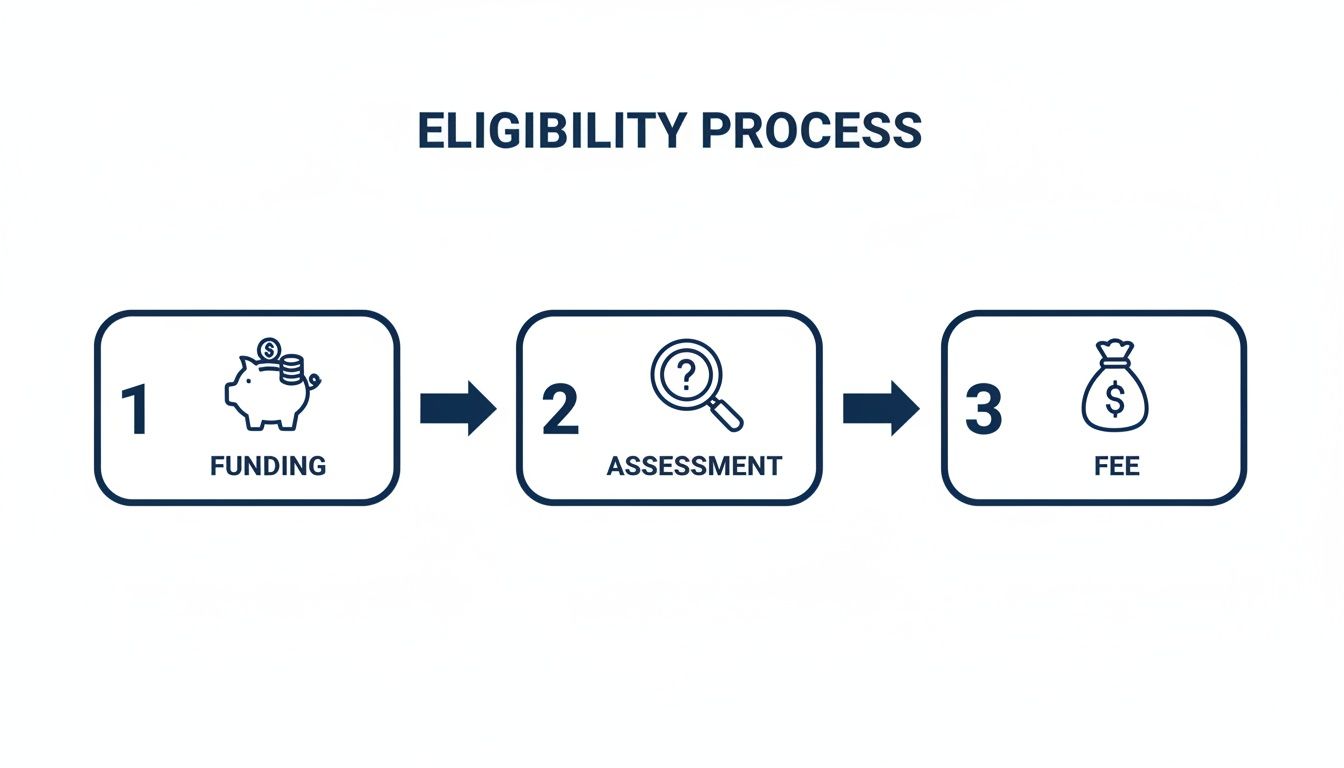
As you can see, it really boils down to confirming your funding, assessing the deal's viability, and then sorting out the fee.
Step 3: Pay the Fee and Receive Your Bond
Once your application gets the green light, the provider will send you an invoice for the one-off fee. This is the only cost involved. Simple.
As soon as you’ve paid it, they will issue the official deposit bond certificate.
This is the golden ticket. It's the document your solicitor or conveyancer will give to the seller’s team to formally exchange contracts. In a competitive market, speed is everything, and most providers can issue a bond within 24-48 hours of a complete application.
Insider Tip: Before you even make an offer, get your solicitor or the real estate agent to confirm the seller will accept a deposit bond. They’re very common, but it’s not a 100% guarantee everywhere. A quick check upfront saves any potential headaches down the track.
Got Questions? Let's Get Them Answered
Even when you get the basics, it's natural to have a few "what if" questions floating around. You're not alone. Let's run through the most common questions we hear from Australian property buyers, so you can move forward with total confidence.
This is where we clear up the confusion and help you decide if a deposit bond is really the right tool for you.
What’s the Difference Between a Deposit Bond and a Bank Guarantee?
It’s easy to mix these two up, but they’re fundamentally different products. Think of a deposit bond as an insurance policy. You pay a one-off premium to an insurer, and they issue a certificate that guarantees your deposit to the seller. Simple.
A bank guarantee, however, is a credit product. To get one, your bank will almost always require you to lock away funds equal to the guarantee amount. So, if you need a $100,000 guarantee, you’ll likely need to have $100,000 in cash sitting untouched in an account.
A bank guarantee ties up your capital, while a deposit bond is designed to free it up. That's the key difference. Deposit bonds are usually much faster to arrange and involve a lot less paperwork.
What Happens If the Property Purchase Falls Through?
This is the big one, and it’s critical to understand. If you, the buyer, can't complete the purchase at settlement (known in legal terms as defaulting on the contract), the seller has every right to "call on" the bond.
When that happens, the bond provider pays the full deposit amount straight to the seller. But it doesn't end there for you. The bond is a legally binding agreement between you and the provider, which means you now owe that entire amount back to them. It’s a serious financial commitment.
A deposit bond protects the seller, not the buyer. If you default, you are still liable for the full deposit amount, which you will owe to the bond provider.
Can I Use a Deposit Bond at an Auction?
Yes, you absolutely can! In fact, it's one of the best ways to use them. Turning up to an auction with a deposit bond ready to go means you can bid with complete confidence.
If your bid is the winning one, you sign the contract and hand over your deposit bond certificate on the spot—just like you would with a bank cheque. It takes away the stress of organising a huge cash transfer on auction day and gives you a real competitive edge.
Do All Sellers Have to Accept a Deposit Bond?
This is a common misconception. No, they don’t. While deposit bonds are very common and widely accepted across Australia, a seller isn’t legally required to accept one.
The best move is always to have your solicitor or conveyancer check with the seller's agent that a deposit bond is okay before you make an offer. It’s a simple step that avoids any nasty surprises later on and ensures everything goes smoothly. For most standard home sales, it’s rarely an issue.
Ready to explore your options and see if a deposit bond can streamline your next property purchase? The team at Diamond Lending can connect you with the right solutions to match your financial goals. Get in touch with us today!
Article created using Outrank