

Before you can even think about putting in an offer on a property, you need to get your head around one of the biggest upfront costs you'll face: stamp duty. The smartest first step for any buyer is to use a reliable stamp duty calculator for Australia. It cuts through the confusion, giving you an instant, clear estimate so you can avoid nasty surprises later on.
Your First Step in Australian Property Buying
So, what exactly is stamp duty? Think of it as the government's fee for processing the legal paperwork that officially makes a property yours. This one-time tax, also known as transfer duty, is a major expense you have to cover from your own savings—it can't just be tacked onto your home loan.
The fee isn't a simple, flat rate. It’s calculated on a sliding scale based on the property's value, so the higher the price, the bigger the tax bill. Because this figure directly impacts how much cash you need to have ready for settlement, getting it wrong can put your entire purchase in jeopardy.

Why the Rules Vary So Much
Here’s where it gets tricky. Every state and territory in Australia plays by its own rules, setting unique rates and offering different concessions. This means the tax on a $600,000 home in Melbourne could be thousands of dollars more (or less) than for the exact same priced home in Brisbane. That's why guessing or using a rough percentage is such a risky move.
This is where a stamp duty calculator for Australia becomes your best friend. It crunches the numbers for you, taking all the critical variables into account to give you a precise estimate:
- Property Value: The purchase price or current market value of the home.
- Location: The specific state or territory the property is in.
- Buyer Type: Are you a first-home buyer, an investor, or moving into the home yourself?
- Property Type: Whether you're buying an established home, vacant land, or an off-the-plan property.
The Financial Impact of State Differences
The difference in stamp duty costs between states isn't just a few hundred dollars—it can be huge. Just look at how much the cost varies for the same property value.
Stamp Duty Snapshot On a $500,000 Property
| State | Standard Stamp Duty Payable | As a Percentage of Price |
|---|---|---|
| NSW | $17,029 | 3.41% |
| VIC | $21,970 | 4.39% |
| QLD | $8,750 | 1.75% |
| WA | $17,765 | 3.55% |
| SA | $21,330 | 4.27% |
Note: Figures are for an owner-occupier who is not a first-home buyer and are indicative only. Rates can change.
As you can see, a buyer in Queensland pays less than half the stamp duty of a buyer in New South Wales for the same $500,000 property. You can find more detailed comparisons by reviewing official state-based stamp duty data.
This massive variation drives home a crucial point: your borrowing power and deposit savings must be planned around your specific state's rules. An unexpected five-figure cost can completely derail even the most carefully crafted budget.
Understanding What Stamp Duty Is and Why You Pay It
At its core, stamp duty—also known as transfer duty—is a government tax you pay on certain big-ticket transactions, most commonly when buying property. Whether you're purchasing your first home, an investment property, or a block of land, this tax is an unavoidable part of the process.
The name is a bit of a throwback to when legal documents were physically stamped to prove the tax was paid. The actual stamp is gone, but the idea is the same: you're paying a fee to your state or territory government to legally recognise and record you as the new owner of an asset.
Think of it this way: when you buy a car, you pay a fee to get the registration transferred into your name. Stamp duty is the property equivalent, just on a much bigger scale. It’s the final tick that solidifies your legal title to the property.
Where Does Your Stamp Duty Money Go?
This isn’t just some random administrative fee. The money collected from stamp duty is a huge source of revenue that helps fund the public services we all use every day.
Each state and territory government channels this income into essential community infrastructure, including:
- Healthcare: Keeping public hospitals running, buying medical equipment, and funding ambulance services.
- Education: Building and maintaining schools, paying teachers, and supporting public education.
- Transport: The construction and upkeep of roads, bridges, and public transport networks.
- Emergency Services: Supporting our police, fire brigades, and other critical response teams.
So, when you pay stamp duty, you're directly contributing to the state's budget for these vital services. It's the mechanism that ensures property owners help fund the infrastructure that supports their property's value and the community around it.
Key Factors That Influence Your Final Bill
The amount you’ll owe isn't a simple flat rate. It's a calculation based on several moving parts, which is why a stamp duty calculator for Australia is so critical for getting an accurate estimate.
The main factors that drive the final number are:
- The Property's Value: This is the biggest one. The tax is calculated on a sliding scale based on the property's ‘dutiable value’—usually the purchase price or its current market value, whichever is higher.
- Your Location: As we've covered, every state and territory has its own tax brackets, rates, and rules.
- Your Buyer Profile: Are you a first-home buyer? This is huge, as you might be eligible for massive concessions or even a full exemption.
- How You'll Use It: The tax can change depending on whether you plan to live in the property (as an owner-occupier) or rent it out as an investment.
- Residency Status: Foreign investors often have to pay an additional surcharge on top of the standard stamp duty rates.
Getting your head around these factors is the first step to mastering your property budget. It takes the mystery out of the numbers you see on a calculator and turns a confusing tax into a predictable, manageable cost. When you know what’s at play, you can move forward as a much more informed and confident buyer.
How Stamp Duty Rules Change Across Australia
One of the biggest head-scratchers for property buyers in Australia is that there's no single, national rulebook for stamp duty. It's a state-based tax, which means every state and territory government writes its own script—setting its own rates, thresholds, and concessions.
This patchwork of regulations is exactly why a reliable stamp duty calculator for Australia is non-negotiable.
The final bill for an identical property can swing by tens of thousands of dollars just by hopping over a state border. For buyers, this creates both headaches and opportunities. A property in one state might look far more attractive to an investor due to its tax setup, while another state might roll out the red carpet for first-home buyers with huge exemptions.
Getting your head around these differences is the key to buying smart. It lets you compare markets with your eyes wide open and budget for the true cost of your purchase, avoiding any nasty financial shocks at settlement.
New South Wales: A High-Value Market with Targeted Relief
As Australia's biggest property market, it’s no surprise that New South Wales has stamp duty brackets reflecting its higher property values. For a typical buyer, the rates can be pretty steep, often ranking among the highest in the country for properties tipping over the $1 million mark.
But the NSW government does offer a helping hand to first-home buyers through its First Home Buyers Assistance Scheme (FHBAS). It’s a game-changer that can make cracking into the market a whole lot more achievable.
- Full Exemption: If you're an eligible first-home buyer, you'll pay zero stamp duty on new or existing homes valued up to $800,000.
- Concessional Rate: For homes priced between $800,000 and $1,000,000, a discounted rate applies, taking the sting out of the final cost.
- Vacant Land: Buying a block to build your dream home? The exemption applies up to $350,000, with concessions available up to $450,000.
This targeted support means that while an investor might be bracing for a hefty bill, a first-home buyer could save over $30,000 in upfront costs—completely changing their financial position.
Victoria: A Tale of Two Buyer Types
Victoria’s stamp duty system draws a very clear line in the sand between first-home buyers and everyone else. If you’re not a first-timer, the rates are generally higher than in other states, especially in the mid-range property market. It’s an approach that generates serious revenue for the state.
To put it in perspective, Victoria's stamp duty on a $500,000 home for a non-first buyer is $21,970, which is a hefty 4.4% of the property's value. In the 2022-23 financial year, the state collected $10.2 billion in duties, which funded 15% of its revenue. But if you're a first-home buyer, you pay zero duty on homes under $600,000, with the benefit tapering off up to $750,000. You can find more details on these figures with some great Victorian stamp duty statistics on duotax.com.au.
This huge difference really shows you the core idea of the Victorian system: make that first step onto the property ladder easier, but levy higher rates on investors and subsequent purchases. It’s a policy that directly shapes how people buy property in the state.
This flowchart shows where the money from property transactions, including stamp duty, actually goes—right back into funding public services.
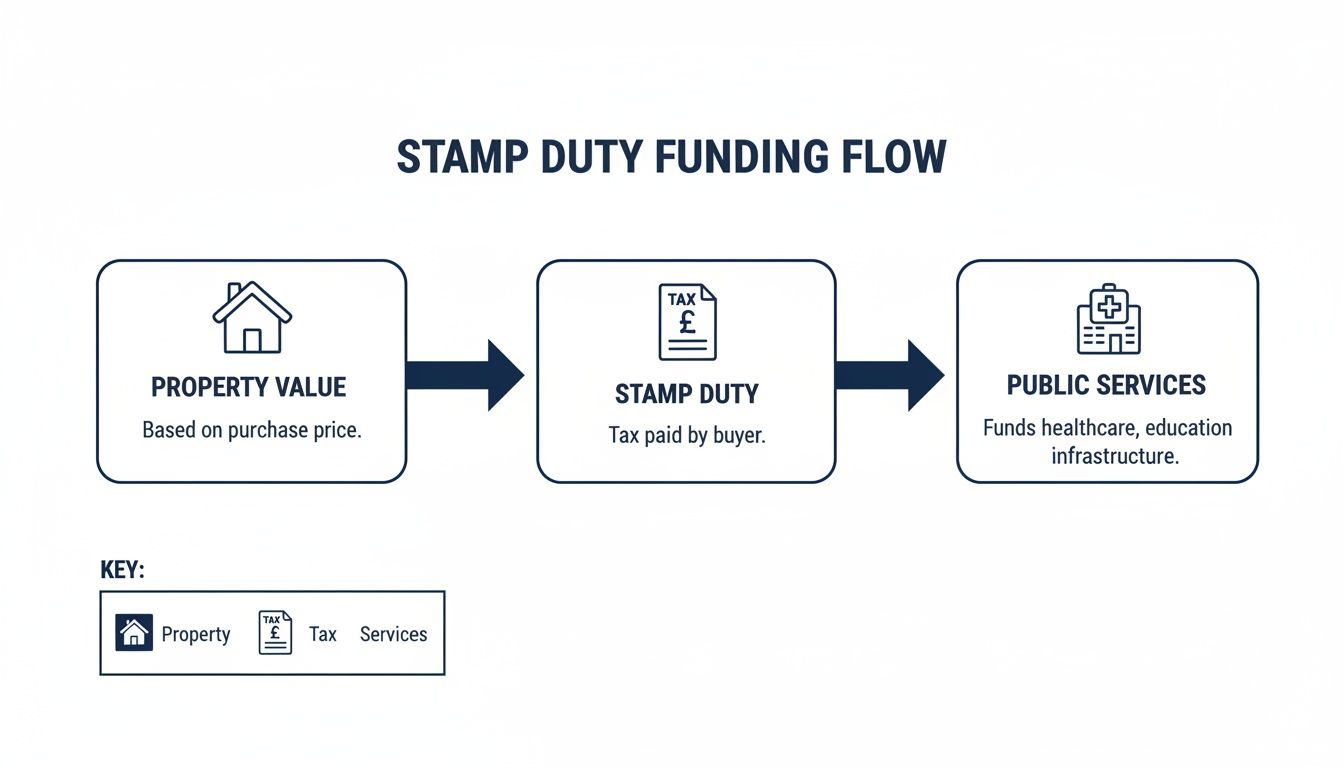
It’s a good reminder that the tax you pay on a property purchase is a direct investment into the community’s schools, hospitals, and roads.
Queensland: The Sunshine State's Concessions
Queensland has long been known as one of the more stamp-duty-friendly states, especially if you plan to live in the property you're buying. The government here offers several concessions that can seriously slash your final tax bill.
Here are the main ones to know about:
- Home Concession: This applies if you intend to move into the property as your principal home within a year. It gives you a much lower rate of duty than what an investor would pay.
- First Home Concession: This is an even juicier discount for eligible first-home buyers. If the property is valued under $550,000, you could end up paying very little—or even no—stamp duty.
- First Home Vacant Land Concession: Similar relief is on the table for vacant land purchases up to a certain value, which is great for encouraging new builds.
With these layered concessions, it’s easy to see why Queensland is often a hot market for both first-timers and people upgrading their family home. Punching your details into a stamp duty calculator for Australia is the only way to know for sure which concessions you can claim.
South Australia: A Big Push for New Housing
South Australia has been making some serious moves to fire up its housing market, with a laser focus on new construction. While its standard stamp duty rates are in line with other states, the biggest savings are reserved for those buying or building a brand-new home.
Right now, the state is offering a full stamp duty exemption for eligible first-home buyers who purchase a new home or vacant land to build on, as long as the property value is below $650,000. This can mean a saving of over $30,000—a massive leg-up for anyone just starting their property journey.
The image below from RevenueSA's website shows the kind of official calculator used to figure out these costs.
As you can see, these tools need precise details like property value and buyer type to give an accurate figure, which just goes to show why a comprehensive calculator that covers all the variables is so important. This focus on new builds is a clear strategy from the government to boost housing supply right across the state.
Putting The Stamp Duty Calculator Into Practice
Knowing the theory behind stamp duty is one thing, but seeing it in action is where the numbers really come alive. A stamp duty calculator for Australia isn't just a gadget for spitting out a figure; it's a powerful financial planning tool. It shows you how different choices, personal circumstances, and property types can lead to wildly different outcomes.
To make this crystal clear, let's walk through four common scenarios. Each story follows a different type of buyer in a different state, highlighting how concessions, property use, and location can dramatically change the final stamp duty bill. These examples show exactly what a calculator does and why it's so essential for accurate budgeting.
Scenario 1: The First-Home Buyer in NSW
Meet Mia, a first-home buyer in Sydney. She has her eye on a $750,000 apartment and needs to nail down her upfront costs. She fires up a stamp duty calculator and plugs in her details:
- State: New South Wales
- Property Value: $750,000
- Buyer Type: First-Home Buyer
- Property Use: Principal Place of Residence (she'll be living in it)
Because her apartment's value is under the $800,000 threshold for the NSW First Home Buyers Assistance Scheme, the calculator gives her an amazing result.
Stamp Duty Payable: $0
This is a perfect example of a full exemption at work. An investor buying the exact same property would be staring down a bill of $28,529. For Mia, that saving of nearly $30,000 is a game-changer, freeing up a huge chunk of cash for her deposit and other buying costs.
Scenario 2: The Seasoned Investor in Victoria
Next up is Ben, a property investor from Melbourne. He’s looking to add a $650,000 townhouse to his portfolio. This isn't his first rodeo, and he plans to rent it out straight away.
His inputs for the calculator are simple:
- State: Victoria
- Property Value: $650,000
- Buyer Type: Existing Homeowner
- Property Use: Investment Property
Since Ben isn’t eligible for any first-home buyer or principal place of residence concessions, he has to pay the full rate. The calculator quickly crunches the numbers for the standard land transfer duty.
Stamp Duty Payable: $34,070
This figure is a critical part of Ben’s investment calculations. It directly impacts his initial cash outlay and the overall return on his investment. Without this precise number, he couldn't accurately assess if the purchase makes financial sense.
Scenario 3: The Off-The-Plan Buyer in Queensland
Now let's head to Brisbane and meet Sarah, who is buying an off-the-plan apartment for $520,000. She plans to live in it once it’s built, and it’s her very first property.
Here are her details for the stamp duty calculator:
- State: Queensland
- Property Value: $520,000
- Buyer Type: First-Home Buyer
- Property Use: Principal Place of Residence
Queensland offers a generous First Home Concession, which massively reduces the duty for eligible buyers purchasing properties under $550,000. The calculator applies this discount to her situation.
Stamp Duty Payable: $0
While the standard home concession would have already lowered her bill, her first-home buyer status wipes it out completely. This shows how layered concessions can deliver enormous benefits, making property ownership far more accessible. After seeing this, Sarah can confidently use a broader property buying cost calculator to map out all her other expenses with certainty.
Scenario 4: The Business Owner in South Australia
Finally, we have David, a self-employed business owner in Adelaide. He's purchasing a $900,000 commercial warehouse for his growing business. The rules for commercial property stamp duty are often a different ball game.
His calculator inputs look like this:
- State: South Australia
- Property Value: $900,000
- Property Type: Commercial/Industrial
In a move to boost business investment, South Australia has completely abolished stamp duty on the transfer of commercial and industrial properties. Unsurprisingly, the calculator delivers a very straightforward result.
Stamp Duty Payable: $0
This is a massive incentive for business owners like David. In another state, a commercial property at this price could attract a duty bill of over $40,000, making SA a very attractive place to invest.
These real-world examples prove that a stamp duty calculator for Australia is more than a simple convenience—it’s an essential strategic tool. It empowers you to see exactly how your personal situation interacts with state-specific rules, turning a complex tax into a clear, manageable number.
How Stamp Duty Affects Your Home Loan and Deposit
So, you've calculated your stamp duty. The next, more critical step is figuring out how you're going to pay for it. This is a crucial detail that catches many homebuyers off guard: stamp duty is a hefty, separate, out-of-pocket expense that has to be covered with your own cash.
It’s a common myth that you can just roll the stamp duty cost into your total mortgage amount. In reality, lenders almost never allow this. Your home loan is secured against the value of the property itself, and stamp duty is simply a government tax—it adds no value to the asset. This means you need to have the cash ready for settlement, right alongside your deposit.

Why Lenders Look at Your Stamp Duty Savings
When a lender assesses your home loan application, they’re not just glancing at your income and deposit. They’re doing a deep dive into your genuine savings and your real-world capacity to finalise the purchase without falling into financial stress. This absolutely includes having enough cash on hand to cover all the associated costs.
If you’ve saved a 20% deposit but have completely forgotten to budget for a $25,000 stamp duty bill, a lender will see that as a major red flag. It points to a potential shortfall and raises questions about how financially prepared you truly are. They need solid proof that you can comfortably manage the entire transaction, from deposit to the final government fees.
A big stamp duty bill can therefore directly shrink your borrowing power. If a large chunk of your savings gets eaten up by this tax, it leaves you with less for your actual deposit. A smaller deposit usually means a higher Loan to Value Ratio (LVR), which can lead to tougher lending criteria or the added cost of Lenders Mortgage Insurance (LMI).
Building Your Upfront Costs Budget
To put forward a strong, confident application, you need to have a complete picture of every single upfront cost. Don't just think about the deposit. Your total savings goal is a combination of several key pieces.
A solid, real-world budget should cover:
- The Property Deposit: Typically 10-20% of the purchase price.
- Stamp Duty: Get the exact figure from a reliable stamp duty calculator for Australia.
- Legal and Conveyancing Fees: The cost for the legal experts handling the property transfer.
- Loan Application and Establishment Fees: Bank charges for getting the mortgage set up.
- Building and Pest Inspections: An essential step of due diligence you can't afford to skip.
Getting your stamp duty estimate right from the get-go is non-negotiable for a smooth loan application. It’s the cornerstone of your upfront budget and shows lenders that you are a well-prepared, low-risk borrower.
The Mortgage Broker's Role in Financial Planning
This is where working with an experienced mortgage broker is invaluable. A good broker does so much more than just find you a loan; they become your financial strategist, helping you map out every single cost down to the dollar. They make sure your budget is realistic and that you have a clear plan to cover everything without any last-minute panic.
A broker will sit down with you, use tools like a stamp duty calculator to nail down the exact funds needed, and then work backwards. They can help structure your savings plan or suggest strategies like using a deposit bond to manage your cash flow. Our guide explains more about what a deposit bond is and when it might be a useful tool.
By creating a complete financial snapshot, a broker ensures there are no nasty surprises. They present your application to lenders in its best possible light, proving you have both the funds and the financial discipline to handle a home loan. This proactive planning can honestly be the difference between getting a 'yes' or a 'no'. ✅
Common Questions About The Stamp Duty Calculator
Even with a great stamp duty calculator for Australia on your screen, it’s completely normal to have a few questions buzzing in your head about how this big tax actually plays out in the real world. Getting your head around the details can make a massive difference to your budget and how confident you feel heading towards settlement.
To clear up any last-minute confusion, here are some straight answers to the questions we hear all the time.
Can I Add Stamp Duty to My Home Loan?
This is easily the most common question we get, and the answer is almost always a firm no. Lenders see stamp duty for what it is: a government tax, completely separate from the market value of your property.
Your home loan is secured against the asset you're buying. Since the tax doesn't add a single dollar to the property's value, banks simply won't lend you extra money to cover it. They expect you to pay stamp duty from your own funds at settlement, which is why having your upfront costs budgeted well beyond just the deposit is so crucial.
When Exactly Do I Have to Pay The Stamp Duty?
The deadline varies a little from state to state, but you’ll always need to pay it at or very close to your settlement date. As a general rule, expect the payment to be due within 30 days of the contract date or at settlement itself.
The good news? You won't have to navigate this on your own. Your solicitor or conveyancer manages the whole process. They’ll calculate the exact amount owed, let you know the deadline, and collect the funds from you before paying the state revenue office on your behalf. This ensures the property title is legally transferred into your name without a hitch.
Are There Exemptions Besides for First Home Buyers?
Yes, but they’re usually quite specific and depend entirely on your state’s rules. While first-home buyer schemes get all the attention, a few other common exemptions pop up.
These can include:
- Transfers between spouses: Often applies when a property is transferred between partners, usually as part of a separation or divorce settlement.
- Deceased estates: Stamp duty generally isn’t payable on a property you inherit through a will.
- Family farm transfers: Special concessions are often available to help keep agricultural land within the family for the next generation.
Some states might also offer concessions for pensioners or for off-the-plan properties that meet certain criteria. It’s always best to check your state’s revenue office website or have a chat with your legal professional to see if you qualify.
Does Stamp Duty Apply If I Buy Vacant Land?
Absolutely. Stamp duty is charged on vacant land because you’re still transferring a legal title of ownership. The tax is calculated on the land's dutiable value, which is typically the price you paid for it.
However, the rules and concessions can be quite different from buying an established home. Many states offer grants or lower stamp duty thresholds for first-home buyers who buy land with the intention of building on it. In NSW, for example, the exemption thresholds for vacant land are lower than for existing homes, so it pays to know the specifics.
When you're planning to build, using a stamp duty calculator for Australia that lets you select 'vacant land' is a must. It gives you a precise cost estimate tailored to your situation, preventing any nasty surprises with your budget later on.
What About Commercial Property Stamp Duty?
The rules for commercial property are a completely different beast and vary wildly across the country. States like New South Wales and Victoria have their own specific stamp duty rates for commercial and industrial properties that you need to be aware of.
On the flip side, some states have scrapped the tax altogether to encourage business investment. South Australia, for instance, has completely abolished stamp duty on the transfer of commercial properties. This can be a huge incentive for investors, potentially saving them tens of thousands of dollars. Always check the specific rules in your state before you sign on the dotted line.
Navigating stamp duty is a critical part of buying property, but it doesn’t have to be a headache. The key is having the right tools and expert advice in your corner. For personalised help structuring your finances for a successful purchase, the team at Diamond Lending is here to support you. We'll make sure you understand all your upfront costs and find a loan that truly fits your goals.
Start your journey with a free assessment today at Diamond Lending.