

Ever tried to get a traditional business loan without much to offer as collateral? For many modern Australian businesses—from digital marketing agencies to thriving consultancies—this is a classic roadblock. Their greatest asset isn't a warehouse full of stock; it's the steady, predictable flow of cash coming in each month.
This is exactly where cash flow lending comes in.
What Is Cash Flow Lending and Why It Matters for Your Business

Instead of a lender asking, "What valuable property or equipment can you pledge as security?", they ask a different question: "How healthy and reliable is your revenue?" They're not looking at what you own, but what you earn.
Think of it this way: a farmer gets a loan based on the expected value of their upcoming harvest, not just the resale price of their tractor. Cash flow lending works on the same forward-looking principle, analysing your business bank statements, sales history, and future projections to gauge your ability to repay a loan. It’s a smart approach that perfectly suits today's service-driven economy.
The Core Problem It Solves
Consistent cash flow is the lifeblood of any small to medium-sized enterprise (SME). Even a profitable business can hit a wall while waiting for client payments or needing to buy inventory before a big sales season. These cash gaps don't just stifle growth; they can threaten your entire operation.
It's a huge issue for Australian businesses. In fact, according to ASIC data, a staggering 41% of failed small businesses point to cash flow trouble as the main culprit. That figure towers over other problems like poor demand or rising costs, making this kind of funding an indispensable tool for SMEs. You can find out more about how cash flow issues impact local businesses right here.
A business can look fantastic on paper and still go under because the cash isn't there when bills are due. Cash flow lending directly tackles that disconnect, offering liquidity precisely when you need it to bridge the gap between earning revenue and actually getting paid.
To help you quickly grasp the concept, here's a simple breakdown of cash flow lending and how it fits into the business finance landscape.
Cash Flow Lending at a Glance
| Feature | Description | Ideal For |
|---|---|---|
| Loan Basis | Based on your historical and projected revenue, not physical assets. | Businesses with strong, predictable income but few tangible assets. |
| Collateral | Unsecured or secured against future earnings. | Service-based businesses, tech startups, and consultants. |
| Approval Speed | Typically much faster than traditional bank loans. | SMEs needing quick capital for growth or operational costs. |
| Use of Funds | Flexible – can be used for working capital, inventory, expansion, etc. | Businesses managing seasonal demand or seizing time-sensitive opportunities. |
This table shows how cash flow lending offers a practical, modern solution for businesses that don't fit the old-school lending model.
Who Benefits Most From This Funding
While any business with strong, consistent revenue can be a good candidate, some models are a perfect match for this type of finance. It's a true game-changer for companies that are asset-light but revenue-heavy.
Here’s who stands to gain the most:
- Service-Based Businesses: Think consultants, marketing agencies, and IT support firms. They often have high monthly recurring revenue but not a lot of physical collateral.
- Tech Startups: A growing tech company might be funnelling all its profits back into development, leaving it with few fixed assets. Their strong sales data is the key to unlocking funds.
- Retail and Hospitality: Cafes, shops, and event businesses can use cash flow loans to stock up before a busy period like Christmas or cover wages during the quieter months.
- Trades and Construction: A builder can get the funds needed to buy materials and pay their crew for a new project before the first client invoice is even paid.
Ultimately, cash flow lending gives business owners the power to act on opportunities without being held back by a lack of traditional collateral. It delivers the financial agility you need to hire that next key team member, launch a new marketing campaign, or upgrade your equipment, all based on the real-world strength of your business.
How Lenders Look at Your Business Cash Flow
When you apply for a cash flow loan, lenders are doing more than just crunching numbers. They’re trying to build a picture of your business's financial health to figure out if you can comfortably handle more debt. Think of it like a doctor checking your vital signs – each number tells a part of the story.
But not every 'doctor' uses the same tools. A big bank will assess your cash flow completely differently from a nimble non-bank lender or a specialised private funder. Knowing how each one thinks is the key to putting together an application that gets a 'yes'.
The Big Bank Approach: The Historian's View
The major banks are like financial historians. They want to see a long, consistent, and well-documented trading history—usually going back several years. Their process is slow and steady, favouring stability and predictability over a recent, explosive growth spurt.
To a bank, a strong application needs:
- A Solid Trading History: They want proof that your business can ride out economic ups and downs. A business that’s been trading for five years is almost always seen as a safer bet than one that's been around for 18 months, even if the newer business is growing faster.
- High Credit Scores: Your personal and business credit files will be put under the microscope. For banks, a clean credit history is a trusted sign of financial discipline.
- Detailed Financials: Be ready to hand over at least two years' worth of comprehensive financials, including profit and loss statements, balance sheets, and tax returns. They’ll pore over these to confirm your business has a track record of sustained profitability.
This traditional approach is thorough, but it’s also slow. It often locks out newer businesses or those with a few bumps in their credit history, which is exactly where the other lenders come in.
The Non-Bank Lender Mindset: All About Recent Performance
Non-bank and fintech lenders are the data analysts of the lending world. They care far more about your current performance than your ancient history. They get that a business’s fortunes can change quickly, so their focus is squarely on what your cash flow looks like right now. This makes them a go-to for business owners who need fast decisions without mountains of paperwork.
For these lenders, your last three to six months of bank statements tell a more important story than your tax return from two years ago. They’re looking at your real-time ability to make repayments, not just your historical profit on paper.
Their evaluation zooms in on a few key things:
- Recent Bank Statements: They analyse the size and frequency of your deposits to see if you have a reliable revenue stream. They’re also scanning for red flags like overdrafts or bounced payments.
- Daily Sales Data: If you’re in retail or e-commerce, some lenders can plug directly into your payment platforms (like Stripe or Square) to see live sales figures. This gives them an incredibly accurate, up-to-the-minute picture of your income.
- Business Activity Statements (BAS): Your latest BAS filings are a government-verified snapshot of your turnover, which helps them confirm the numbers they see in your bank account.
This data-first approach lets them approve funding in days, not weeks, offering the kind of speed many Aussie SMEs desperately need.
Private Funders: The Deal-Focused Perspective
Private funders and lenders have a much more specialised focus. Of course, they still want to see healthy cash flow, but what they really care about are the specifics of the deal and, most importantly, the exit strategy. They're less fussed about standard metrics and more interested in whether your plan makes commercial sense.
For instance, a property developer needing a short-term loan to cover costs before a project sells will be judged on the strength of that future sale. The lender's main question is simple: "How will we get repaid when this is all over?" This makes them a fantastic option for businesses with clear, project-based funding needs where the end goal is already in sight.
What Australian SMEs Need to Apply for Funding

Knowing what a lender wants to see is half the battle won when you're applying for cash flow funding. While every lender has its own unique spin on the rules, the core requirements for Aussie SMEs are surprisingly consistent. It all comes down to proving your business is stable and brings in regular revenue.
Before you even get to the paperwork, lenders run a quick check to see if your business meets their basic thresholds. Think of it as a pre-screening to make sure they’re dealing with an established, operational business with a bit of history.
Standard Eligibility Requirements
Most lenders are looking for a few simple indicators of your business's health. These aren't designed to trip you up; they're just there to confirm your enterprise is a real, trading entity.
Here's a quick rundown of what you’ll typically need to have in place:
- An active ABN/ACN: This is non-negotiable. You must have a registered Australian Business Number or Australian Company Number.
- Minimum trading period: Lenders usually want to see you've been in business for at least 6 to 12 months. This gives them confidence you’re not a fly-by-night operation.
- Turnover threshold: You'll generally need to hit a minimum revenue figure, either monthly or annually. This can range from $10,000 per month for smaller fintech lenders to much higher for traditional banks.
Once you’ve ticked these boxes, you're ready to gather the documents that tell the real story of your financial health.
Essential Documents for Your Application
This is where the rubber meets the road. Your goal is to paint a clear, up-to-date picture of the money flowing in and out of your business. Having these documents organised and ready to go can dramatically speed up your approval time.
The logic here is simple: prove your revenue. Lenders need to see real, consistent deposits landing in your account that back up the turnover figures you’ve claimed. Clean, organised statements make their job easier and your application much stronger.
The demand for cash flow lending for businesses has absolutely skyrocketed. The Australian business financing sector has ballooned to an estimated $83.1 billion, with a compound annual growth rate of 16.9% over the last five years. This boom, partly fuelled by the RBA's interest rate hikes since May 2022, shows just how many SMEs are using these products to fuel their growth.
For a standard application, you should have these on hand:
- Business Bank Statements: Be prepared to provide the last 3 to 6 months of statements from your main business trading account.
- Business Activity Statements (BAS): Your latest BAS filings are crucial as they give a government-verified snapshot of your reported GST and turnover.
- Profit and Loss Statement: A recent P&L, usually for the current financial year to date, shows your bottom-line profitability.
Low-Doc and No-Doc Pathways
What if your paperwork isn't perfect? It’s a common scenario for self-employed tradies, consultants, or businesses with less conventional structures. Thankfully, many non-bank lenders now offer "low-doc" (low documentation) or "no-doc" solutions to bridge this gap.
Instead of demanding full-blown financials, they might accept alternative proof of income, like:
- An accountant's letter verifying your earnings.
- Interim financials drawn up by your bookkeeper.
- Bank statements on their own, provided they show strong, consistent revenue streams.
These flexible pathways are a game-changer, allowing good businesses to get funded without being held back by red tape. If you're navigating this process, our guide on how to get a business loan offers more practical tips to get your application over the line.
The Upsides and Downsides of Cash Flow Business Loans
Like any financial product, cash flow lending has its pros and cons. Getting a clear-eyed view of both the powerful advantages and the potential pitfalls is crucial before you dive in. It’s all about making a smart, strategic decision for your business—one where you can tap into the benefits while respecting the risks.
First, let’s look at the upsides and understand why so many Australian SMEs are turning to this type of funding to kickstart growth or simply steady the ship.
Key Benefits of Cash Flow Lending
The main drawcards of cash flow loans really boil down to speed, accessibility, and flexibility. These are three things that can be frustratingly absent when dealing with traditional bank loans. For a business owner who needs to move quickly, these benefits can be a game-changer.
- Fast Access to Funds: Forget the weeks or even months of waiting that come with old-school loans. Cash flow finance is built for speed. Lenders zero in on your recent bank statements and business turnover, which means they can often give you a yes or no in a matter of days. This is perfect for jumping on those time-sensitive opportunities, like grabbing a heavily discounted batch of stock from a supplier.
- No Property Security Needed: One of the biggest roadblocks for many modern, asset-light businesses is not having a property to put up as collateral. Cash flow lending sidesteps this entire issue by securing the loan against your future earnings instead. This means you don’t have to risk the family home or your commercial premises just to get the funding your business needs to grow.
- Repayments That Match Your Rhythm: Lenders often design repayment schedules that actually make sense for your revenue cycle. Instead of a rigid, fixed monthly payment that can feel like a dead weight during a quiet patch, you might find yourself with smaller, more frequent payments (think daily or weekly). These are far easier to manage because they sync up with the natural pulse of your sales.
Think of a café owner gearing up for the summer rush. They could use a cash flow loan to hire extra staff and stock up on produce, confident that the slightly faster repayments will be a breeze to handle when the customers are flooding in. In the same way, a consultant could use the funds to invest in new project management software to land a major contract, all without a painful, drawn-out approval process.
Understanding the Potential Risks
While the benefits are compelling, it’s just as important to walk into cash flow lending with your eyes wide open. These loans are a fantastic tool, but they demand a disciplined approach to your finances. Knowing the potential downsides from the start helps you borrow responsibly.
The convenience and speed of cash flow lending come at a price. Because lenders are taking on more risk by not requiring property as security, the cost of borrowing is typically higher than a traditional secured loan. This is a crucial trade-off to consider.
Here are the main risks to keep on your radar:
- Higher Interest Rates and Fees: It’s a simple reality: unsecured lending is riskier for the lender, and that risk is priced into the loan. You’ll almost always find that interest rates on cash flow loans are higher than what you’d get on a fully secured business loan. You're essentially paying a premium for the speed and convenience.
- The Demands of Frequent Repayments: Daily or weekly repayments can be great when they align with your income, but they also require you to keep a constant, sharp eye on your cash flow. A few unexpectedly slow days could put you under serious pressure. You have to have a rock-solid handle on your daily ins and outs. This structure just isn’t a good fit for businesses with unpredictable or "lumpy" revenue streams.
- The Danger of Overly Optimistic Forecasts: Your loan amount is approved based on what your business is projected to earn. If you borrow against a rosy forecast that doesn't quite pan out—maybe a huge contract gets delayed or a seasonal peak isn’t as strong as you hoped—you could find yourself struggling to meet repayments. This can put an immense strain on the business.
Comparing Your Business Finance Options
Choosing the right type of funding can feel like you're navigating a maze. With so many options out there, how do you figure out which path is the right one for your business? The first step is getting to grips with the fundamental differences between the main types of business finance.
This is where a simple side-by-side comparison makes all the difference. While cash flow lending zeroes in on your revenue, other popular products like asset-based lending and invoice financing are built on completely different foundations. Each one is designed to solve a very specific problem.
Cash Flow Lending vs Asset-Based Lending
The biggest distinction here is what the lender uses to secure the loan. Cash flow lending is all about your earning potential. Lenders look at your past and projected revenue to figure out how much you can borrow, which is perfect for businesses with strong sales but not a lot of physical assets.
On the other hand, asset-based lending is tied directly to the valuable things your business owns. This could be anything from heavy machinery and company vehicles to real estate or even your inventory. The loan amount is a percentage of what those assets are worth, and they act as direct collateral. It’s a great fit for manufacturing, construction, or transport companies with significant equipment on the books.
The Role of Invoice Financing
Invoice financing, sometimes called invoice factoring, is a specialised tool that solves one of the most common cash flow headaches: waiting for customers to pay their bills. Instead of looking at your overall revenue or your physical assets, lenders use your unpaid customer invoices as security.
They’ll advance you a large chunk (often 80-90%) of an invoice’s value straight away. This gives you immediate access to cash you've already earned but haven't received yet. It’s an excellent option for B2B companies with long payment terms, letting them bridge that painful gap between doing the work and getting paid.
If you're still weighing things up, this decision tree can quickly point you in the right direction.
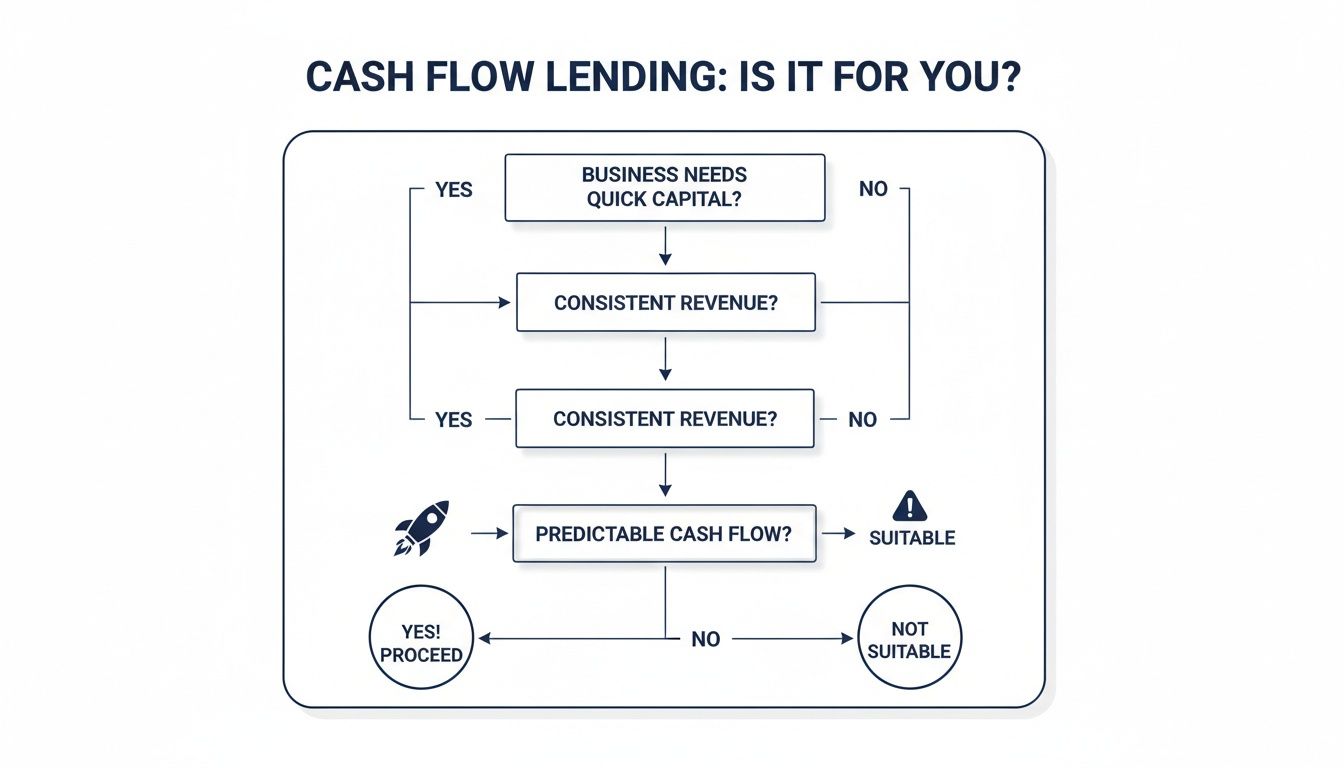
As the flowchart shows, if your business has strong, consistent revenue but you’re light on major physical assets, cash flow lending is often the most direct route to funding.
A clear picture starts to emerge when you compare these options. Your business model and what you own are the biggest factors in deciding what kind of finance will work best. One isn't inherently better than the others; they just serve different purposes.
A Head-to-Head Comparison
To make the choice even clearer, let's break down the core differences in a simple table. This should help you quickly match your business situation to the right financial product. For a deeper dive, our article exploring the different types of loans for business provides even more detail.
Comparing Business Funding Types Cash Flow vs Asset-Based vs Invoice Finance
| Funding Type | Basis for Loan | Collateral Required | Best Suited For |
|---|---|---|---|
| Cash Flow Lending | Your business's historical and predictable future revenue. | Typically unsecured, backed by future cash flow. | Service-based businesses, tech startups, and retailers with strong sales. |
| Asset-Based Lending | The appraised value of your physical business assets. | Equipment, property, inventory, or company vehicles. | Manufacturing, construction, or logistics companies with valuable assets. |
| Invoice Finance | The value of your outstanding customer invoices. | Your accounts receivable ledger (unpaid invoices). | B2B businesses and consultancies with long client payment cycles. |
At the end of the day, picking the best fit comes down to answering one key question: what is my business's strongest financial feature? If it's your consistent daily or monthly sales, cash flow lending is probably your answer. If it's your valuable equipment, asset-based lending is the way to go. And if it's a stack of unpaid invoices, invoice financing can unlock that trapped cash.
How Australian Businesses Use Cash Flow Loans

Theory is one thing, but seeing cash flow lending for businesses in action is where it really clicks. Across Australia, countless SMEs are using this exact type of funding to solve everyday problems and jump on opportunities that would otherwise be out of reach.
These aren't just abstract concepts; they're real stories of growth, stability, and smart business moves. Let’s walk through a few common scenarios where a cash flow loan is the perfect fit.
Fuelling the Construction Industry
Imagine a Melbourne construction company that just landed a massive contract to fit out a new office block. It's a game-changing win, but there's a problem: they need to front tens of thousands of dollars for materials and pay their subcontractors weekly. The client, as is often the case, won't pay the first invoice for at least 60 days.
This is a classic cash flow gap. A cash flow loan gives them the immediate capital to buy supplies and cover wages, getting the project off the ground without delay. Once those large client payments start hitting their account, the loan is comfortably repaid.
This kind of financial agility is becoming the norm. In fact, small and medium-sized enterprises (SMEs) now account for 51% of Australia's total business lending, a sharp increase from 42% in March 2023. This jump proves that using finance to manage project costs is now a mainstream strategy, and you can learn more about Australian business payment trends in recent industry reports.
Empowering Self-Employed Professionals
Let’s take a self-employed IT consultant in Sydney. She's built a fantastic reputation and has a steady pipeline of work. Her goal is to start bidding on larger corporate projects, but to do that, she needs to upgrade her tech stack—new servers, specialised software, and key cybersecurity certifications.
Her income history is a bit complex, and without major physical assets, a traditional bank loan is a non-starter. A low-doc cash flow loan is the ideal solution here. A lender can look at her last six months of consistent invoices and bank statements to approve the funds for the upgrade, empowering her to chase bigger clients and dramatically increase her earning potential.
For many sole traders and small service providers, a cash flow loan is an investment in their own capability. It allows them to scale up their services and revenue without being held back by traditional lending barriers.
Preparing for the Seasonal Rush
Now, picture a boutique retail store on the Gold Coast getting ready for the Christmas rush. They know from past years that sales will triple in November and December. To cash in, they have to order a huge amount of inventory back in September.
They can't wait for holiday sales to fund the stock order—it's a chicken-and-egg problem. A short-term cash flow loan lets them buy in bulk, negotiate better supplier rates, and have fully stocked shelves ready for the festive season. The surge in holiday revenue then easily covers the loan repayments, turning a potential inventory headache into their most profitable quarter of the year.
Each of these examples brings to life the core strength of cash flow lending. It delivers timely, practical solutions tied directly to the real-world rhythm of a business, making it a vital tool for ambitious Aussie SMEs.
How an Expert Broker Simplifies Your Funding Journey
Trying to navigate the world of cash flow lending for businesses on your own can feel like you’re trying to find your way through a maze, blindfolded. With so many lenders, different ways they assess risk, and confusing repayment terms, it’s easy to feel overwhelmed. This is exactly where a sharp finance broker becomes your greatest asset.
Instead of you spending countless hours digging through websites and filling out application after application, a broker does all the heavy lifting. They’re not just a middleman; they’re your strategic partner, using their inside knowledge and network to pinpoint the one funding solution that actually fits your business.
Your Advocate in a Complex Market
An experienced broker brings more to the table than just a list of lenders—they bring genuine expertise and act as your advocate. Their real value is in understanding the subtle but critical differences between loan products and knowing which lenders are a good fit for specific business profiles. This insight is gold, especially for businesses that don't fit the standard bank mould.
Think of your broker as a translator. They take your business’s financial story and present it to lenders in a way that highlights its strengths, making a ‘yes’ far more likely.
For instance, brokers are experts at:
- Structuring applications for tricky situations, like finding low-doc options for self-employed owners or securing finance for someone with a few bumps in their credit history.
- Accessing a wide panel of lenders, including specialist non-bank and private funders that you simply won't find on Google.
- Negotiating better terms on your behalf, which can save you a significant amount on interest and fees over the life of the loan.
A Clear Path to Funding
When you partner with an expert, getting funded isn't just possible—it becomes efficient and surprisingly stress-free. The journey is broken down into a few clear steps, so you always know what’s happening without getting buried in paperwork.
Here’s what that typically looks like:
- An initial chat to get a real understanding of your business, its needs, and where it stands financially.
- Matching you with the best-fit lenders from their extensive network.
- Guiding you through the documents needed and helping you submit a strong application.
- Following up with the lender all the way through until the money lands in your account.
This organised approach takes the guesswork out of the equation, letting you get back to what you do best—running your business. You get the benefit of expert advice and a tailored solution, without the headache of going it alone.
Ready to see what your cash flow lending options look like? The team at Diamond Lending is here to make your funding journey simple. We specialise in finding the right financial solutions for Australian businesses, connecting you with lenders who get what you’re trying to achieve. Start with a quick, no-obligation chat to see how we can help. Get in touch with us today to take the first step.