

Deciding between an Interest Only (IO) and a Principal and Interest (P&I) home loan is one of the biggest financial calls an Australian borrower will make. The difference sounds simple, but the long-term impact is huge. With a P&I loan, you’re chipping away at your debt from day one. With an IO loan, you’re only covering the interest for a set period, which keeps your repayments lower for a while but leaves the actual loan amount untouched.
This isn’t just a small detail; it’s a strategic choice that will shape your cash flow, how much interest you pay over the long haul, and your entire wealth-building journey.
Choosing Your Home Loan Repayment Structure
When you take out a home loan, you’re not just borrowing money—you're signing up for a long-term financial game plan. The repayment structure you choose dictates how quickly you build equity in your property and the total cost of the loan by the time it’s all paid off. Getting your head around the mechanics of each option is the first step to making a smart decision that actually lines up with what you want to achieve financially.
A Principal and Interest loan is the bread and butter of Australian mortgages. It's the most common and straightforward path. Every single repayment you make is split in two:
- The Principal: This is the part that actually pays down the money you borrowed.
- The Interest: This is the lender’s fee for lending you the cash.
As the years go by, more of your repayment goes towards the principal and less towards interest. This means you’re building equity with every payment, a disciplined and direct route to owning your home outright.
An Interest Only loan works very differently, at least for a fixed period—usually one to five years. During this time, your repayments only cover the interest being charged. The original loan amount, the principal, doesn't shrink at all. This makes your initial repayments significantly lower, which can be a brilliant tool for managing your cash flow.
Key Differences at a Glance
To cut through the noise, here’s a simple breakdown of how these two loan structures stack up against each other. This table really highlights the trade-offs you’re making between lower initial payments and building up your equity over the long term.
| Feature | Interest Only (IO) Loan | Principal and Interest (P&I) Loan |
|---|---|---|
| Monthly Repayments | Lower during the initial IO period. | Higher from the start. |
| Principal Reduction | Principal is not paid down during the IO term. | Principal is reduced with every repayment. |
| Equity Building | Relies on the property's value increasing (capital growth). | Builds equity through both repayments and capital growth. |
| Total Interest Paid | Higher over the life of the loan. | Lower over the life of the loan. |
The choice between interest only vs principal and interest goes way beyond just the number on your monthly statement. It's about your entire financial strategy. If you want to see how these different scenarios could play out with your own numbers, a specialised calculator is the best way to get some real clarity.
You can run the numbers yourself using an interest only mortgage calculator to see exactly how each option could work for you.
A Detailed Comparison of IO and P&I Loans
When you’re looking at a home loan, it’s easy to get fixated on the interest rate. But the repayment structure you choose—either Interest Only (IO) or Principal and Interest (P&I)—is just as crucial. This single decision shapes your monthly budget, how quickly you build wealth, and what your mortgage will ultimately cost you.
So, what's the real difference? It’s all about where your money goes. With a P&I loan, every repayment chips away at your loan balance (the principal) and covers the interest. But with an IO loan, for the first one to five years, your payments only cover the interest. The actual loan amount doesn't budge.
This infographic lays out the core mechanics of each loan type, showing how they impact your finances from day one.
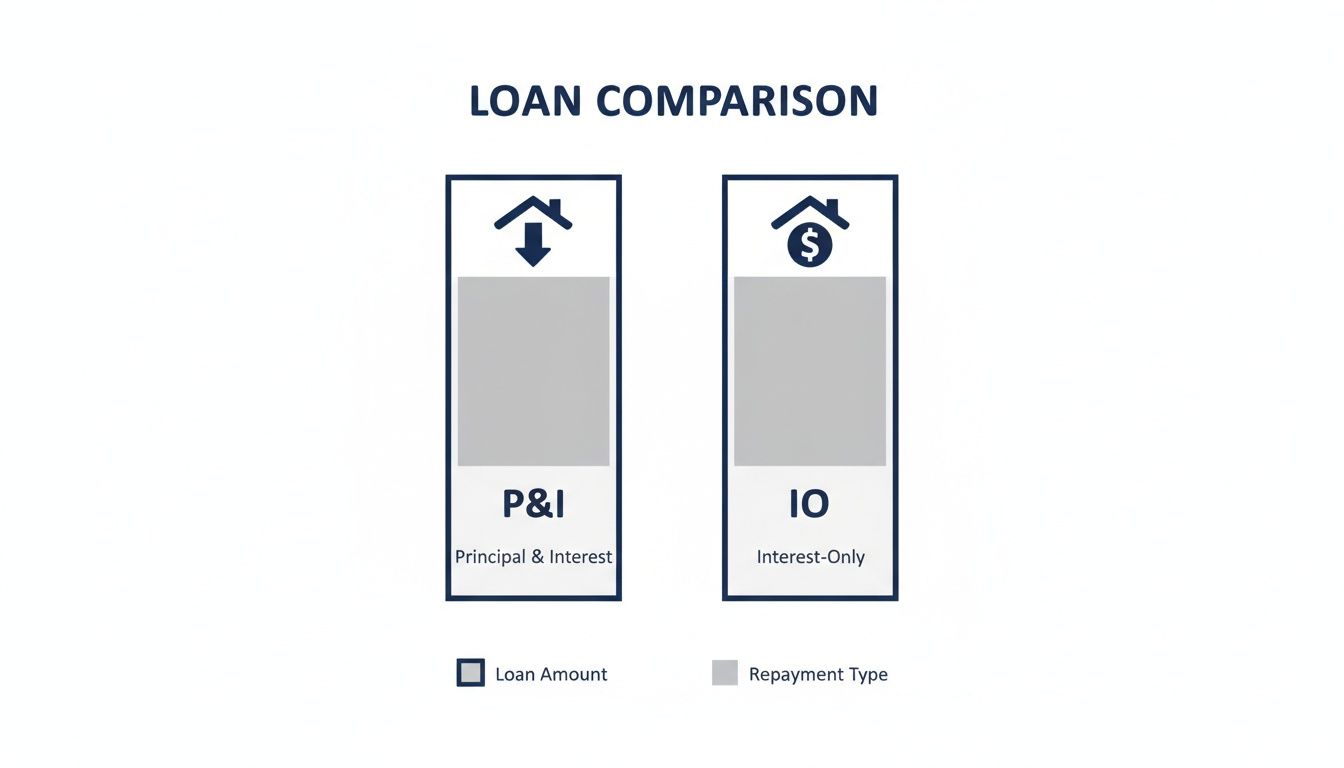
As you can see, the IO loan gives you an immediate cash flow boost (the dollar sign), while the P&I loan is all about steady, consistent debt reduction (the downward arrow).
To help you weigh your options, this table breaks down the key features side-by-side.
IO vs P&I Loan Features at a Glance
| Feature | Interest Only (IO) Loan | Principal and Interest (P&I) Loan |
|---|---|---|
| Monthly Repayments | Lower during the initial IO period (typically 1-5 years). | Higher from the start, but consistent and predictable. |
| What You Pay | Covers only the interest accrued on the loan balance. | Covers both the interest and a portion of the principal. |
| Loan Balance | Remains unchanged during the IO period. | Decreases with every repayment made. |
| Total Cost | Higher over the life of the loan due to paying interest on the full amount for longer. | Lower total interest paid over the life of the loan. |
| Equity Building | Relies solely on capital growth (property value increasing). | Builds equity through both principal reduction and capital growth. |
| Risk Profile | Higher risk, especially if property values stagnate or fall. | Lower risk, as you are actively paying down your debt. |
This table gives a quick snapshot, but the real impact of your choice depends entirely on your personal financial strategy and circumstances.
Monthly Cash Flow and Budgeting
The biggest drawcard for an IO loan is obvious: much lower initial repayments. By only servicing the interest, you can free up a significant chunk of cash each month. It's a powerful strategy for property investors aiming to maximise cash flow or for self-employed borrowers with lumpy, inconsistent income.
But that cash flow relief has a time limit. Once the IO period ends, the loan flips to a P&I structure. The catch? You have to repay the entire original loan balance over a much shorter timeframe. This triggers what’s known as "repayment shock"—a sudden, often steep, hike in your monthly payments.
A P&I loan, on the other hand, is built for predictability. Your payments are higher from day one, but they’re stable, making long-term budgeting straightforward.
Total Cost and Long-Term Implications
While IO loans offer a short-term win, they almost always cost more in the long run. Why? Because you're paying interest on the full loan amount for the entire IO period without reducing the principal by a single dollar. That means a much bigger total interest bill by the time the loan is paid off.
The trade-off is simple. An IO loan prioritises immediate cash flow but comes with higher long-term costs and delayed equity. A P&I loan demands more from your budget upfront but rewards you with disciplined wealth creation and long-term savings.
Let's put some real numbers to it. On a $500,000 loan over 30 years at a 4.39% interest rate, standard P&I repayments would be $2,501 per month. The total interest paid would be $400,307.
Now, if you took that same loan with a five-year IO period, your initial repayments would drop to just $1,829 a month. Sounds good, right? But over the full term, the total interest paid balloons to $434,161. That’s an extra $33,854 straight to the bank. You can run your own numbers using comparison tools like Canstar to see how different scenarios play out.
Equity Accumulation and Risk Profile
For most homeowners, building equity—the part of the property you actually own—is the name of the game. A P&I loan gives you two ways to do this: every principal repayment you make, plus any rise in your property's market value (capital growth). This two-pronged approach builds a solid financial buffer and lowers your overall risk.
An IO loan is a different story. It builds equity only if the property value goes up. You are 100% reliant on the market, because your repayments do nothing to reduce your debt. This is a much riskier position to be in. If the market flattens or drops, you could easily owe more than your property is worth (known as negative equity).
This makes the interest only vs principal and interest decision one of the most critical you'll make in managing your financial exposure.
The Shifting Sands of Australian Interest-Only Lending
Choosing between an interest-only vs principal and interest loan isn't a decision you make in a bubble. The Australian lending landscape has changed dramatically over the years, and those changes directly affect who can get an Interest-Only (IO) loan and how much it costs. To make a smart choice today, you have to understand this recent history.
For a long time, IO loans were the go-to for property investors. They were easy to get and seen as the best way to maximise cash flow and tax deductions. But around 2017, the market hit a turning point that forced the Australian Prudential Regulation Authority (APRA) to step in.
Why APRA Slammed the Brakes
With property prices soaring and household debt at record highs, APRA grew concerned about the risks building up in the banking system. IO lending became a key target. The regulators worried that too many borrowers were just banking on capital growth to build equity, rather than actually paying down their debt. It was a house of cards waiting to fall.
In response, APRA put strict new rules in place, including a cap on how many new IO loans lenders could write. This single move completely reshaped the market, forcing banks to:
- Scrutinise Applications Much Harder: Suddenly, lenders were digging a lot deeper into IO applications. They demanded stronger proof that you could handle not just the initial IO period, but also the much higher repayments when the loan inevitably switched to P&I.
- Hike Up the Interest Rates: To slow down IO lending and stay under the new caps, banks started "rate loading." This just means they began charging a premium on IO loans, making them significantly more expensive than their P&I equivalents for the first time.
The effect was immediate. The popularity of IO loans nosedived as both lenders and borrowers shifted towards the relative safety and stability of P&I mortgages.
The post-2017 regulatory climate marked a fundamental shift. IO loans transitioned from a widely available product to a specialised tool reserved for borrowers with a clear strategic purpose and a strong financial position.
The numbers tell the story perfectly. Before the crackdown, IO lending was at its peak. At its height, it made up a massive 64% of all investor loans and 23% of owner-occupier loans, fuelling fears about how much debt wasn't being paid down. You can learn more about the RBA's findings on housing market risks. Today, the picture is completely different. IO loans are now a much smaller slice of the market as everyone has adapted to the new normal.
What This All Means for You Today
The legacy of these changes is a lending environment that's still pretty cautious about IO loans. While the hard caps are gone, the banks haven't forgotten the lessons learned.
For investors, this means you can't just want an IO loan; you need a rock-solid strategy to justify it. Lenders will want to see your numbers, your plan, and proof that you can absorb the "repayment shock" when the IO period ends. Just wanting lower repayments isn't enough anymore.
For owner-occupiers, it’s an even tougher sell. Lenders see IO loans as a much higher risk for someone living in their own home. You'll generally need a very specific and compelling reason—like managing cash flow during a major renovation or navigating a temporary drop in income—to get one across the line. The market has firmly established P&I as the standard, safer path for the average homeowner.
When Each Loan Type Makes Financial Sense

Deciding between an Interest-Only (IO) and a Principal and Interest (P&I) loan isn't about finding a one-size-fits-all "best" option. It's about what’s right for your specific financial situation and goals right now.
Each structure serves a very different purpose. A strategy that’s brilliant for a seasoned property investor could be a financial mistake for a young family buying their first home. This is where a clear-headed look at your own circumstances is your most important tool.
The Strategic Case for Interest-Only Loans
Tighter lending rules have made IO loans less common than they once were, but for the right borrower, they are still a powerful financial tool. When used correctly, an IO loan offers a level of cash flow agility a standard P&I loan just can't match.
Here are a few scenarios where an IO loan often makes perfect sense:
-
For Sophisticated Property Investors
This is the classic use case. Smart investors use IO loans to maximise their cash flow, which frees up capital to grow their property portfolio faster. Lower monthly repayments mean more money for a deposit on the next property or for renovating an existing one to boost its rental yield. -
For Developers and Renovators
When a property is a construction site, it’s not earning you any income. An IO loan keeps your holding costs as low as possible during this crucial phase. Once the project is finished and the property is either tenanted or sold, the loan can be paid off or switched over to P&I. -
For Borrowers with Lumpy Income
If you're self-employed, a freelancer, or work on commission, your income can swing from high to low. An IO loan can act as a financial buffer during the leaner months, keeping your repayments manageable. Then, when a big payment comes in, you can make extra contributions directly against the principal.
IO loans have long been a favourite for Australian investors. They peaked at around 64% of all investor lending back in 2017, while only making up 23% of owner-occupier loans at the same time. This shows just how strategically investors used them to manage cash flow.
The Clear Advantage of Principal and Interest Loans
For most Australians—especially those buying a home to live in—a P&I loan is the most sensible and financially sound choice. It's built on discipline, security, and the steady goal of building wealth.
Here’s why a P&I loan is the gold standard for most homeowners:
-
For First-Home Buyers
Getting into the property market is a massive step. Building equity from your very first repayment is crucial for your long-term financial security. A P&I loan forces this discipline, systematically chipping away at your debt and growing your ownership stake. -
For Typical Owner-Occupiers
If your main goal is simply to own your home outright and live debt-free, a P&I loan is the most direct way to get there. Every single repayment brings you closer to that finish line, and you'll pay far less interest over the life of the loan. It offers predictability and peace of mind. -
For Risk-Averse Borrowers
An IO loan relies heavily on the property’s value going up to build your equity. A P&I loan, on the other hand, builds equity in two ways: through your own repayments and through any capital growth. This dual approach is simply less risky and gives you a much stronger financial foundation.
The core difference is the objective. P&I loans are for debt reduction and building wealth in your own home. IO loans are a specialised tool for leveraging investment capital and managing short-term cash flow.
When you're weighing up an interest only vs principal and interest loan, your personal goals dictate the right move. For investors looking to scale, understanding the specifics of a property investment loan is a vital first step. For almost everyone else, the disciplined, equity-building power of a P&I loan is the smarter, safer path to homeownership. 🏡
How to Navigate a Switch in Your Repayment Type

Flicking the switch on your home loan's repayment structure is a big deal. It’s a strategic financial move that needs proper planning, whether your interest-only period is coming to an end or your personal circumstances have taken a turn. Getting it right is key to keeping your finances on track.
There are really two main scenarios when it comes to switching between interest only vs principal and interest repayments. Each one has its own process, lender hoops to jump through, and potential costs you need to be aware of before you dive in.
Transitioning From IO to P&I
This is the switch most borrowers will face. Your interest-only term expires, usually after one to five years, and the loan automatically flips to principal and interest. The key is to be proactive here, otherwise, you could be in for a nasty shock when you see your new repayment amount.
Once that IO period is over, your loan reverts to a P&I schedule. But here’s the crucial part: the original loan amount now needs to be paid off over the remaining loan term. Say you had a 30-year loan with a five-year IO period. You now have just 25 years left to repay the entire principal, which means your repayments are about to jump significantly.
Here’s how to handle it smoothly:
- Watch Your Mailbox: Your lender will send you a notice months before the IO period wraps up. Don’t ignore it. It will show you exactly what your new P&I repayment will be.
- Do a "Practice Run" With Your Budget: At least three months out, start setting aside the difference between your current IO payment and the new P&I amount. This not only softens the financial blow but proves you can actually manage the higher commitment.
- Think Carefully About an Extension: You can always ask your lender to extend the IO period. But be warned, this isn't a simple request anymore. It's a brand-new application that will be scrutinised. Lenders are much tougher now and will want a very good reason for the extension.
Failing to prepare for the end of an IO term is one of the biggest financial traps a borrower can fall into. That "repayment shock" can seriously strain your budget if you haven't planned for the sudden and significant increase in your monthly mortgage payment.
Refinancing From P&I to an IO Loan
Going the other way—from P&I back to an IO loan—is less common and nearly always means a full refinance application. You can do this with your current lender or a new one, but it’s a strategic play. It’s often used by investors wanting to free up cash for another property or by homeowners needing some temporary breathing room in their budget.
Lenders will put this kind of application under the microscope. You’ll need to build a strong case for why you need an IO period and show you have a clear plan to manage the loan. The process typically involves:
- A Full Financial Health Check: Lenders will comb through your income, expenses, and entire financial situation all over again.
- A New Property Valuation: Expect your property to be revalued to check the current loan-to-value ratio (LVR).
- Potential Fees: Don't forget the costs involved. You could be up for discharge fees on your old loan, application fees, and government charges.
Switching your repayment type isn’t just ticking a box. It’s a fundamental change to your financial strategy. Whether you're moving from IO to P&I or back again, a bit of forward-thinking will ensure the transition supports your goals instead of giving you a massive headache.
So, Which Loan is Right for Your Financial Future?
Let’s be clear: choosing between an interest-only vs. a principal-and-interest loan isn’t about finding the one "best" option. It’s about matching the loan structure to your specific financial strategy.
The decision really hinges on a clear-eyed look at your goals, your cash flow needs, and your appetite for risk. There’s no universal right answer here, only the right answer for you.
A Principal and Interest (P&I) loan is the classic path to building wealth through property. It’s built for stability, forcing you to save by chipping away at your debt and building equity from the very first repayment. This structure is the bedrock of traditional homeownership, giving you peace of mind and a clear finish line to becoming mortgage-free.
On the other hand, an Interest Only (IO) loan is a strategic tool. It’s all about managing cash flow. It frees up your capital in the short term, which can be a game-changer for investing, funding renovations, or just navigating periods of lumpy income. But this flexibility comes at a cost—higher interest bills over the long run and a greater reliance on your property’s value growing to build your wealth.
Your Next Steps
The perfect loan structure is one that gets you to your long-term goals without putting you under unnecessary financial stress. The core trade-off is simple:
- Choose P&I for steady equity growth, lower overall interest costs, and a straightforward path to owning your home outright.
- Choose IO for maximum short-term cash flow, investment leverage, or temporary budget relief, but be prepared for the higher long-term cost.
The most important step is to move from theory to a concrete plan. Your decision shouldn't be based on general advice, but on detailed financial modelling tailored to your unique situation. A generic online calculator only ever shows you part of the picture.
Trying to make this choice on your own can be daunting, and frankly, it’s a big risk. Getting personalised advice from a mortgage professional is the smartest move you can make.
An expert can model different repayment scenarios for you, compare products from a huge range of lenders, and make sure your final decision is one you can be confident in. A clear, expert-guided strategy is the only way to ensure your home loan structure works for you, not against you.
Still Got Questions?
Navigating the world of home loans throws up plenty of questions, especially when you’re trying to weigh up the fundamental differences between an Interest Only (IO) and a Principal and Interest (P&I) loan. Let's tackle some of the most common queries we hear from Australian borrowers.
Are Interest Only Loans A Good Idea For Investors?
For a savvy property investor, an IO loan can be a seriously powerful tool. By only servicing the interest, you free up a significant amount of monthly cash flow. That extra cash can then be channelled into a deposit for your next investment property or used to fund a quick renovation on an existing one. It can also have the added benefit of maximising your tax-deductible interest expenses.
But this strategy doesn’t come without risk. You're banking entirely on capital growth to build equity because your repayments aren't chipping away at the loan principal itself. This makes the interest only vs principal and interest decision a critical one for managing your portfolio's overall risk profile.
Can You Make Extra Repayments On An Interest Only Loan?
Yes, you absolutely can. Most Australian lenders will let you make extra repayments on an IO home loan, and these additional payments go straight towards reducing the principal balance. This is a great way to get ahead, pay off your loan faster, and slash your total interest costs over time.
It’s a flexible option for when you have a good month or a cash windfall. Just be sure to check the fine print of your loan agreement first, as some products might have limits or even fees tied to extra repayments.
An IO loan gives you that initial cash flow boost, but a P&I loan is the disciplined path to actually owning your property outright. The right choice comes down to one thing: is your main goal investment leverage or debt reduction? Figuring that out is the key to aligning your loan with your financial future.
What Happens When My Interest Only Period Ends?
This is a make-or-break moment in the life of an IO loan. Once your agreed IO period finishes (usually after one to five years), your loan automatically flips over to a P&I repayment schedule. The big challenge here is something the industry calls "repayment shock."
Why the shock? Because the original principal amount now needs to be paid off over a shorter remaining loan term, your monthly repayments are going to jump—often significantly. For instance, if you had a 30-year loan with a five-year IO period, you now have only 25 years left to pay off the entire principal. It's crucial to budget for this hike well in advance to avoid any financial stress.
Choosing the right loan structure can genuinely shape your financial journey for years. At Diamond Lending, our expert mortgage brokers can model different scenarios for you, comparing hundreds of loan products to find the perfect fit for your goals.
Ready to find a home loan that actually works for you? Schedule a free 15-minute consultation with our team today.