

If you want to improve your credit score in Australia, it really comes down to one thing: proving you can handle your finances responsibly over time. The best strategies aren't complicated. It’s about consistently paying your bills on time, keeping your credit card balances low, and regularly checking your credit reports for any errors that might be dragging your score down.
Understanding Your Australian Credit Score
Before you can start fixing your score, you need to get your head around what it actually is and how it’s calculated. Think of it as a financial report card that lenders glance at to quickly size up the risk of lending you money. A higher score tells them you're a reliable borrower, which can unlock better interest rates and more financial opportunities down the track.
In Australia, your credit information is gathered and managed by three main credit reporting bodies: Equifax (which used to be Veda), Experian, and Illion (formerly Dun & Bradstreet). Each one has its own way of calculating your score, using its own unique algorithm, so don't be surprised if your score varies a little between them.
What Makes Up Your Score?
Several key bits of information from your credit report feed into that final number. While the exact weighting can differ, the most important factors are pretty consistent across the board.
- Repayment History: This is the heavyweight champion of credit scoring. It shows whether you've paid your bills on time over the past two years, and it has the biggest impact.
- Credit Utilisation: This is a measure of how much of your available credit you’re actually using. If your credit cards are constantly maxed out, it can signal financial stress to lenders.
- Credit Applications: Every time you apply for a loan or credit card, it’s noted as a 'hard enquiry' on your file. Firing off multiple applications in a short space of time can definitely lower your score.
- Type and Mix of Credit: Lenders like to see that you can responsibly manage a few different types of credit, like a credit card alongside a car loan.
- Length of Credit History: Generally speaking, a longer track record of responsible credit management will have a positive impact on your score.
Comprehensive Credit Reporting
The introduction of Comprehensive Credit Reporting (CCR) completely changed the game for Australians. In the old days, reports mostly just showed the bad stuff—defaults, late payments, that sort of thing. Now, they also include positive information, like your history of making on-time payments for credit cards and other loans.
This is great news because it means your good financial habits are actively rewarded and help build a stronger credit profile. It gives you the power to show lenders you’re reliable, which is absolutely critical when you're going for bigger financial products. A solid credit history, for instance, is a cornerstone of a successful application, as we cover in our guide on how to obtain a home loan.
A healthy credit score isn't just a number; it's a reflection of your financial habits and a key asset in achieving your long-term goals, from buying a car to securing a mortgage.
To help you figure out where you stand, here’s a breakdown of the typical credit score bands used in Australia.
Australian Credit Score Ranges and What They Mean
This table breaks down the typical credit score bands used by Australian credit reporting bodies, helping you understand where you stand and what lenders see.
| Score Range | Rating | Lender Perception |
|---|---|---|
| 833 – 1,200 | Excellent | You’re seen as a very low-risk borrower. Lenders will likely offer you their best rates and products. |
| 726 – 832 | Very Good | You’re considered a reliable borrower with a strong history. You’ll have access to competitive rates. |
| 622 – 725 | Good | A solid score. Lenders see you as a responsible borrower, and you should qualify for most standard loans. |
| 510 – 621 | Average | Lenders might be a bit more cautious. You may face higher interest rates or stricter conditions. |
| 0 – 509 | Below Average | This signals a higher risk to lenders, often due to defaults or missed payments. Securing credit will be challenging. |
Knowing your score and what it means is the first step towards taking control.
Getting Your Free Report
Every Australian is entitled to a free copy of their credit report from each of the three main bureaus once every 12 months. Taking them up on this offer is the essential first step. It lets you see exactly what information lenders have on you and, just as importantly, spot any inaccuracies that could be unfairly hurting your score.
This simple habit of checking in on your financial health is becoming more common—and it's making a difference. Recent data shows a clear link between financial literacy and better credit outcomes. Between 2022 and 2024, the number of Australians who knew how to access their credit report grew from 50% to 58%.
Over a similar period, the national average Equifax score rose from 855 to 861, pushing it firmly into the 'Excellent' category. You can explore more about these trends and what they mean for consumers in Equifax's Australian Scorecard reporting.
Finding and Fixing Credit Report Errors
Think of your credit report as your financial resume. Just like a typo can get a job application tossed aside, a mistake on your credit file can lead to a lender showing you the door. These errors are surprisingly common and can be one of the biggest—yet most fixable—factors dragging down your score.
For many people I've worked with, identifying and correcting these inaccuracies is the quickest way to see a real, tangible improvement. An incorrect late payment, a fraudulent account you never opened, or a default that should have disappeared years ago could be costing you valuable points. Taking the time to comb through your file with a critical eye is an essential first step.
This visual breaks down the core process for reviewing your credit health.
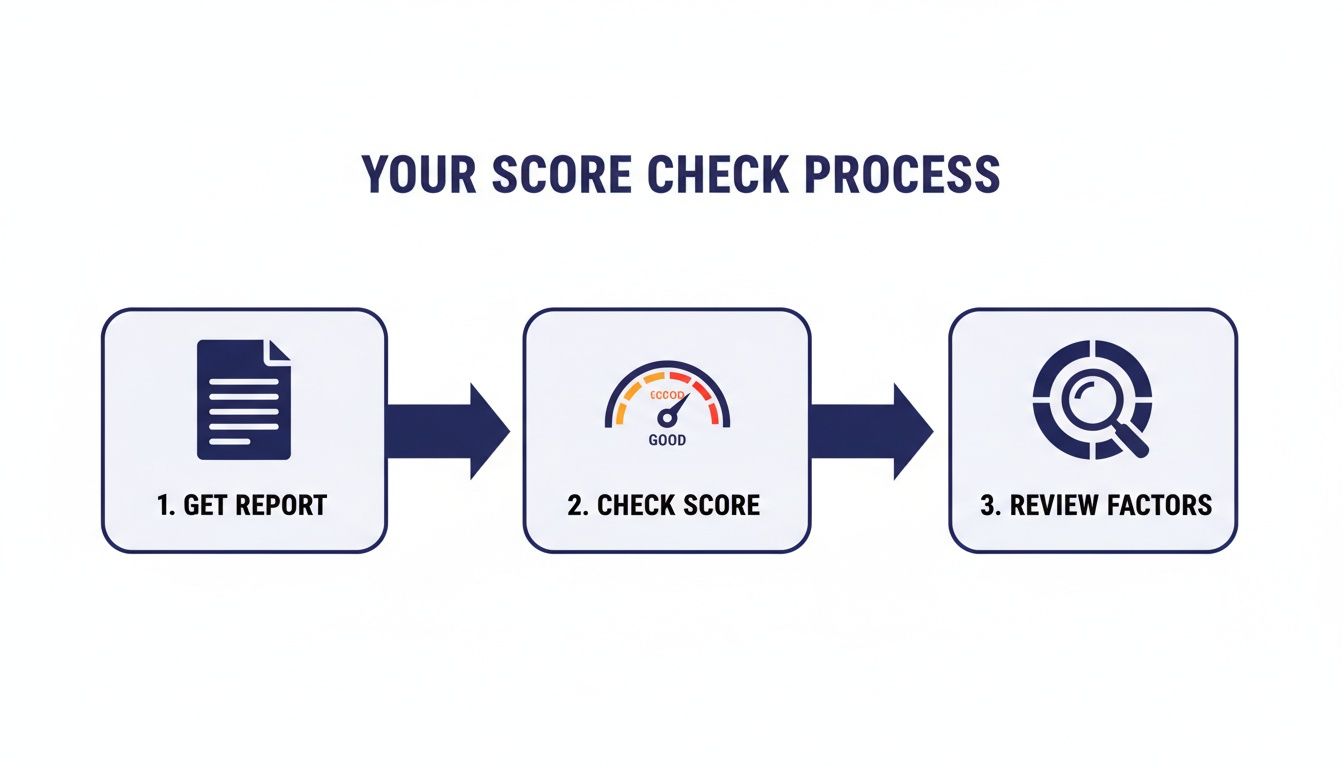
It’s a simple but powerful loop: get your report, understand the score, and then dig into the details to find areas for improvement—like the errors we’re about to discuss.
Common Credit Report Mistakes to Look For
When you get your report, don't just glance at the score. You need to become a bit of a financial detective, scrutinising every single line item for accuracy. Many people are shocked to find errors that have been silently chipping away at their financial reputation for years.
Here are the usual suspects to keep an eye out for:
- Incorrect Personal Information: Check your name (including any previous names), date of birth, and addresses. A simple typo might seem harmless, but it can sometimes lead to your file being mixed up with someone else's.
- Accounts That Aren't Yours: This is a massive red flag for identity theft. If you spot a credit card or loan that you never opened, you need to act immediately.
- Outdated Negative Listings: In Australia, most negative information has a set expiry date. For instance, a default or court judgment should typically be removed after five years. Make sure old issues aren't lingering longer than they should.
- Duplicate Accounts: Sometimes, a single debt can be listed twice, making your situation look worse than it is. This often happens if a debt gets sold to a collection agency.
- Incorrect Payment Status: A payment you made on time might be incorrectly reported as late. This is a critical error to fix, as your repayment history is the single biggest factor influencing your score.
The Process for Disputing Errors
Finding an error is the first step; getting it corrected requires a methodical approach. You generally need to raise the dispute with both the credit reporting body (Equifax, Experian, or illion) and the credit provider who supplied the incorrect information in the first place.
The credit reporting body has a legal obligation to investigate your claim, usually within 30 days. They'll reach out to the credit provider to verify the information. If the provider agrees it's an error or simply fails to respond, the bureau must correct your file.
Key Takeaway: Always provide as much evidence as you can when you lodge a dispute. This could include bank statements, receipts, or previous emails that prove your claim. A well-documented dispute is far more likely to be resolved quickly and in your favour.
Crafting an Effective Dispute Letter
While you can often lodge disputes online, sending a formal letter or email creates a clear paper trail. Your communication should be professional, clear, and factual. Avoid getting emotional and just stick to the details. Here’s a simple template you can adapt.
Sample Dispute Letter Template
- Your Details: Start with your full name, date of birth, current address, and previous address if relevant.
- Clear Statement of Purpose: "I am writing to dispute an item on my credit report. I have enclosed a copy of my report with the inaccurate item circled."
- Identify the Error: Clearly state which account is incorrect and explain precisely why it's a mistake. For example: "The Telstra account (Account No. [Number]) listed as a default is incorrect. This account was paid in full on [Date], and I have attached a copy of the final receipt as proof."
- State Your Desired Outcome: "Please investigate this matter and remove this inaccurate listing from my credit file immediately."
- Attach Your Evidence: List the documents you're including. "Enclosed are copies of my credit report, the payment receipt, and my driver's licence for identification purposes."
By systematically finding and fixing these errors, you’re not just cleaning up your file; you’re actively working to improve your credit score in Australia and taking back control of your financial story.
Building Positive Credit Habits That Last
Improving your credit score isn't about finding a magic trick. It's about building a solid foundation of consistent, positive financial habits. Think of it like training for a marathon; you won’t see results overnight, but steady, deliberate effort pays huge dividends over time.
Lenders in Australia want to see a predictable pattern of reliability. The habits you build today are what create that track record for tomorrow.

Let's unpack the two most critical behaviours that influence your score: making payments on time, every time, and managing how much of your available credit you actually use. Nailing these two areas is the most powerful way to improve your credit score in Australia for the long haul.
Master Your Payment History
Your repayment history is, without a doubt, the single biggest factor in your credit score. Under Australia's Comprehensive Credit Reporting (CCR) system, every on-time payment you’ve made for the last 24 months is visible to lenders.
Each one acts as a small vote of confidence. On the flip side, a single missed payment can leave a mark that takes two full years to fade.
A late payment, even if it's just a few days overdue, can be reported and drag your score down. To a lender, it signals potential financial stress or just simple disorganisation. The goal is to build an unbroken chain of on-time payments that proves you are a low-risk borrower.
Setting up systems to ensure you never miss a due date isn't just good practice; it's a core credit-building strategy.
Practical Tips for Perfect Payments:
- Automate Everything You Can: Set up direct debits for your recurring bills like phone, internet, and utilities. This is the simplest "set and forget" method to guarantee payments are made on time.
- Use Calendar Reminders: For bills that have variable amounts or dates, pop multiple reminders in your phone or digital calendar. I usually set one for a week before the due date and another a day or two before, just in case.
- Create a Payment Hub: A simple spreadsheet or a budgeting app can help you track all your due dates in one place. Seeing everything laid out visually makes it much easier to manage cash flow and plan for upcoming expenses.
Understand Your Credit Utilisation Ratio
After payment history, the next most important factor is your credit utilisation ratio (CUR). This sounds more complicated than it is. It's simply the percentage of your total available credit that you are currently using.
Lenders pay close attention to this ratio. Why? Because a high CUR suggests you might be overly reliant on credit to manage your day-to-day finances. Keeping your balances low shows you have your spending under control and aren't stretched too thin.
A good rule of thumb is to keep your credit utilisation below 30%. So, if you have a credit card with a $10,000 limit, you should aim to keep your outstanding balance below $3,000 at all times.
Here’s a real-world example of how this plays out.
Scenario A vs. Scenario B
Imagine two people, Sarah and Tom. They both have a single credit card with a $5,000 limit and they both pay their bills on time without fail.
| Aspect | Sarah's Situation | Tom's Situation |
|---|---|---|
| Credit Limit | $5,000 | $5,000 |
| Outstanding Balance | $4,500 | $1,000 |
| Credit Utilisation | 90% | 20% |
| Lender's Perception | High risk, financially stretched. | Low risk, responsible credit use. |
Even though both pay on time, Tom’s credit score will likely be higher. His low utilisation demonstrates strong financial management. Sarah's high balance, in contrast, could be a red flag for lenders, even if she has never missed a payment.
A great tip to manage this is to make a few small payments throughout the month instead of just waiting for the statement to arrive.
Be Strategic About New Credit Applications
Every time you apply for a credit product—a credit card, a car loan, or any other form of finance—it gets recorded as a hard enquiry on your credit report. While a single enquiry won't tank your score, applying for several in a short space of time can definitely have a negative impact.
A flurry of applications can be interpreted by lenders as a sign of financial distress, something often called "credit seeking." It can make you look like a higher-risk borrower, and each hard enquiry can stay on your report for up to five years.
To protect your score, it pays to be thoughtful and strategic about when and why you apply for new credit.
- Space Out Your Applications: Avoid applying for multiple credit products at once. If you can, try to wait at least six months between applications.
- Do Your Homework First: Before you hit "apply," research lenders and their products to make sure you actually meet the eligibility criteria. This reduces the chance of a rejection, which leaves you with a hard enquiry for no benefit.
- Only Apply When You Need To: Ask yourself if you truly need that new line of credit. Building a healthy score is about quality, not quantity. A long history with a few well-managed accounts is far better than having many new ones.
How Long Does It Take to Actually Improve Your Credit Score?
Let's be upfront: improving your credit score isn't an overnight fix. Patience is key. While some quick wins can give you a small boost, real, lasting improvement comes from building consistent, positive financial habits over time.
To set realistic goals, you first need to understand how long different bits of information hang around on your credit report. This knowledge is your roadmap to recovery. It helps you see why the small, smart changes you make today will eventually overshadow any past mistakes.
Knowing these official retention periods helps you build a genuine long-term strategy, rather than chasing a quick fix that doesn't exist.
Understanding the Lifespan of Your Credit Data
Different credit events have a set expiry date on your report. Once this period passes, the information legally has to be removed, giving you a cleaner slate. The good news is that the negative impact of old listings also tends to fade over time, especially as new, positive information starts to fill up your file.
Here’s a quick summary of how long different entries will stick around. This table outlines the official data retention periods for different credit events, helping you get a clear picture of your score recovery timeline.
How Long Information Stays on Your Australian Credit Report
| Type of Information | Retention Period |
|---|---|
| Repayment History Information | 2 years |
| Credit Enquiries (Hard Enquiries) | 5 years |
| Overdue Debts / Defaults | 5 years |
| Court Judgments | 5 years |
| Bankruptcy | 5 years from the date you became bankrupt OR 2 years from when it ends, whichever is later. |
As you can see, a minor slip-up like a single late payment will be gone from your repayment history relatively quickly. On the other hand, more serious events like a default or court judgment will cast a much longer shadow.
The most important takeaway? Your credit history isn't permanent. Every day that passes is one step closer to an old negative listing dropping off, and every on-time payment you make adds positive weight to your file.
Recovery Timelines in the Real World
So, how do these timelines play out in practice? Let’s look at a couple of real-world scenarios to see how a score can bounce back from different situations. This will help you focus your energy where it counts.
-
Chloe's Minor Slip-Up: Chloe missed a credit card payment by 20 days last year. It was a simple oversight. This late payment will show up in her repayment history for 2 years. But because she's made every single payment on time since, the negative impact of that one event is already fading. Lenders can see a consistent, positive pattern that far outweighs one little mistake.
-
Ben's Bigger Hurdle: Ben had a default listed three years ago for a utility bill he forgot about when he moved. That default will stay on his report for a total of 5 years. For the next two years, it will still affect his ability to get finance, though its impact lessens as it gets older. His best move is to demonstrate perfect financial behaviour now to prove to lenders the default was a one-off issue from the past, not a current habit.
The Power of Positive Momentum
While you can't just delete a legitimate negative listing before its time is up, you absolutely control what gets added to your report from this day forward. Building a strong, positive history is the most powerful tool you have.
Every month you pay your bills on time, you're creating fresh, positive data that the credit bureaus record. Over time, this new information starts to drown out the old negative entries, gradually lifting your score.
Think of it like tending a garden. You can't undo last season's frost, but you can plant healthy new seeds today that will grow, flourish, and eventually dominate the landscape. This consistent effort is the secret to how you can improve your credit score in Australia for good.
Credit Score Strategies for Unique Situations
Standard advice on fixing your credit score doesn't always work for everyone. Let's be honest, not everyone has a straightforward PAYG job, and past financial hiccups can cast a long shadow. The real key is tailoring your strategy to your specific circumstances.
Whether you're running your own show or rebuilding after a setback, the goal is always the same: prove to lenders that you're financially stable and reliable. So, let’s look at some practical, real-world approaches for these distinct situations.
Proving Your Worth When You're Self-Employed
For self-employed Aussies, the biggest hurdle is almost always proving consistent, reliable income. Your cash flow might be a rollercoaster—great months followed by leaner ones—and that kind of unpredictability makes lenders nervous.
The trick is to structure your finances to present a clean, professional picture of your earning power. Lenders need to see a stable financial history, which means keeping your personal and business finances strictly separate. Mingling expenses makes it incredibly difficult for a lender to figure out the health of your business and your ability to handle a new loan.
To build a stronger profile, start with these non-negotiables:
- Separate Bank Accounts: You need distinct accounts for your business income and expenses. This isn't just good accounting; it's essential for clear financial reporting when it's time to apply for a loan.
- Pay Yourself a Regular Salary: Even if your business income fluctuates, pay yourself a consistent "wage" from your business account into your personal one. This creates the paper trail of stable personal income that lenders are looking for.
- Keep Impeccable Records: Use accounting software to keep your books clean and current. Having two years of well-organised financials and tax returns ready to go is the gold standard for most lenders.
By treating yourself like an employee of your own business, you create the predictable financial story that gives lenders the confidence to say yes.
Rebuilding Your Score After a Default or Judgment
Having a default, court judgment, or another serious black mark on your credit report can feel like hitting a brick wall. It’s a clear signal to lenders of past financial difficulty, and rebuilding that trust takes time and deliberate effort. The good news? It's entirely possible.
While these listings hang around on your file for five years, their impact does fade over time. This is especially true when you can show a strong, recent history of positive financial behaviour. Your focus should be on creating a compelling "after" picture that looks nothing like the "before."
Your goal isn't just to wait for the negative listing to expire; it's to actively build a new, positive credit history that demonstrates the past issue was an exception, not the rule.
A solid savings history becomes a powerful tool here. It shows lenders you have financial discipline and can manage your money responsibly, even with a blemish on your record. Proving you can consistently put money aside shows your financial situation has stabilised.
This journey requires patience, but you can methodically work towards a healthier credit profile. For those facing these challenges, understanding your options is the first step. You can learn more by exploring our detailed guide on navigating credit-impaired loans in Australia, which offers deeper insights into getting back on your financial feet.
Common Questions About Improving Your Credit Score
When you're working to improve your credit score in Australia, a lot of questions come up. Getting clear, straightforward answers is the best way to move forward with confidence. Here are some of the most common queries we hear.
Does Checking My Own Credit Score Harm It?
Absolutely not. When you check your own credit report through an official Aussie credit bureau, it’s logged as a ‘soft enquiry’.
This kind of check is completely invisible to lenders and has zero impact on your score. In fact, checking your own file regularly is one of the smartest financial habits you can build. It helps you track your progress, catch potential identity theft, and spot any errors that might be holding you back. Only ‘hard enquiries,’ which happen when you apply for credit, can affect your score.
What Is the Fastest Way to Boost My Score?
While building a great credit score is more of a marathon than a sprint, some actions definitely get you results faster than others.
The single quickest way to see a jump is to find an error on your report and successfully dispute it. Getting an incorrect default or a late payment removed can boost your score almost overnight. After that, the next best thing is to aggressively pay down your credit card balances. Lowering your credit utilisation ratio—how much credit you’re using versus your limit—can deliver a noticeable improvement in just a few months.
Keep in mind, true credit health comes from consistency. While quick fixes like error correction are valuable, the foundation of a strong score is always built on a solid history of on-time payments.
How Do Buy Now Pay Later Services Affect My Score?
Yes, Buy Now Pay Later (BNPL) services can and do affect your credit score in Australia. With the Comprehensive Credit Reporting (CCR) system, many BNPL providers are now reporting your repayment history to the bureaus.
This means your activity with services like Afterpay or Zip is treated much like any other line of credit:
- On-time payments can help build a positive repayment history and improve your score.
- Missed or late payments can be recorded as negative marks, dragging your score down.
Lenders also look at how many BNPL accounts you have open. Too many can sometimes be seen as a red flag for financial stress, even if you’re keeping up with all the payments.
Should I Close Old Credit Card Accounts?
It might feel like good financial housekeeping to close old, unused credit cards, but it can often do more harm than good.
First, closing an account reduces your total available credit, which can instantly push your credit utilisation ratio higher and potentially lower your score. Second, it can shorten the average age of your credit history, another key factor that lenders like to see.
A much better strategy, especially if the card has no annual fee, is to simply keep it open with a zero balance. This preserves your credit history and keeps your utilisation low—both big wins for your score.
Ready to take the next step in your financial journey? At Diamond Lending, we specialise in finding the right finance solutions for your unique circumstances, whether you're buying a home, growing your business, or navigating a complex credit history. Discover how our expert team can help you achieve your goals by visiting https://diamondlending.com.au.