

Diving into the property market for the first time can feel like you’ve been handed a complex puzzle without the instructions. A first home buyer mortgage broker is your expert guide the one who has the picture on the box simplifying the whole process from start to finish. They act as your personal strategist, helping you navigate the maze of home loans to find the one that fits you perfectly.
Why a Mortgage Broker Is Your Greatest Asset
Buying your first home is one of the biggest financial milestones you’ll ever reach, but it’s often bogged down with confusing jargon and what feels like a million different choices. This is exactly where a mortgage broker becomes indispensable. Think of them as a translator and a project manager all rolled into one, completely focused on making your dream of owning a home a reality.
Instead of spending weeks approaching different banks yourself a process that’s both time-consuming and honestly, pretty frustrating a broker does all the heavy lifting for you. They have access to a huge panel of lenders, from the big banks you know to specialist institutions you’ve never heard of. This gives you a massive spectrum of options you just wouldn’t find on your own. That variety is crucial for locking in a competitive interest rate and favourable loan terms.
The Advantage of Expert Guidance
A specialist first home buyer mortgage broker offers much more than just choice; they give you clarity and confidence. They take the time to really understand your financial situation your income, your savings habits, and where you see yourself in the future. Armed with that knowledge, they can pinpoint the lenders and loan products that actually make sense for you.
This tailored approach is especially valuable right now. For example, recent data shows that the average first home buyer loan in Australia was $554,961 in June. That’s a fair bit different from the overall average of $678,011 for all new owner-occupier loans. A good broker helps you make sense of these numbers, securing competitive rates and structuring your application to maximise your borrowing power. You can discover more about current home loan trends in Australia to get the bigger picture.
More Than Just Finding a Loan
A broker’s job doesn’t stop once they’ve found you a potential loan. They are your ally through the entire application process, managing the mountain of paperwork, liaising with lenders, and keeping you in the loop every step of the way.
Here’s a breakdown of what they actually do:
- Assessment: They’ll run a fine-tooth comb over your finances to figure out your true borrowing capacity.
- Comparison: They compare dozens of loan products, breaking down the interest rates, fees, and features into plain English so you know exactly what you’re signing up for.
- Application: They prepare and submit your loan application, making sure it’s presented in the best possible light to give you the highest chance of approval.
- Negotiation: They can often negotiate with lenders on your behalf to get a better deal than you might get by walking in off the street.
When you partner with an expert like a Diamond Lending broker, you aren’t just getting a loan. You’re gaining a strategic partner who is genuinely committed to your success. They take the guesswork and stress out of the equation, letting you focus on the exciting part finding your new home.
Your Home Loan Journey from Application to Settlement
The path to getting your first home loan can feel like a huge, complicated maze. But really, it’s just a series of clear, manageable steps. Think of your first home buyer mortgage broker as your project manager—the person who guides you through every stage, from that first chat right up to the moment you’re holding the keys.
Let’s walk through what that journey actually looks like.
Getting a Head Start with Pre-Approval
Your first big move is getting pre-approval. This is basically a conditional ‘yes’ from a lender, giving you a solid idea of how much they’re willing to lend you after a quick look at your finances. It’s the single most powerful tool you can have.
Why? Because it turns you from a window shopper into a serious buyer.
Having pre-approval gives you a clear budget to work with, so you don’t waste time falling for properties you can’t afford. It also signals to real estate agents that you’re a genuine contender, which can give you a massive edge when it’s time to make an offer. Your Diamond Lending broker will handle this entire process, making sure your application is rock-solid from day one.
From Making an Offer to Formal Application
Once you find the one and your offer gets accepted, things start moving pretty quickly. This is where you shift from a conditional nod to a full-blown loan application. Your broker will pull together any updated documents and formally submit everything to your chosen lender.
Next, the lender will organise an independent valuation of the property. This is a critical step for them—they need to be sure the house is actually worth the amount you’re asking to borrow. Your broker stays on top of this, keeping you in the loop and handling any questions the lender might have.
The formal application stage is where your broker’s meticulous preparation pays off. By ensuring all paperwork is accurate and submitted promptly, they minimise delays and keep the process moving smoothly toward final approval.
This infographic breaks down the core things a broker does to make this journey easier.
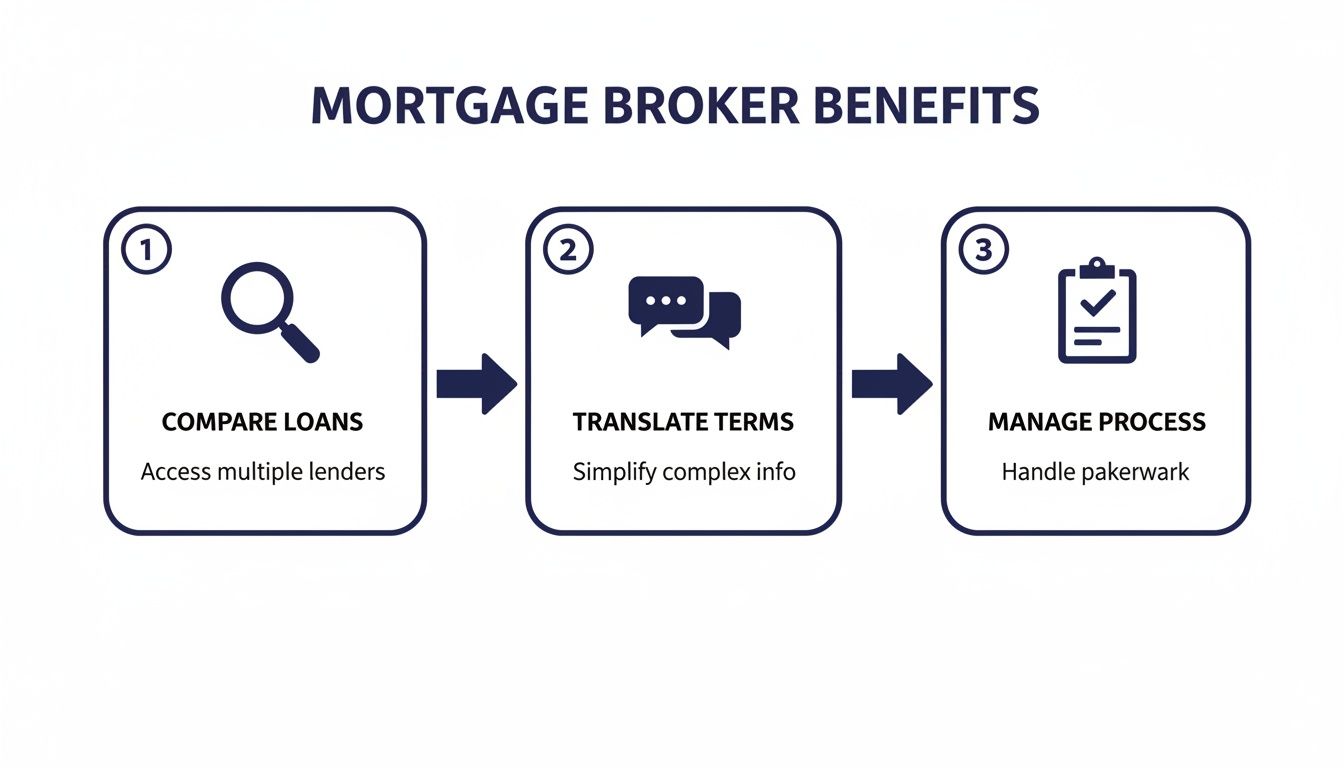
As you can see, it’s all about comparing your options, translating the bank jargon, and managing the whole process so you can focus on the exciting stuff.
Securing Final Approval and Reaching Settlement
After a successful valuation and one last check of your finances, the lender issues unconditional or formal approval. This is the green light you’ve been waiting for! It means the loan is officially yours, and you’re on the home stretch.
The final leg of the race, from formal approval to settlement, is mostly handled by your solicitor or conveyancer. But your broker is still right there with you, acting as a key point of contact. They’ll work closely with everyone the lender, your legal team, and the seller’s side to make sure everything lines up for the big day.
Settlement day is when it all becomes official. Here’s a quick rundown of what happens:
- Funds are Transferred: The lender moves the loan funds to your legal team, who then pays the seller.
- Documents are Exchanged: All the legal paperwork is finalised and lodged with the relevant land title office.
- Keys are Released: Once the money has cleared, the real estate agent gets the call to hand over the keys. Congratulations, you’re officially a homeowner!
From that very first conversation to the final handover, your Diamond Lending broker is your advocate. We handle the admin grind, solve problems before you even know they exist, and give you the clarity you need to feel confident every step of the way.
Unlocking Government Grants and Support Schemes
One of the biggest hurdles for any first-time buyer is getting that deposit together. The good news? The federal and state governments have a whole range of powerful schemes designed to give you a leg up and get you into the property market sooner.
Think of these grants and guarantees as a booster pack for your savings. They can slash your upfront costs, help you buy with a smaller deposit, or let you dodge expensive fees. But the rules, eligibility criteria, and application processes can be a moving target. This is where a first home buyer mortgage broker becomes your secret weapon.
Your broker’s job is to be your expert guide, spotting every single scheme you might qualify for and weaving them into your home loan strategy so you don’t miss a thing.
Major Federal Government Initiatives
The Australian Government has a few key programs that have helped thousands of first-home buyers get their foot in the door. These are usually the first place to look when you’re trying to lower that initial financial hurdle.
Two of the most popular schemes are:
- First Home Guarantee (FHG): This is a huge one. It lets eligible buyers purchase a home with a deposit as low as 5% without having to pay for Lenders Mortgage Insurance (LMI). The government essentially acts as a guarantor for up to 15% of the property value, saving you thousands in insurance premiums and years of saving.
- First Home Super Saver (FHSS) Scheme: The FHSS scheme lets you make extra voluntary contributions to your super fund to save for your first home. You can then pull those contributions back out (along with any earnings) for your deposit, giving you a nice tax-effective way to boost your savings.
These schemes are absolute game-changers, but the eligibility criteria can be strict. They often have income caps, property price limits, and rules about prior property ownership. A broker makes sure your application ticks every single box so you don’t miss out on these opportunities.
State-Based Grants and Concessions
On top of the federal support, every state and territory throws in its own incentives. These usually come in the form of cash grants or massive discounts on stamp duty a major upfront cost that can catch people by surprise.
For example, depending on where you live, you might be able to get:
- A $10,000 First Home Owner Grant (FHOG) if you’re buying or building a brand-new home.
- A full exemption or a big concession on your stamp duty, which could easily save you tens of thousands of dollars.
Because these programs change from state to state, a good broker with national experience is invaluable. They’ll know exactly what’s available in your area, calculate your potential savings, and build it into your borrowing power assessment.
This guidance has become critical. First home buyers recently hit a record-high 27.7% of all property purchases, largely driven by people taking advantage of these programs. Brokers have been at the centre of this trend, helping buyers lock in savings.
It’s also crucial to understand exactly how these grants work with your deposit. Sometimes a grant can’t be used for the deposit itself but can cover other costs. Our guide on understanding deposit bonds also explores other ways to handle your deposit. A broker will clear up all these details, making sure there are no nasty surprises on your journey to owning your first home.
Decoding Mortgage Jargon: LVR and LMI Explained
When you start your property journey, you’ll quickly run into a world of acronyms that can feel like another language. Two of the most common ones you’ll hear from your first home buyer mortgage broker are LVR and LMI. Getting your head around these is crucial for making smart financial moves.

Think of it like this: lenders have a rulebook for managing their risk, and LVR and LMI are two of the biggest rules in it. Understanding how they work puts you in a much stronger position when it’s time to structure your home loan.
What Is Loan to Value Ratio (LVR)?
The Loan to Value Ratio (LVR) is simply the percentage of the property’s value that you’re borrowing from a lender. The rest is your deposit. It’s a quick calculation that tells a bank how much skin you have in the game versus how much they do.
For example, if the home you want to buy is valued at $500,000 and you have a $100,000 deposit, you need to borrow $400,000. Your LVR would be 80% ($400,000 ÷ $500,000).
Lenders see an LVR of 80% or lower as the gold standard. It shows them you have a significant financial commitment a 20% deposit which reduces their risk. This often unlocks more competitive interest rates and better loan features for you.
Understanding Lenders Mortgage Insurance (LMI)
So, what happens if your LVR is higher than 80%? This is where Lenders Mortgage Insurance (LMI) comes into play. It’s a one-off insurance premium you pay when you borrow more than 80% of the property’s value.
Crucially, LMI protects the lender, not you. If you were unable to make your repayments and the sale of your home didn’t cover the outstanding loan, the lender’s insurance policy would cover their loss.
LMI can feel like a penalty, but it’s better to see it as a tool. It allows lenders to approve home loans for buyers with smaller deposits, helping many people get into the property market years sooner than they otherwise could.
The cost of LMI isn’t fixed; it’s calculated on a sliding scale. A higher LVR (meaning a smaller deposit) results in a more expensive LMI premium because the lender is taking on more risk. Your broker can give you an exact quote based on your specific situation.
How to Minimise or Avoid LMI
For many first home buyers, avoiding LMI is a major goal. The most direct way is to save a 20% deposit, but let’s be real—that’s getting harder. Today, only 12% of Australian homes are considered affordable for an average first home buyer household, a steep drop from 30% in recent years. This affordability crunch makes saving an average deposit of $159,000 a massive challenge. You can read more about these findings on housing affordability in Australia.
Thankfully, there are other strategies your mortgage broker can help you explore:
- Government Schemes: As we’ve discussed, programs like the First Home Guarantee let you buy with a deposit as small as 5% without paying any LMI.
- Guarantor Loans: A family member (usually a parent) can use the equity in their own property as additional security for your loan, helping you avoid LMI altogether.
- LMI Capitalisation: Some lenders allow you to add the LMI premium to your total loan amount, so you don’t have to pay it upfront in cash.
A skilled first home buyer mortgage broker will assess your financial position and walk you through all your options. They’ll help you weigh the cost of LMI against the benefits of entering the property market sooner, making sure you land on a decision that aligns perfectly with your goals.
Finding Solutions for Complex Financial Situations
Not everyone fits the textbook image of a home buyer with a perfect 9-to-5 job and a spotless credit file. The reality is, many Australians have more complex income streams or a few bumps in their financial past. This is where a specialist first home buyer mortgage broker really shows their worth, turning what feels like a roadblock into a clear path forward.
Maybe you’re self-employed, a freelancer, or a contractor with a fluctuating income. Perhaps a past credit issue is still lingering on your record. If you walk into a big bank with this kind of profile, you might get a quick “no,” leaving you feeling completely deflated.
That’s because major lenders often lean on automated systems designed to approve straightforward, predictable incomes. A good broker, however, knows your story is much more than what a standard payslip can show. They become your financial advocate, ready to find a real solution.
Navigating Low-Doc and Alt-Doc Loans
For self-employed borrowers who can’t produce two years of neat tax returns, there are specialised loans known as low-documentation (low-doc) or alternative-documentation (alt-doc) loans. These aren’t “no questions asked” loans; they simply offer different ways to prove you can afford the mortgage.
Instead of full tax returns, a specialist lender might be happy to look at other evidence, like:
- Business Activity Statements (BAS) from the last 12 months.
- A formal declaration from your accountant confirming your income.
- Business bank statements that show a healthy, consistent cash flow.
A broker’s guidance here is crucial. They know exactly which lenders are comfortable with low-doc applications and can help you prepare the right paperwork to present your financial position in the strongest possible light. This alone can dramatically boost your chances of getting an approval that a bank would have dismissed out of hand.
A broker’s greatest strength is their network. They have access to dozens of lenders, including specialists who are willing to look beyond automated credit scores and standard income proof to understand the real story behind your finances.
Finding Lenders Who Understand Your Story
Your financial situation is unique, and a good mortgage broker gets that. They take the time to dig into the details of your income, whether you’re a gig-economy worker, a small business owner, or someone working to rebuild their credit. With this deep understanding, they can match your specific profile to the right lender.
This is a massive advantage. Some lenders are known for being more flexible with self-employed applicants, while others have policies designed for people with variable income or minor credit blips. Trying to find these lenders on your own is like searching for a needle in a haystack.
Ultimately, a broker’s job in these situations is to build a compelling case for you. They don’t just submit forms; they tell your story, highlighting your strengths and providing context for any weaknesses. This personalised approach helps lenders see you as a reliable borrower, not just a set of numbers on a screen. For a first home buyer mortgage broker at Diamond Lending, finding these tailored solutions isn’t just part of the job—it’s what we do best, ensuring everyone gets a fair shot at owning their own home.
How to Choose the Right Broker and Avoid Common Mistakes
Picking the right mortgage broker is just as critical as finding the right house. This relationship will literally shape your entire home-buying journey, so it’s vital to find someone who gets what it’s like to be a first home buyer. A great broker brings clarity to the chaos; the wrong one just adds to the confusion.

To choose wisely, you need to ask the right questions. Think of it like an interview for a very important job—because that’s exactly what it is.
Questions to Ask a Potential Broker
Before you sign on the dotted line, have a chat armed with a few key questions. The way they answer will tell you everything you need to know about their experience, how they operate, and whether they’re the right fit for you.
- How many lenders are on your panel? More lenders mean more choices. A wide panel gives you a much better shot at finding a competitive loan that actually fits your life.
- Do you have experience with first home buyers? A first-timer’s needs are completely different from an investor’s. You want someone who knows the grants inside-out and can explain complex stuff in simple terms.
- What is your communication style? Will they keep you in the loop with regular calls, emails, or texts? Knowing this upfront saves a lot of stress wondering what’s going on.
- What are your fees? For most home loans, a broker’s service is free for you (the lender pays them). It’s super important to confirm this from the get-go so there are no surprises.
A transparent, client-first approach is the hallmark of a great broker. At Diamond Lending, we prioritise clear communication and ensure you understand every step, empowering you to make informed decisions without pressure.
Common Pitfalls for First Home Buyers
Getting into the property market for the first time is incredibly exciting, but there are a few common traps that can catch people out. Knowing what they are is the best way to sidestep them.
One of the biggest mistakes is underestimating the upfront costs. Your deposit is just the beginning. You’ll also need to budget for stamp duty, legal fees, building inspections, and potentially LMI. A good broker will map all this out for you, so you have a realistic budget with no nasty shocks.
Another classic error is making big financial changes mid-application. Applying for a new car loan, quitting your job, or even running up a credit card can send a massive red flag to the lender. It can seriously jeopardise your approval. From pre-approval to settlement, it’s best to keep your financial life as stable and predictable as possible.
Here are a few other common tripwires to watch for:
- Not getting pre-approval first: House hunting without a clear budget is a recipe for frustration and disappointment.
- Fixating only on the interest rate: The lowest rate isn’t always the best deal. A loan with a rock-bottom rate but sky-high fees or inflexible features can end up costing you more.
- Failing to read the fine print: Your broker is there to translate the jargon and make sure the loan’s terms and conditions align with your long-term goals.
By partnering with an experienced first home buyer mortgage broker, you get an expert in your corner, dedicated to helping you avoid these common traps. They provide the strategic guidance you need for a smooth and successful journey to owning your first home.
Frequently Asked Questions
Jumping into the world of home loans for the first time brings up a lot of questions. It’s completely normal. To help you feel more confident, we’ve put together a few of the most common things first-home buyers ask us, with clear, straight-up answers.
How Much Does It Cost to Use a First Home Buyer Mortgage Broker?
Here’s the good news: for almost all standard home loans, our service is at no cost to you.
So, how do we get paid? Brokers receive a commission from the lender you ultimately choose, but only after your loan has settled. This structure is regulated to ensure our primary focus is always on your best interests, not the lender’s. A reputable broker, like our team at Diamond Lending, provides all their expertise without charging you a fee.
How Long Does Home Loan Pre-Approval Take?
The timeline for pre-approval can vary. Typically, once we’ve submitted all your documents, you can expect an answer anywhere from a few days to two weeks.
The exact timing often comes down to the lender’s current workload and how complex your financial picture is. An experienced first home buyer mortgage broker really shines here—we make sure your application is complete and properly presented from the get-go, which helps speed things up and gives you a realistic timeline to work with.
What Happens If My Loan Application Is Declined?
A loan rejection is disappointing but it’s definitely not the end of the road. Instead of you having to start the whole process over from scratch, our first job is to find out from the lender exactly why they said no.
Common reasons for a decline include:
- The lender’s valuation of the property came in lower than the purchase price.
- An unexpected issue popped up on your credit file.
- Your income type didn’t quite fit that particular lender’s strict policies.
Once we know the reason, we have a clear path forward. We’ll either work with you to fix the issue or pivot and take your application to a different lender on our panel whose criteria are a much better fit for your situation. This is one of the biggest advantages of using a broker—we always have a Plan B (and C, and D).
Can I Use a Broker If My Bank Already Pre-Approved Me?
Yes, absolutely. A pre-approval from your bank isn’t a final commitment, and you’re always free to see what else is out there. Think of it as a good starting point.
A mortgage broker can take that existing pre-approval and compare it against dozens of other home loan products. We can often find an option with a better interest rate, lower fees, or more flexible features that could save you thousands over the life of your loan. It costs nothing to get a second opinion, and it could make a massive difference to your financial future.
Ready to start your home ownership journey with confidence? The expert team at Diamond Lending is here to guide you every step of the way, from answering your first questions to celebrating your settlement day. Get in touch with us for a free, no-obligation chat today.