

When a traditional bank loan feels just out of reach, Melbourne private lending specialists step in. They offer a powerful alternative for property developers, business owners, and savvy investors who need to move faster than the big banks allow.
Private lending is a type of asset-backed finance, but forget the stuffy bank jargon. At its core, it’s about getting funds from non-bank institutions or private individuals who prioritise speed and flexibility over rigid, tick-a-box criteria. It's built for borrowers who need capital now, not in six weeks.
Understanding Private Lending in Melbourne

Think of applying for a bank loan like catching a commercial flight. You're bound by a fixed schedule, strict baggage rules, and endless paperwork. If you don't fit their exact requirements, you simply can't get on board.
Private lending, on the other hand, is like chartering a private jet. It offers a direct, customised route built around your destination and your timeline. This is exactly what’s needed in Melbourne's dynamic property market, where opportunities don't wait for bank committees.
The Core Principles: Speed and Flexibility
The real magic of private lending is how quickly it delivers funds. In a competitive market like Melbourne, a property auction or a prime development site won't wait. Losing weeks to a bank approval can mean losing the entire deal.
Private lenders care more about the value of the property you're offering as security (the asset) and less about your historical tax returns. This asset-first approach allows them to make decisions and settle loans in a matter of days, not months. That speed is an absolute game-changer.
Flexibility is the other side of the coin. Private lenders can shape a loan in ways banks simply can't, accommodating unique financial situations. This might include:
- Interest-only periods: A great way to manage cash flow while you're in the middle of a construction project or waiting for another property to sell.
- Capitalised interest: This is where interest payments are rolled into the loan balance, freeing up your immediate cash for more critical uses.
- Accepting complex income sources: Perfect for self-employed people or business owners whose finances don't fit neatly into a bank's spreadsheet.
For a clearer picture, let's break down the key differences.
Private Lending vs Traditional Bank Loans
| Feature | Private Lending | Traditional Bank Loan |
|---|---|---|
| Speed | Typically settles in 5-14 days | Can take 4-8 weeks or longer |
| Assessment Focus | Value of the security property & exit strategy | Borrower's credit history & income documents |
| Flexibility | High (custom loan structures) | Low (rigid, one-size-fits-all policies) |
| Documentation | Minimal (low-doc options available) | Extensive (tax returns, payslips, etc.) |
| Loan Term | Short-term (3-24 months) | Long-term (up to 30 years) |
| Best For | Time-sensitive deals, bridging finance, construction | Standard property purchases, refinances |
This table really highlights how private lending is built for specific, time-critical scenarios where traditional finance just can't keep up.
Why Demand Is Soaring in Melbourne
The need for Melbourne private lending specialists has exploded in recent years, and it's not hard to see why. The local economic climate has created the perfect storm.
As major banks face tighter regulations, their lending criteria have become incredibly restrictive. This has created a massive funding gap for perfectly good borrowers and projects that fall just outside the banks' narrow guidelines.
On top of that, Melbourne's red-hot property market brings its own pressures. Developers often need to lock down a site before a competitor swoops in, and homeowners might need bridging finance to buy their next place before the current one has sold.
In these situations, the slow, methodical pace of a major bank is a huge liability. Private lending fills this void, providing the urgent capital needed to seize those fleeting opportunities. It's become an essential tool for anyone trying to navigate Melbourne’s fast-moving real estate and business worlds.
Understanding the Private Credit Market in Melbourne
When you hear "private lending," it’s easy to think of it as a last resort or some fringe financial activity. But that’s a misconception. In reality, private lending is a huge, well-established part of Australia's financial ecosystem, especially in a dynamic property and business hub like Melbourne. It’s become a mainstream funding channel for a good reason.
This market fills a critical gap left wide open by the major banks. For developers, self-employed individuals, and business owners, the rigid, one-size-fits-all criteria of traditional lenders can be a major roadblock. Non-bank lenders and private funders offer a vital alternative, focusing less on historical income paperwork and more on the quality of the asset itself. It’s this shift in focus that makes the private credit world so essential.
The Scale and Importance of Private Credit
This isn’t a small niche; it's a powerful force in our national economy. In Melbourne, Melbourne private lending specialists are connecting borrowers to a deep pool of capital that keeps the city's projects moving. This becomes absolutely crucial when mainstream banks tighten their lending policies or take weeks to assess complex income structures, like those of high-net-worth or self-employed clients.
The Australian private credit market is a major player, with ASIC estimating it holds around $200 billion in assets under management. This shows just how much non-bank and private lenders have become a meaningful alternative to the major banks for property-backed and business lending.
That huge number demonstrates the trust and reliance placed on private funding. It’s the financial backbone for countless projects that might otherwise never get off the ground because of traditional banking red tape.
How Private Loans Are Structured
A key difference is how these loans are built. Unlike a 30-year mortgage you’d get from a big bank, private loans are designed for short-term, strategic purposes. This is reflected in their common features.
- Loan Term: Most private loans are short, typically running between 3 to 36 months.
- Interest Structure: They are often set up with interest-only payments. This is a game-changer for managing cash flow during a project's life cycle.
- Security: These loans are almost always secured against real estate, which gives the lender the confidence they need to fund the deal quickly.
These structures are purpose-built for scenarios like property development, bridging finance between a sale and a purchase, or seizing a quick business opportunity. The goal isn't long-term debt; it’s about getting access to short-term capital to achieve a specific, profitable outcome. You can learn more about these funding types in our detailed guide to private finance in Melbourne.
Risk, Rates, and the Role of a Specialist
Of course, this flexibility and speed come with a different pricing model. ASIC's own surveillance of private credit funds found that interest rates can vary significantly, which reflects the risk-based pricing that is a hallmark of the sector.
Rates in some wholesale funds, for instance, ranged from 8.00% to 41.66%, depending on the deal's complexity, urgency, and the lender's perceived risk. That’s the trade-off for speed and accessibility. For an in-depth look, you can read the full ASIC report on the private credit market.
This is exactly where a specialist becomes invaluable. A good broker understands this complex landscape. They can navigate the wide range of lenders and rates to find a facility that actually matches your needs and risk profile, ensuring the terms are both appropriate and completely transparent.
Key Scenarios Where Private Lending Is the Smart Choice
Private lending isn’t just a Plan B; it's a strategic tool designed for high-stakes situations where conventional finance simply can't keep up. For Melbourne’s property developers, business owners, and savvy investors, knowing when to use it can be the difference between seizing a golden opportunity and watching it slip through your fingers.
The real power of private finance shines when you need speed, flexibility, and a lender who focuses on your assets, not endless paperwork.
Think about it. A prime development site comes up for sale with a 14-day settlement, or you find your dream home before your current one is even on the market. In these moments, waiting weeks for a bank to scrutinise two years of tax returns just isn’t an option. This is exactly where Melbourne private lending specialists step in, offering solutions built for real-world urgency.
Bridging Finance When Timelines Don't Align
One of the most common and powerful uses for private lending is bridging finance. Let's say you've found the perfect property in a sought-after Melbourne suburb like South Yarra, but you need to act fast before it’s snapped up. The catch? The funds you need are tied up in your current property, which hasn't sold yet.
A traditional bank would likely show you the door, as they need a confirmed sale contract before they'll even consider lending for your next purchase. A private lender, on the other hand, sees things differently.
They can provide a short-term bridging loan secured against both properties. This gives you the cash to purchase the new place immediately, taking all the pressure off a rushed, stressful sale of your existing home. Once your old property sells, you simply pay back the bridging loan.
It’s a solution that turns a timing mismatch into a smooth, controlled transition, empowering you to buy on your terms, not the bank’s.
Fuelling Construction and Development Projects
Melbourne is a city that’s always growing, and property developers are at the heart of that expansion. But getting construction finance from the major banks can be a slow, frustrating grind, especially for unique or complex projects. Banks often get nervous about funding anything that doesn’t fit their standard cookie-cutter models, like boutique apartment builds or specialised commercial developments.
This is where private lending really excels. Private lenders often have direct experience in construction and can assess a project based on its future potential and feasibility—its "as if complete" value—rather than just looking in the rearview mirror at historical data. They can release funding in stages that match your construction timeline, ensuring builders and suppliers are paid on time and the project stays on track.
- Rapid Site Acquisition: Secure a prime development site in Richmond or Fitzroy before competitors can even get their bank manager on the phone.
- Flexible Drawdowns: Access funds as you hit different construction milestones, which is great for managing your cash flow.
- Complex Project Funding: Get the backing you need for innovative projects that banks might consider too risky or unconventional.
Unlocking Equity for Business Opportunities
For Melbourne's entrepreneurs, opportunities can appear out of nowhere. You might need a sudden cash injection to buy new equipment, acquire a competitor, or fund a massive order. If your capital is locked up in commercial or residential property, a private loan can unlock that equity almost instantly.
Unlike banks that demand detailed business plans and income projections, a private lender focuses on the value of your property. They can arrange a caveat loan or a second mortgage, putting working capital in your account in a matter of days. This speed allows you to act decisively and invest in your business when the moment is right—all without having to sell off your valuable property assets. It’s a smart way to make your real estate work for your business ambitions.
How Melbourne Private Lending Specialists Assess Loans
To get the most out of private lending, you need to understand how a private lender thinks. It’s a world away from the big banks, who are often fixated on historical income, payslips, and perfect credit scores.
Melbourne private lending specialists work with funders who take a much more practical, asset-first approach. The entire process is built for commercial reality and speed, not rigid bureaucracy.
This shift in mindset completely changes the game. Instead of asking, "What was your taxable income last financial year?", a private lender gets straight to the point with two fundamental questions: "What is the security property worth?" and "How will you pay this loan back?".
The Two Pillars of Private Loan Assessment
The entire approval framework is built on two core pillars. Get these right, and you open the door to incredible flexibility and lightning-fast decisions. These pillars are the Loan-to-Value Ratio (LVR) and your Exit Strategy.
-
Loan-to-Value Ratio (LVR): This is the single most important number in private lending. It's a simple calculation: the loan amount as a percentage of your security property's value. A lower LVR means lower risk for the lender, which makes getting a "yes" much easier. For example, borrowing $600,000 against a property valued at $1,000,000 gives you a conservative 60% LVR.
-
The Exit Strategy: This is your clear, believable plan for repaying the loan when the short term is up. It’s not just a vague idea; it's a documented pathway that gives the lender total confidence you can finalise the debt.
This asset-led model is precisely why a private lender can look past things like a patchy income history or a blemish on your credit file. If the property's value provides a solid buffer and your exit plan is rock-solid, many of the roadblocks the banks put up simply become irrelevant.
Defining a Strong Exit Strategy
A vague hope of repaying the loan just won't cut it. A strong exit strategy needs to be a concrete, verifiable plan. For most borrowers here in Melbourne, it will fall into one of three main categories.
- Refinancing to a Mainstream Lender: You might use a short-term private loan to finish a quick renovation or get your business financials in order. Once that's done, your stronger position allows you to refinance with a traditional bank at a lower rate, paying out the private lender in the process.
- Sale of the Security Property: This is the go-to for property developers and house flippers. The private loan funds the purchase and construction, and the exit is simply selling the completed—and more valuable—property.
- Sale of Another Asset: Perhaps you have another property or a significant business asset you plan to sell during the loan term. The proceeds from that sale are earmarked to clear the private debt.
The infographic below shows a few common scenarios where this assessment model really shines.
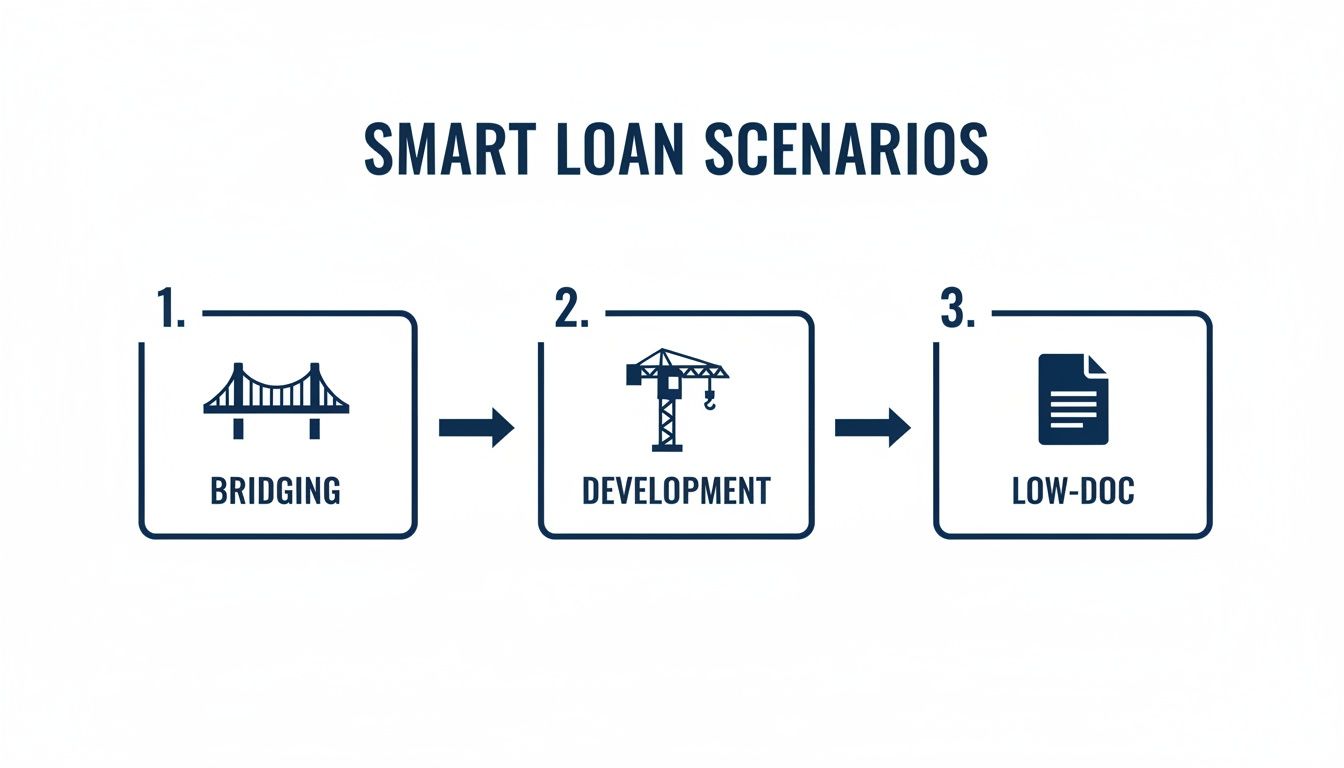
This simple flow highlights how asset-backed lending makes fast funding possible for bridging, development, and low-doc situations that banks often turn away.
The Critical Advantage of Speed
This streamlined, asset-first assessment is what makes incredible speed possible. When you strip it all back, speed and flexibility are the biggest advantages private lenders have over the banks.
A traditional lender in Australia can easily take 6–8 weeks to approve and settle a complex commercial loan, especially for self-employed borrowers or construction projects. In sharp contrast, Melbourne private lending specialists can often secure indicative approvals in hours and settle deals in just a few days.
This speed is a total game-changer, especially in a competitive market. With the Australian Bureau of Statistics reporting significant quarterly jumps in new loan commitments, the pressure on buyers and developers is only increasing. For a closer look at these market dynamics, you can explore our full analysis of private lending in Melbourne.
Getting Clear on Private Finance Costs and Timelines
When you’re looking at private finance, it’s crucial to have a straight-up, realistic view of the costs involved. The higher price point of a private loan isn't a penalty; think of it as a trade-off for speed, flexibility, and an appetite for risk that the major banks simply don’t have.
This kind of funding is a strategic move. The extra cost is what you invest to lock in a time-sensitive opportunity, bridge a tricky funding gap, or get a project off the ground weeks, if not months, ahead of schedule. Understanding exactly where the money goes allows you to make a clear-headed decision about whether it makes sense for your situation.
Breaking Down the Interest Rates
The biggest cost is, of course, the interest rate. It directly reflects the higher risk and the rapid turnaround private lending offers. While your typical bank mortgage rates might be in the low-to-mid single digits, private loan rates are built differently.
In Melbourne, for most property-backed private loans, you can expect annual interest rates to land somewhere between 9% and 15%. For more complex or urgent deals, this can creep higher, but a good specialist will always make sure the rate lines up fairly with the deal’s risk profile.
This rate is what compensates the lender for taking on a deal a bank would say "no" to—like lending against a property that needs development or to a borrower with non-standard income proof. It's the price you pay for getting your hands on capital exactly when it counts.
The Standard Fee Structure
Beyond the interest rate, a private loan also comes with several one-off fees. These cover the admin and legal groundwork needed to get the facility set up and funded. Any professional Melbourne private lending specialist will hand you a clear quote detailing every single cost upfront, so there are absolutely no surprises down the track.
Common fees you’ll see include:
- Establishment or Application Fee: The lender charges this to cover their work in assessing and structuring the loan. It’s almost always a percentage of the total loan amount.
- Brokerage Fee: This is what pays your specialist for their expertise in finding the right lender, putting the deal together, and managing the entire process for you.
- Valuation Costs: The lender needs an independent valuation of the security property to confirm its market value, and the borrower covers the cost of this report.
- Legal Fees: Both you and the lender will have solicitors to prepare and review the loan documents. You'll be responsible for covering both sets of legal costs.
A Hypothetical Cost Example
Let's put this into a real-world context. Say you need a $700,000 bridging loan for six months to snap up a new property in Melbourne before your current place sells.
Here’s what the breakdown might look like:
- Loan Amount: $700,000
- Interest Rate: 12% per annum (which works out to 1% per month)
- Establishment Fee: 2% of the loan amount ($14,000)
- Brokerage Fee: 1.5% of the loan amount ($10,500)
- Valuation & Legal Fees: Roughly $5,000
In this scenario, your total upfront fees would be about $29,500. On top of that, the monthly interest-only payment would be $7,000. By seeing the full cost structure laid out like this, you can properly weigh it against the profit you stand to make from securing the new property or the financial upside of a smooth, stress-free transition.
How to Choose the Right Melbourne Private Lending Specialist

Choosing the right partner to guide you through Melbourne's private lending market is just as critical as the loan itself. The best Melbourne private lending specialists are more than just finance brokers; they’re your strategist, your advocate, and your navigator.
A great specialist does more than hunt for a low rate. They take the time to understand your end goal and then structure a deal that actually sets you up for success. It's this choice that can make or break a project's outcome.
The difference between a good specialist and a bad one often comes down to their experience, their transparency, and the real-world quality of their lender network. Your goal is to find a trusted advisor who can turn a complex financial process into a clear, manageable path forward.
Key Qualities of a Top-Tier Specialist
Not all specialists are created equal. When you're vetting potential partners, there are a few non-negotiables to look for. These are the tell-tale signs of a professional who puts your interests ahead of a quick commission.
A top-tier specialist will always have:
- Access to a Diverse Lender Panel: They shouldn’t be beholden to just one or two lenders. A wide network means more options and a much better chance of finding the perfect loan structure for your unique situation.
- Proven Experience with Complex Scenarios: Don't be shy about asking for their track record. Have they funded deals like yours before, whether it’s a multi-stage construction project, a low-doc loan, or an urgent bridging facility?
- Complete Transparency on Fees: They must provide a clear, itemised breakdown of all potential costs—brokerage fees, lender establishment fees, valuation costs, and legal fees—long before you commit to anything. No surprises.
- A Clear Communication Style: A good specialist translates complex jargon into plain English. They answer your questions directly and keep you in the loop at every single stage of the process.
This mix of access, hands-on experience, and transparency is what separates the true professionals from the rest.
Critical Questions to Ask Any Specialist
Before you engage anyone, have a checklist of critical questions ready. Their answers will tell you everything you need to know about their expertise, their process, and whether they're the right fit for you.
Think of it as an interview—you're hiring them to manage a crucial financial step.
- What’s your direct experience with situations like mine? Ask them for specific examples of similar deals they've successfully closed.
- Can you give me a full, written breakdown of all potential costs? Vague answers here are a major red flag. Demand a clear quote.
- Which lenders on your panel are best suited for my scenario and why? This tests their real knowledge of the market and their ability to match you with the right funder.
- What does your communication process look like? Will you get regular updates? Who is your main point of contact?
- What are the biggest potential challenges with my application? An honest specialist will be upfront about potential hurdles and should already have a plan to tackle them.
The growth of Melbourne private lending specialists is directly linked to major shifts in Australian credit. As new investor loan commitments rise and non-bank lenders continue to gain market share, having an expert guide is more important than ever. Industry analysis shows private mortgage lending is growing at more than double the rate of the major banks, highlighting a structural shift that makes specialists central to funding strategies.
To get a better handle on this trend, you can explore insights on Australia’s private credit sector.
Your Questions About Private Lending Answered
Even after getting the basics down, it’s completely normal to have more questions before you jump into something like private lending. We get it.
Here are some of the most common queries we hear from our clients right here in Melbourne. We believe in giving direct, straightforward answers to help you feel confident and fully informed before you even think about taking the next step.
Getting these details straight can make all the difference.
Is Private Lending Safe and Regulated in Melbourne?
Yes, absolutely. This isn't the wild west of finance. Private lending is a legitimate and regulated part of Australia's financial industry. Any professional lender worth their salt must hold an Australian Credit Licence (ACL) or be an authorised representative of a licence holder. This framework ensures they stick to strict compliance and consumer protection laws.
Every loan is locked in with legally binding contracts, and the lender's interest is secured by a registered mortgage or a caveat lodged against the property title. A reputable Melbourne private lending specialist like us will only ever work with a panel of vetted, compliant funders. It's our job to make sure your interests are protected from start to finish.
What Is a Good Exit Strategy for a Private Loan?
An exit strategy is simply your plan to pay back the loan when the term is up. A good exit strategy is one that's clear, realistic, and can be easily verified. Lenders need to see with a high degree of certainty how they’re going to be repaid on time. A vague hope or a "we'll see" attitude just won't cut it.
The most common and effective exit strategies we see are:
- Refinancing to a traditional bank loan: This is a classic move. It often happens once your financial situation has improved (for example, your tax returns are up to date) or a construction project is finished, making you a much more attractive applicant for a major bank.
- Selling the security property: This is the standard exit for property developers or anyone doing a "fix and flip" renovation. The profit from the sale is used to pay out the private loan.
- Using proceeds from a completed project: For developers, the funds from selling completed townhouses or units in a project are used to clear the initial finance for the land and construction.
A huge part of a specialist's job is to help you define and validate this strategy before the loan is even approved.
A strong exit strategy is the foundation of a successful private loan application. It gives the lender the confidence they need to approve funding quickly, because they're focused on the future outcome, not your past financial records.
Can I Get a Private Loan for a Property Outside Melbourne?
Of course. While we're Melbourne-based specialists with deep roots and knowledge of the local market, many private lenders and brokers have a national reach. We can connect you with funders who finance properties and projects right across Australia, in every state and territory.
The core lending principles don’t change—it’s all about the asset's value (LVR) and having a bulletproof exit strategy. That said, having a specialist who understands the unique quirks of the Melbourne market is still a major advantage for local projects, ensuring valuations and risk assessments are spot on.
Ready to see how private lending can unlock your next opportunity? The team at Diamond Lending has the expertise to guide you through every step.
Book a no-obligation call with us today to talk through your scenario.