

Putting an offer on a house is more than just picking a price. It’s about getting your finances watertight with a mortgage pre-approval, understanding the property's real market value, and then putting forward a formal written offer with crystal-clear terms. The strength of your offer hinges not just on the number you write down, but on your proven ability to get the funds and see the deal through to the end.
Preparing Your Finances for a Winning Offer
Before you even think about how much to offer, you need to build a rock-solid financial foundation. This isn't just about knowing your budget; it's about showing up as a serious, low-risk buyer that sellers and their agents will take notice of. When you have your financial ducks in a row, you gain negotiating power and a whole lot of peace of mind.
Putting in the groundwork now means that when you do find the one, you can move fast and with conviction. This process will turn you from a casual window shopper into a buyer who’s ready to sign on the dotted line.
Your First Move: Mortgage Pre-approval
Getting a mortgage pre-approval is, without a doubt, the most powerful first step you can take. This is a formal thumbs-up from a lender, clearly stating how much they’re prepared to lend you after taking a proper look at your financial situation. Forget simple online calculators; this involves real documents like payslips, bank statements, and ID.
A pre-approval letter does two critical things for you:
- It defines your real budget. You’ll know your absolute ceiling, which stops you from falling for homes you simply can't afford.
- It makes you credible. Sellers and agents see you as a qualified, serious buyer. Your offer instantly looks stronger than one from someone who hasn’t even spoken to a lender.
Having pre-approval shows you've done your homework and are ready to go. In a competitive market, an offer "subject to finance" from a pre-approved buyer is worlds apart from an offer from someone starting from scratch.
This flowchart breaks down the essential financial steps, from doing your initial sums to getting the final lender sign-off.
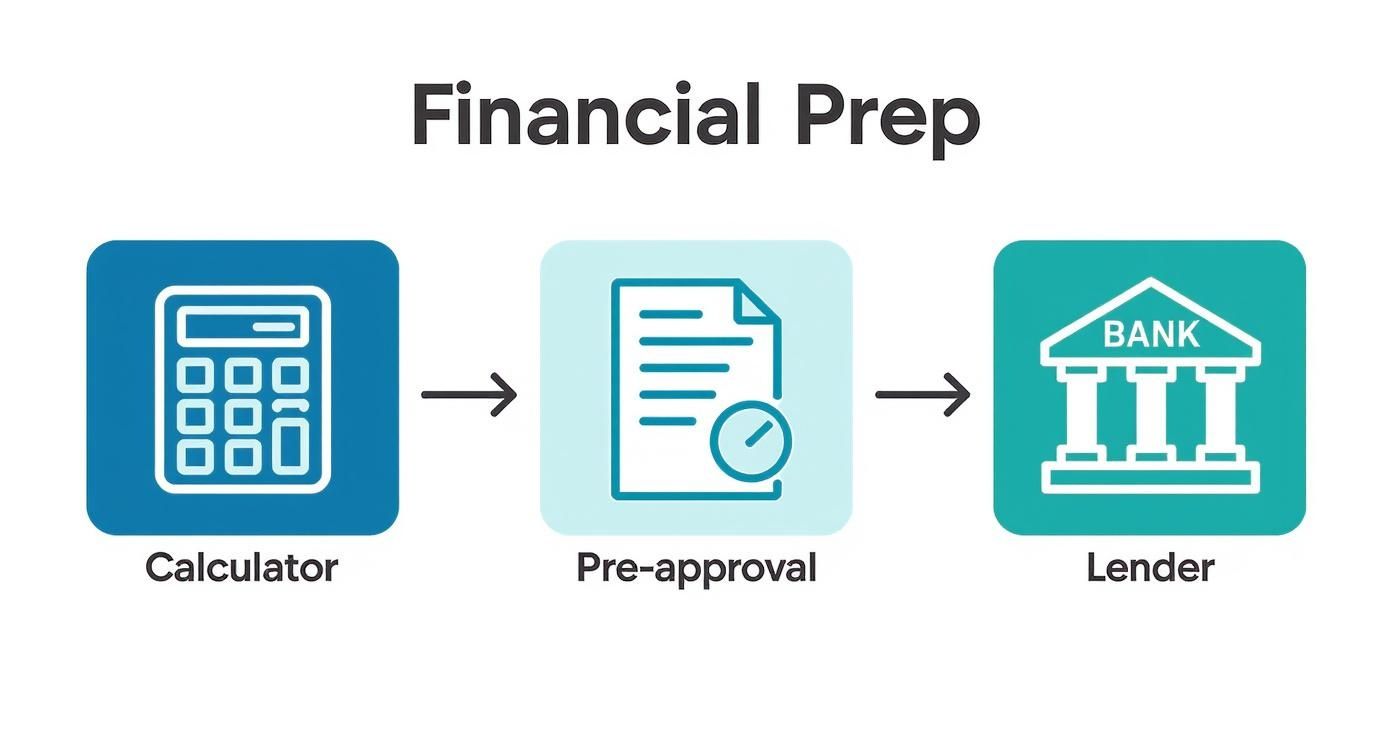
As you can see, figuring out your borrowing capacity is where it all begins, leading straight into the all-important pre-approval process and your final choice of lender.
Understanding Your Lending Options
Australia’s home loan market is incredibly varied, with options for almost every financial circumstance. While the big banks are the obvious choice, specialist lenders and mortgage brokers can often open doors to a much wider array of products. This is especially true for buyers who don't have a standard 9-to-5 income.
Think about these different pathways:
- Low-Doc/No-Doc Loans: A lifesaver for self-employed people or contractors who can’t produce traditional payslips. Lenders will look at other proof of income, like your Business Activity Statements (BAS) or a letter from your accountant.
- Credit-Impaired Loans: If your credit history isn't perfect, don’t despair. Some lenders specialise in second-chance finance, offering solutions for people who've hit a rough patch in the past. Our guide on how to obtain a home loan dives deeper into these options.
First home buyers are facing huge affordability hurdles, which has a massive impact on how they structure their offers. Shockingly, the percentage of suburbs an average Aussie can afford a mortgage in has dropped from 57% in 2017 to a projected 16% in 2025. This forces buyers to be incredibly strategic with their deposit size and borrowing power.
Here’s a quick checklist to make sure you have all your financial bases covered before you start making offers.
Your Financial Readiness Checklist Before Making an Offer
This table outlines the key steps to get your finances in order, ensuring you can make a credible and compelling offer on a property.
| Preparation Step | Why It's Critical | Action Item |
|---|---|---|
| Budget & Savings Assessment | Establishes your true deposit size and what you can afford for ongoing costs like stamp duty, legal fees, and inspections. | Review bank statements, list all savings, and calculate your total available funds for a deposit and upfront costs. |
| Credit Health Check | Your credit score directly impacts which lenders will approve you and at what interest rate. A clean report strengthens your application. | Request a free copy of your credit report and address any errors or outstanding issues immediately. |
| Mortgage Pre-approval | This is the ultimate proof to sellers that you're a serious buyer with the financial capacity to complete the purchase. | Gather your income documents (payslips, tax returns) and financial statements, then apply with a lender or broker. |
| Loan Repayment Calculation | Ensures the home you're offering on is genuinely affordable long-term, preventing future financial stress. | Use a reliable mortgage calculator with your pre-approved loan amount to estimate your weekly or monthly repayments. |
Getting these items ticked off doesn't just prepare you for an offer; it gives you the confidence to negotiate effectively and move forward without any last-minute financial surprises.
Calculate Your Repayments for Long-Term Confidence
Finally, before you lock in an offer price, grab a mortgage calculator and map out your future repayments. It's a simple step that helps you see past the big purchase price and grasp the real, long-term financial commitment. By plugging in the loan amount, interest rate, and term, you can get a clear picture of your weekly, fortnightly, or monthly payments.
This practical check ensures the offer you make isn't just competitive, but actually sustainable for your lifestyle. It’s about being able to comfortably manage your mortgage for years to come, without it causing constant financial strain.
Doing Your Homework to Nail the Offer Price
A winning offer isn't pulled out of thin air; it’s built on solid research, not guesswork. Just going by the real estate agent’s price guide is one of the biggest mistakes you can make. Before you even think about a number, you need to become a mini-expert on the local market. That’s how you’ll make an offer with total confidence.
This approach takes the emotion out of the equation. It makes sure your offer is competitive, realistic, and perfectly tuned to what's happening in the market right now. It's all about knowing what a property is truly worth before the back-and-forth even starts.

Analyse Comparable Sales Like a Pro
The best way to figure out a property’s value is to look at comparable sales, or 'comps' as they're known in the industry. These are properties that have recently sold nearby and are similar in size, age, condition, and features to the one you have your eye on. The key is to look at the actual sale prices, not the listing prices.
To find great comps, here's what you do:
- Keep it recent: Focus on properties sold in the last 3-6 months. The market moves fast, so anything older is less reliable.
- Stay hyper-local: Stick to the same suburb, or even better, the same few streets. A house just one suburb over can be in a completely different price bracket.
- Compare apples with apples: Look for places with the same number of bedrooms and bathrooms, a similar block of land, and comparable extras like a garage or a pool.
Going through this process gives you a realistic price range and, just as importantly, solid evidence to justify your offer when it's time to negotiate.
Learn to Read the Market Signals
Beyond what individual houses are selling for, the broader market trends give you crucial context. Understanding these signals helps you figure out how much competition you’re up against and how motivated the seller might be. This tells you whether you can afford to be a bit cheeky with your offer or if you need to come in strong.
Australia’s property market is known for being competitive, especially in the major cities. As of late 2025, the national median house price is hovering around $966,313, with the capital city average closer to $1,111,588. Knowing this bigger picture is vital.
A rising auction clearance rate is a dead giveaway of a "hot" market. It means buyers are fighting over properties, so you’ll likely need to make a strong, clean offer to stand a chance. On the flip side, a low clearance rate suggests a cooler market where you might have more room to negotiate.
To get a feel for the market's temperature, keep an eye on two key indicators:
- Auction Clearance Rates: This is the percentage of properties that sold at auction over a weekend. Anything above 70% usually signals a strong seller's market.
- Average Days on Market (DOM): This tells you how long properties are sitting on the market before they sell. A low DOM means demand is high and you’ll need to move fast.
Don't Forget to Factor in All the Costs
Your offer price is just the headline act. The total cost of buying a property includes a bunch of other significant expenses you absolutely must budget for. Getting this wrong can cause serious financial stress later on.
These extra costs, often called closing costs, can easily add another 3-5% on top of the purchase price. Forgetting to account for them is a rookie error that can sink a purchase, even after you’ve had an offer accepted.
To avoid nasty surprises, map out every single expense from the get-go. A comprehensive property buying cost calculator is your best friend here. It gives you a detailed breakdown of everything from stamp duty and legal fees to building inspection costs, helping you see the full financial picture. This kind of preparation is what separates a successful purchase from a stressful one.
Structuring Your Offer and Its Conditions
Once you’ve crunched the numbers and settled on a price, it's time to put your offer in writing. This isn't just a casual note; it becomes the formal contract of sale, a legally binding document once everyone signs on the dotted line. Nailing the details here is a critical part of making a successful offer.
Think of your offer as a complete package, not just a price tag. A well-structured offer protects your interests and clearly lays out your intentions for the seller, paving the way for a much smoother transaction.
Defining What Stays and What Goes
One of the most common arguments I see after a sale is over "inclusions" and "exclusions." It’s a simple misunderstanding that can sour the whole experience. Inclusions are the items you expect to stay with the house, while exclusions are what the seller plans to pack up and take.
A word of advice: never assume. Just because you saw a fancy dishwasher or a beautiful garden shed during the inspection doesn't mean it's automatically yours.
Your offer needs to be explicit.
- Standard fixtures: Things physically attached to the property, like built-in ovens, hot water systems, and light fittings, are almost always included.
- Moveable items: Be specific about anything that can be unplugged or moved. If you want the curtains, the freestanding dishwasher, or even those expensive pot plants by the front door, write them into the contract.
If the seller has a prized chandelier they intend to keep, it should be listed as an exclusion. Getting this clarity upfront prevents a world of headaches on settlement day.
Your Safety Net: Protective Conditions
Conditions, often called 'subject to' clauses, are your escape hatches. They're specific requirements that must be met for the sale to go ahead, giving you the legal right to walk away—with your deposit intact—if something goes wrong.
An offer without conditions might look tempting to a seller, but for you, it's a massive financial gamble. Unless you're a seasoned investor with cash to burn, making a conditional offer is always the smarter, safer play.
These clauses turn a risky bet into a calculated move. They buy you crucial time to do your homework properly without being locked into a property that turns out to be a lemon.
Unpacking the Most Common Clauses
While you can add all sorts of conditions, a couple are considered non-negotiable for the vast majority of Aussie buyers. They form the backbone of a secure offer and are standard practice.
- Subject to Finance Clause: This is your most important shield. It gives you a set timeframe, usually 14 to 21 days, to get unconditional approval for your home loan. If the bank says no for whatever reason, this clause lets you terminate the contract and get your full deposit back.
- Subject to a Building and Pest Inspection Clause: This lets you bring in the experts to check for structural defects, termite damage, or any other nasty surprises lurking beneath the surface. If the report comes back with major issues, you can either pull out of the deal or use the findings as leverage to negotiate a lower price or ask for repairs.
Your solicitor or conveyancer will be all over the wording to make sure you're fully protected.
Here’s a simple table breaking down the essential conditions and why they matter.
Essential Conditions to Include in Your Offer
| Condition | Purpose of This Clause | When It's Essential |
|---|---|---|
| Finance Approval | Provides a safe exit if your lender declines your loan application, protecting your deposit. | Always, unless you are making a genuine cash offer with proof of funds available. |
| Building & Pest Inspection | Allows you to uncover costly structural defects, termite damage, or safety hazards before you're legally committed. | For nearly all established properties, especially older homes or those showing signs of wear. |
| Sale of Existing Property | Makes the purchase contingent on you successfully selling your current home within a specified timeframe. | When you need the funds from your current home's sale to finance the new purchase. |
Getting these clauses right gives you control and peace of mind during what can be a stressful process.
Conditional vs. Unconditional Offers
Deciding whether to make a conditional or unconditional offer is a strategic move, often dictated by how hot the market is.
- Conditional Offer: This is the standard, and by far the safer, path. It includes those protective clauses we just talked about, giving you breathing room for your due diligence.
- Unconditional Offer: This means you're buying the property 'as is'—no ifs, no buts. It’s a powerful move in a seller's eyes because it offers them certainty, but it carries huge risk for you. You're locked in, even if your finance falls through or you later discover the house is riddled with termites.
In a frantic, competitive market, going in unconditional can definitely give you an edge. But it should only ever be an option if your finance is 100% unconditionally approved and you are completely confident in the property’s condition. For most people, the protection of a conditional offer is well worth it.
Navigating Negotiations to Finalise the Deal
So you've submitted your offer. Now, the real conversation begins. This part of the process can feel pretty intense, but having a smart strategy makes all the difference. Just remember, your first offer is almost never the final word; it’s really just the opening line in a dialogue to find that sweet spot that works for both you and the seller.
This is where all that research and prep work you did really pays off. A well-reasoned offer gives you a solid platform to negotiate from, turning what could be a stressful back-and-forth into a structured, business-like discussion.

Handling Counter-Offers with Confidence
It's almost a given that the seller will come back with a counter-offer. Don't let this discourage you—it's actually a great sign! It means they’re serious about selling and are willing to meet you somewhere in the middle. The key is to evaluate their new proposal calmly and strategically, not emotionally.
Look closely at what they’ve changed. Did they just bump up the price, or have they tweaked other conditions like the settlement date? Figuring out their priorities gives you a clue as to what they value most, which is a powerful piece of information for the next round.
Before you fire back a response, circle back to your budget and your property research. You need to have an absolute maximum price in your head—your 'walk-away' number—and you have to be prepared to stick to it. This discipline stops you from getting swept up in the heat of the moment and overpaying.
Knowing When to Hold and When to Fold
Making the call on whether to accept a counter-offer, make a new one, or walk away is genuinely tough. A small price increase might be worth it to lock in your dream home, but it's vital to recognise when a seller's expectations are just plain unrealistic.
Think about these common scenarios:
- A small price bump: If the seller’s counter is only a little above your offer and still comfortably within your budget, accepting it could be the fastest way to seal the deal.
- Meeting in the middle: A classic tactic is to respond with an offer that splits the difference between your last number and their counter. It shows you’re willing to compromise and keeps things moving.
- Holding your ground: If your research confirms your initial offer was fair and the seller is pushing for more than the property is worth, it can be smart to stand firm. You can politely decline their counter and let them know your previous offer is still on the table.
A key takeaway from experienced negotiators is to never make it just about the price. Flexibility on other terms, like offering a shorter settlement period if the seller is in a hurry, can make your offer more attractive without costing you a cent more.
Dealing with Multiple-Offer Situations
In a hot market, you’ll likely find yourself up against other buyers. This is where you need to make your offer stand out for reasons that go beyond the dollar figure. The agent is legally required to present every offer, so you need to give the seller every reason to pick yours.
To strengthen your position, you could:
- Offer a larger deposit: A bigger deposit signals that you're financially solid and serious about the purchase.
- Have fewer conditions: While it carries some risk, an offer with minimal conditions (like if you already have unconditional finance approval) is incredibly appealing to sellers.
- Add a personal touch: Sometimes, a letter to the seller explaining why you love their home can create an emotional connection that sways their decision.
The Australian market is often fast-paced. In the first nine months of 2024, there were approximately 395,642 dwelling transfers, an 8.93% year-over-year increase. This paints a picture of a lively market where acting decisively is a huge advantage. You can read more on the latest Australian property market trends to get a feel for the competitive landscape.
The Role of Your Conveyancer or Solicitor
During negotiations, your conveyancer or solicitor is more than just a legal advisor; they're a strategic partner. They'll handle all the formal communication with the seller's legal team, ensuring every counter-offer is documented correctly and is legally sound.
They play a crucial role in explaining the real-world implications of any changes to the contract. For instance, if a seller wants to shorten the 'subject to finance' clause, your solicitor can advise whether that’s a reasonable risk based on your lender’s typical turnaround times. Leaning on their expertise ensures you don’t accidentally agree to something that could put your deposit on the line.
From Offer Accepted to Holding the Keys
Congratulations, your offer is accepted! That's a massive milestone, but the journey isn't quite over. Think of this next part as the final leg of the race – the bit between acceptance and getting the keys, where all the legal and financial pieces come together.
This stage is all about satisfying your contract conditions and letting the formal process unfold. With a clear roadmap, you can move through these last few weeks with confidence, knowing exactly what's next on the path to settlement day.
Navigating the Cooling-Off Period
In most Australian states, private treaty sales come with a cooling-off period. This is a legally mandated window—usually three to five business days—that gives you one last chance to reconsider your decision without a major legal fight. It’s an important safety net that kicks in the moment you and the seller sign the contract of sale.
During this time, you can legally withdraw from the purchase for any reason. Just be aware that pulling out isn't completely free. You'll typically have to forfeit a small percentage of the purchase price, often 0.25%, as a penalty. Keep in mind, this safety net doesn't usually apply to properties bought at auction, where the sale is final as soon as the hammer falls.
Use this time wisely. It’s your last real opportunity to double-check your finances and be absolutely certain this is the right move before you are fully locked in.
Satisfying Your Contract Conditions
Once the cooling-off period is over, the focus shifts to meeting those 'subject to' clauses you put in your offer. This is where your careful planning really pays off, as each condition must be met by its due date for the sale to become unconditional.
The two most common hurdles are finance and inspections.
- Securing Unconditional Finance: Even with a pre-approval, your lender needs to give the final, unconditional sign-off. They'll order their own valuation of the property to make sure it’s adequate security for the loan. Your mortgage broker or banker will be guiding you through submitting any last bits of paperwork needed to get that formal approval across the line.
- Completing Building and Pest Inspections: Now’s the time to book in those professional inspections you made your offer conditional on. A licensed inspector will give you a detailed report on the property's structural integrity and check for any pests like termites. If the report uncovers significant problems, you may have grounds to renegotiate the price or even walk away, depending on the wording of your clause.
The goal here is to tick off each condition methodically. Clear, constant communication between you, your mortgage broker, and your conveyancer is absolutely essential to make sure deadlines are hit and the whole process stays on track.
The Conveyancer's Crucial Role
While you're busy sorting out finance and inspections, your conveyancer or solicitor is working tirelessly behind the scenes. Their job is to handle the complex legal transfer of the property title from the seller's name to yours, ensuring everything is legally sound.
They manage a whole host of critical tasks you might not even see:
- Title Searches: Verifying the seller legally owns the property and that there are no nasty surprises like outstanding claims or restrictions on the title.
- Council and Water Rates: Calculating the adjustments for rates and taxes, so you only pay your share from the day you take ownership.
- Liaising with Your Bank: Coordinating directly with your lender to ensure the mortgage funds are ready to go on settlement day.
- Preparing Transfer Documents: Drafting and reviewing all the legal paperwork needed to register you as the new owner.
Essentially, your conveyancer is the project manager for the entire settlement process. They make sure all legal and financial boxes are ticked correctly and on time.
The Final Pre-Settlement Inspection
Just before settlement day, usually in the final week, you get the right to a pre-settlement inspection. This is your last chance to walk through the property and make sure it's in the same condition as when you first made your offer.
You’re not there to find new faults or renegotiate. You’re there to confirm two key things: that the seller hasn't caused any new damage since you last saw it, and that all the agreed-upon inclusions (like the oven, dishwasher, or specific light fittings) are still there and in working order.
Take a copy of your contract with you and check everything off the list. If something isn't right, let your conveyancer know immediately so they can sort it out before the final payment is made.
Answering Your Final Questions Before You Make an Offer
It's completely normal to have a few last-minute questions buzzing around your head before you put an offer on the table. This is a huge decision, and getting those final details straight is what gives you the confidence to move forward.
Let's clear up some of the most common queries that pop up at this exciting stage.

How Much Can I Offer Below the Asking Price?
There’s no golden rule here. The right amount depends entirely on the local market, the property's condition, and how long it’s been for sale.
In a seller’s market where homes are flying off the shelves, an offer 5-10% below the asking price might not even get a response. But if you’re in a buyer’s market or the property has been sitting for a few months, a lower offer could be a very sensible place to start negotiations.
Your strongest asset is your research. When your offer is backed by solid data from recent comparable sales, it stops being a "lowball" and becomes a credible, evidence-based proposal.
What Are the Risks of an Unconditional Offer?
Going in with an unconditional offer is a high-stakes play. You're legally committing to buy the property exactly as it is, removing your safety nets for finance, building inspections, or pest checks.
The biggest risk? You could lose your entire deposit—and even be sued for further damages—if you can't follow through with the purchase for any reason.
While it’s a powerful way to make your offer stand out, you should only ever consider it if you’ve ticked all these boxes:
- You have 100% unconditional finance approval locked in with your lender.
- You’ve done your due diligence and are completely confident about the property’s condition.
- Your financial position is strong enough to handle any unexpected repair bills that might pop up.
For most buyers, the peace of mind that comes with conditions like "subject to finance" is worth far more than the slim edge an unconditional offer might provide.
"Remember, the real estate agent works for the seller. Their primary legal duty is to achieve the best possible price and terms for their client, not for you. While they must act ethically and honestly with buyers, their loyalty is always with the person paying their commission."
This is a crucial distinction. Always make sure you have your own team—a mortgage broker and a conveyancer—who are fighting exclusively for your best interests.
How Should I Respond to a Counter-Offer?
A counter-offer is good news! It means the seller is serious and willing to negotiate. Your next move should be calm, considered, and strategic—not emotional.
Before you do anything, go back to your budget, review your property research, and remind yourself of your absolute walk-away price.
You essentially have three choices:
- Accept the counter-offer if it feels fair and fits comfortably within your budget.
- Make your own counter-offer, perhaps meeting them somewhere in the middle to show good faith.
- Hold your ground on your last offer if you genuinely believe it reflects the home’s true market value.
The key is to stick to the facts and your financial game plan. That way, you’ll make a decision you're happy with long after you get the keys.
Navigating the complexities of home loans is the first step to making a confident offer. At Diamond Lending, we specialise in finding the right finance for your unique situation, from first-home buyers to self-employed professionals. https://diamondlending.com.au
Article created using Outrank