

Yes, securing one of the available bad credit home loans in Australia is absolutely possible, even if you’ve had some financial bumps in the road. Specialist lenders have emerged specifically to look at your current situation and your ability to repay a loan now, rather than getting stuck on past mistakes. The very first step, before anything else, is to understand exactly what’s on your credit file.
What a Bad Credit History Really Means for Your Home Loan

The term 'bad credit' often brings to mind major events like bankruptcy. In reality, for lenders, it covers a much wider spectrum. Many Australians are surprised to find out that a few late payments here and there can be enough to impact their borrowing power. The key is to stop guessing about your financial history and get a crystal-clear picture of what lenders will see when they pull up your file.
This isn’t about dwelling on the past; it’s about taking back control. When you get your hands on your credit report, you shift from being a passive applicant hoping for the best to an informed borrower ready to build a strong case for your home loan.
Understanding the Lender's Perspective
When a bank or a specialist lender reviews your credit file, they're not just looking at a number. They’re piecing together the story of your financial reliability. Every single entry helps them assess their risk in lending to you.
A single missed credit card payment from three years ago tells a very different story than a recent, unpaid default on another credit account. Lenders want to see the context—what happened, when it happened, and what your financial behaviour has looked like since.
This context is particularly important in Australia right now. With household debt among the highest in the world, lenders are naturally more cautious. To put it in perspective, NAB and ABS data for Q2 2025 showed that total liabilities per household hit $313,633, a figure that highlights the financial pressures many are facing. You can dig into more data about Australian personal debt from finder.com.au.
Decoding Your Credit Report
Your credit report is the official record of your borrowing history, and your first mission is to get a free copy. You can request one from official credit reporting bodies like Equifax, Experian, or Illion. Once you have it, you need to scan for specific negative listings that could be red flags for lenders.
Keep an eye out for these:
- Payment Defaults: A payment over $150 that's more than 60 days overdue.
- Court Judgments or Writs: Legal actions taken against you for unpaid debts.
- Clearouts: A listing that means a lender couldn't locate you to collect a debt.
- Serious Credit Infringements: These are recorded when a lender believes you’ve committed fraud.
- Bankruptcy or Debt Agreements: Formal insolvency arrangements filed under the Bankruptcy Act.
A common mistake we see is people assuming a small, forgotten default on a utility bill from years ago won't matter. While it's less severe than a major default, it still needs to be explained. Lenders value honesty and a straightforward explanation for every blemish on your file.
When it comes to bad credit applications, lenders dig deeper than just the credit score. They're trying to understand the whole picture of you as a borrower today.
The table below outlines the key factors a specialist lender will typically assess.
Key Factors Lenders Assess for Bad Credit Applicants
| Assessment Factor | What Lenders Look For | Why It Matters |
|---|---|---|
| Recency of Credit Events | How long ago did the defaults or late payments occur? Events from 3-5 years ago are viewed more favourably than those in the last 6-12 months. | Shows that the financial hardship was in the past and that your recent behaviour demonstrates improved financial management. |
| Type and Size of Default | Was it a small telco bill or a large credit account? Was it a single event or a pattern of missed payments? | A one-off event caused by something specific (like a job loss) is easier to explain than a consistent history of non-payment across multiple accounts. |
| Paid vs. Unpaid Defaults | Have you since paid off the outstanding debt? A 'paid' default is always better than an 'unpaid' one. | Paying off a defaulted debt shows responsibility and a commitment to meeting your obligations, even if they were late. |
| Reason for the Issue | Was there a legitimate reason for the credit impairment, such as illness, divorce, or a business failure? | Lenders can be more understanding if there was a clear, temporary hardship that caused the issue, rather than simple financial mismanagement. |
| Current Financial Position | What does your income, savings, and deposit look like now? Do you have stable employment? | Strong current financials, including a solid deposit and stable income, can significantly offset the risk posed by past credit issues. |
Ultimately, these factors help a lender build a story. A story that, hopefully, shows you are a reliable borrower today, despite any past challenges.
How Your Credit Score Is Calculated
Along with the detailed listings, you'll see a credit score—usually a number between 0 and 1,200. This score is a quick snapshot of your creditworthiness, but it’s definitely not the only thing lenders look at.
A score below 500 is generally considered poor and will likely get you a "no" from the major banks. However, many specialist lenders are prepared to look beyond the number.
They'll focus more on the details. Have you paid off past defaults? How recent are the credit problems? Do you have a stable job and a decent deposit saved up now? These factors paint a much more complete picture of your ability to handle a home loan today, making your homeownership dream a real possibility.
Finding the Right Specialist Lender for Your Situation

Hearing a flat "no" from a major bank can feel like your homeownership dream just hit a brick wall. But in reality, it’s often just a detour onto a different, more flexible path. There’s an entire network of specialist lenders in Australia—sometimes called non-conforming lenders—who exist specifically to help borrowers who don’t fit the standard mould.
These lenders have built their entire business on understanding that life happens. A past default, a tough financial period, or an income stream that isn’t a neat 9-to-5 salary doesn't automatically mean you’re out of the game. Their whole approach is different from the big banks, focusing much more on your story and where you are right now.
How Specialist Lenders Think Differently
Unlike the major banks that lean heavily on automated credit scoring systems, specialist lenders take a much more hands-on approach. They’re willing to look at the ‘why’ behind the blemishes on your credit file.
This means they consider the human factors that a computer algorithm would simply ignore. For them, a paid default from three years ago caused by a sudden job loss is a world away from a string of recent, unpaid credit card bills. They’re far more interested in your current ability to comfortably service a loan.
Their flexibility allows them to work with a huge range of financial situations, including self-employed tradies, contractors, or people who have bounced back from a financial setback. They are essentially story-based lenders, and your application is your chance to tell them a good one.
Common Types of Bad Credit Home Loans
When you start looking into non-conforming finance, you'll come across a few different types of loans, each designed for different levels of credit impairment. Knowing the lingo helps you figure out what might work for you.
Here are the main categories you'll see:
- Near Prime Loans: These are for people with very minor credit issues—think a single, small paid default or a few late payments from a couple of years back. The interest rates are usually only a touch higher than standard home loans.
- Specialist Loans: This is the most common home for bad credit home loans in Australia. These products are built for those with more significant issues, like multiple defaults (paid or unpaid), old court judgments, or a patchy repayment history.
- Private Lending: For more complex situations, like needing finance urgently or having a very messy credit history, a private loan can be a powerful tool. Our guide on understanding private lending solutions breaks down when this path makes the most sense.
It's crucial to see these loans not as a forever solution, but as a strategic stepping stone. The goal is simple: get the loan, build a perfect repayment history for 12-24 months, and then refinance to a traditional loan with a much better interest rate once your credit file is looking healthy again.
This strategy gets your foot in the property market door now, while paving the way for a more affordable mortgage down the track.
Real-World Scenarios and Lender Matches
To bring this to life, let’s look at how specialist lenders might approach a couple of different profiles. It's all about matching the right solution to the specific problem.
Scenario 1: The Self-Employed Tradesperson
- Applicant: Sarah, a plumber who has been running her own business for four years.
- Credit Issue: A $3,000 default to a supplier from two years ago, which she paid off last year. Her income also fluctuates, making it hard to show two clean years of tax returns.
- Lender Approach: A specialist lender would likely consider a 'low-doc' specialist loan. They’d focus on her recent Business Activity Statements (BAS) and bank statements to confirm her current income. The paid default is seen for what it is—a past business issue that has been sorted.
Scenario 2: The Young Family Recovering from Hardship
- Applicant: Ben and Chloe, looking to buy their first home.
- Credit Issue: They have several late payments on their credit cards from 18 months ago when Ben was unexpectedly out of work for three months. Every account is now perfectly up to date, and he’s been in a stable job for over a year.
- Lender Approach: A 'Near Prime' lender is a great fit here. They can clearly see the credit issues were isolated to a specific period of hardship and that the couple's recent financial conduct is spotless. They represent a much lower risk than someone with ongoing repayment problems.
In both examples, the lender looks beyond the black-and-white data to understand the context, opening up a path to a home loan that a major bank would almost certainly block.
Building an Application That Lenders Can't Ignore
When your credit file has a few bumps and bruises, the rest of your home loan application needs to be rock-solid. Specialist lenders are prepared to look past old mistakes, but they need to see undeniable proof that you’re a reliable borrower today.
It’s all about building a story of financial stability. Your goal is to give them a complete package that answers their biggest questions before they even ask them: Can you manage your money? Do you save consistently? Have you cleaned up old debts? Honesty and preparation are your best friends here.
Demonstrating Genuine Savings
A strong, consistent savings history is non-negotiable. It’s the clearest signal you can send a lender that you’ve got financial discipline down pat. They want to see you methodically putting money away over time, not just a big lump sum that magically appeared last week.
Here’s how to make your savings history work for you:
- Consistency is Everything: Lenders love seeing regular deposits into a savings account over at least a 3-6 month period. It proves you can live within your means and have cash left over.
- Explain the Big Deposits: Got a tax return, a bonus from work, or sold your car? Be ready to show where any large, one-off deposits came from. Documentation adds a layer of trust.
- Don't Cram at the Last Minute: An account that's been gathering dust for months and then suddenly fills up right before you apply is a huge red flag. Start building that savings pattern now.
Think of your savings account as your financial resume. Every regular deposit is a glowing reference telling the lender you’re a solid candidate for a mortgage.
This track record is often more powerful than the total amount you’ve saved. It shows you can handle the rhythm of regular mortgage repayments.
Tackling Consumer Debt Head-On
Lenders will put your existing debts under a microscope, especially high-interest debt like credit cards and Afterpay. Too many cards or high balances can scream "financially overstretched," making it look like you can't handle another loan.
Your first move should be to prioritise. Focus on smashing down the balances on your highest-interest credit cards. It’s also a smart move to reduce your credit limits once they’re paid off, because lenders assess your entire available limit, not just what you owe.
This is more important than ever right now. Lenders are on high alert as interest-bearing credit card debt in Australia soared to $18.4 billion in late 2025, its highest point since 2021. Banks are checking everyone's existing credit exposure with a fine-tooth comb. You can see more on how consumer debt trends affect lending via YouTube.
A clean, simple financial slate with minimal consumer debt makes you a much stronger applicant.
Crafting a Clear Letter of Explanation
For any black marks on your credit file, a short and honest Letter of Explanation is a must. This isn't about making excuses. It's a straightforward account of what happened, why it happened, and—most importantly—what you’ve done to fix it and make sure it never happens again.
Your letter needs to be:
- Short and Sweet: Stick to the facts. The lender doesn’t need your life story.
- Factual: Clearly state the date of the issue, who it was with, and the amount.
- Accountable: Own it. Acknowledge the problem without pointing fingers.
- Solution-Focused: Explain how you resolved it (e.g., "The default was paid in full on [Date]") and highlight your good financial habits since then.
For instance, you might write: "In May 2022, a default was listed by ABC Telecom for $250. This happened when I was out of work after a company-wide redundancy. The bill was paid in full in July 2022. Since starting my current job in August 2022, I’ve had a perfect payment record and have been saving consistently."
That one paragraph tells the lender everything they need to know. It owns the problem, gives it context, and shows you’ve turned things around.
Actionable Ways to Improve Your Loan Eligibility
Timing is everything when you're looking for a bad credit home loan. Applying when your financial profile is at its strongest can be the difference between getting the keys to your new home and getting another black mark on your credit file. It's all about taking proactive, strategic steps to strengthen your position and show lenders you're a reliable borrower again.
In some cases, you might need professional credit repair, especially if there are clear errors on your report that need disputing. For most people, though, the real work is in rebuilding good financial habits over time. It’s a long game, but it proves your creditworthiness far more effectively than any quick fix.
Build a Flawless Repayment Rhythm
The single most powerful way to improve your eligibility is to establish a perfect, unbroken track record of paying every single bill on time. Specialist lenders put a huge amount of weight on your recent financial conduct, often zooming in on the last 6 to 12 months of your history.
This means every repayment matters—from your rent and phone bill to any existing credit card or car loan payments. A simple but effective trick is to set up direct debits for all your regular expenses to ensure nothing slips through the cracks. This consistent, reliable behaviour shows a lender that whatever happened in the past, is truly in the past.
Become a Master Saver
Saving for a larger deposit does so much more than just reduce the loan amount. It sends a powerful signal to lenders, showing them you have financial discipline and can manage your money. A bigger deposit lowers the lender's risk, which can often be the deciding factor in a borderline application.
While you might see prime loans advertised with a 5% deposit, for bad credit home loans, you really want to aim for 20% or more. This commitment shows you have significant 'skin in the game' and can dramatically improve your approval odds, sometimes even scoring you a better interest rate.
A larger deposit also means you can avoid Lenders Mortgage Insurance (LMI), which is a hefty upfront cost that only protects the lender, not you. Saving more now can literally save you thousands down the track. For more practical steps, check out our guide on how to improve your credit score in Australia.
Minimise New Credit Enquiries
Every time you apply for credit—a new credit card, a store finance deal, even an Afterpay account—it leaves an enquiry on your credit file. Too many of these in a short period is a major red flag for mortgage lenders. It can make you look financially stressed or over-reliant on debt.
In the 6 to 12 months before you plan to apply for a home loan, it's critical to put a freeze on all new credit applications. Just let your credit file have a quiet period. This shows stability and proves you can manage your finances without constantly seeking new credit, making you a much lower-risk applicant.
To help you prioritise, here's a look at some short-term fixes versus the long-term strategies that truly move the needle for lenders.
Actionable Steps to Boost Your Home Loan Eligibility
| Strategy | Timeframe | Impact on Application |
|---|---|---|
| Pay down credit card balances below 50% | 1-2 months | Medium. Reduces credit utilisation, which lenders see as a positive sign of managing debt. |
| Set up direct debits for all bills | Immediate | High. Creates an unbroken record of on-time payments, a key factor for specialist lenders. |
| Stop all new credit applications | 6-12 months | High. Prevents new enquiries from spooking lenders and signals financial stability. |
| Save a larger deposit (aim for 20%) | 12+ months | Very High. Significantly reduces lender risk, may help you avoid LMI, and shows strong discipline. |
| Maintain a clean repayment history | 6-12 months | Very High. This is the single most important factor specialist lenders look for. |
| Prepare a letter explaining past issues | 1-2 weeks | Medium. Provides context for past defaults or hardships, showing transparency. |
Focusing on the high-impact, long-term strategies is what builds a genuinely strong application. While quick fixes help, lenders are most impressed by sustained positive behaviour.
This simple three-step process is a great way to visualise the core actions needed: boost your savings, reduce your existing debt, and be ready to explain any past credit issues.
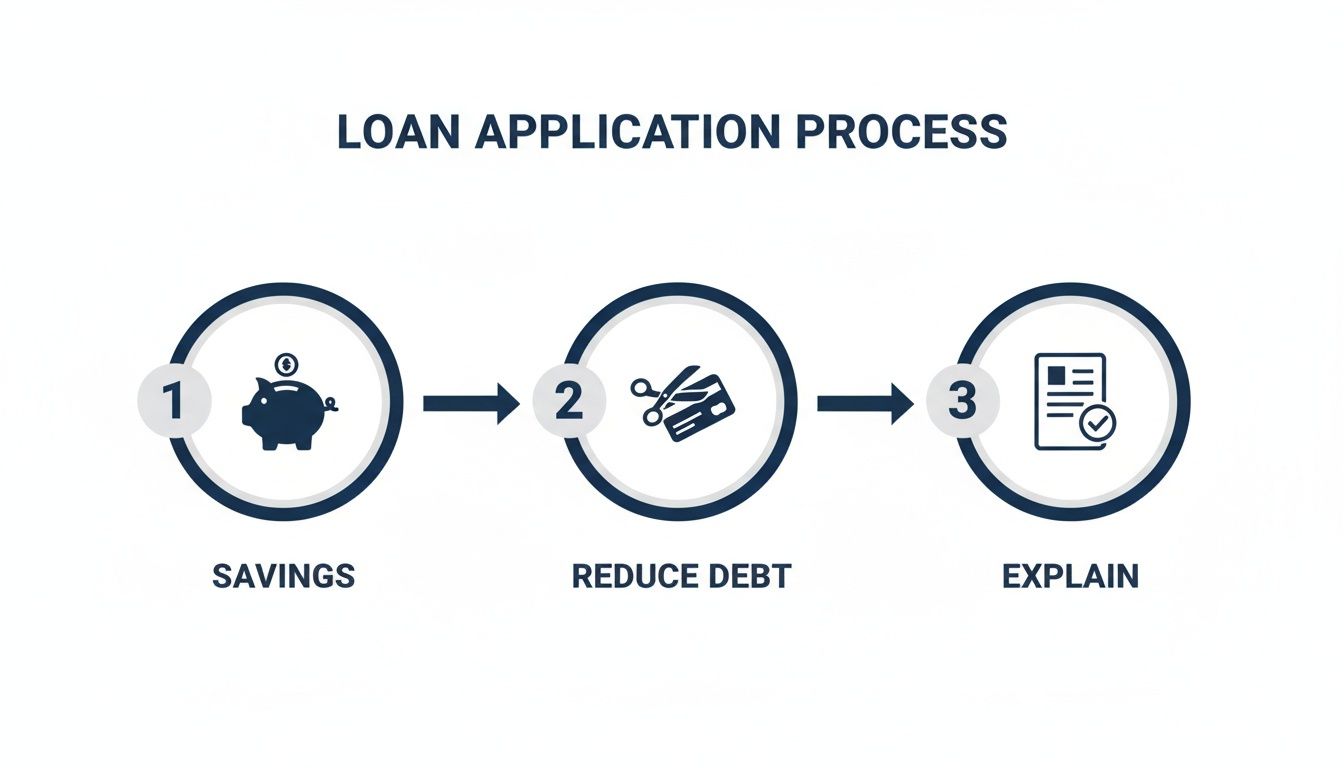
This visual roadmap reinforces that a strong application is built on solid savings, minimal consumer debt, and clear, honest communication.
The Real Costs and Risks of a Bad Credit Mortgage

Getting the keys to a new home with a bad credit loan is a huge win, especially when property ownership felt out of reach. But it’s crucial to walk into this new chapter with your eyes wide open to the financial reality. These loans are a fantastic tool, but they come with higher costs and unique risks you need to manage from day one.
Understanding these factors isn't about scaring you off. It’s about empowering you. Knowing the numbers helps you budget properly and, most importantly, ensures this mortgage is a stepping stone to a better financial future, not a long-term burden.
Why Are the Interest Rates Higher?
The first thing you’ll notice is the interest rate. It’s higher. Specialist lenders are willing to take on a risk that the major banks won't, and the higher rate is simply how they balance that equation. You can generally expect an interest rate that is 1% to 4% higher than what you'd see on a standard prime mortgage.
This isn’t a penalty; it’s a direct reflection of the risk outlined in your credit history. The lender needs a greater return to offset the increased possibility of late or missed payments. This is a common situation for many, and it's reflected in national data. For instance, non-conforming loans—those built for borrowers with a few credit hiccups—consistently show higher arrears rates. By the first quarter of 2025, some non-conforming loan pools were seeing arrears hit 2.5-3%, significantly above prime loans. You can discover more about mortgage delinquency rates in Australia to get the bigger picture.
A higher rate means bigger monthly repayments and a much higher total cost over the life of the loan—if you don't have a plan to refinance down the track.
What This Means for Your Budget and Total Loan Cost
So, what does a couple of extra percentage points actually look like in your bank account? The difference is bigger than you might think.
Let’s run a quick scenario:
- Loan Amount: $500,000
- Standard Loan Rate: 5.5%
- Bad Credit Loan Rate: 7.5%
On the standard loan, your monthly principal and interest repayment would be about $2,839. With the bad credit home loan, that repayment jumps to roughly $3,496. That’s an extra $657 every single month.
Over a year, that adds up to nearly $8,000 more going towards your home loan.
The key is not to accept this higher repayment as your forever reality. Think of it as the entry fee to get into the property market today. Your focus must immediately shift to building a clear exit strategy to a cheaper, prime loan as soon as you can.
This mindset changes the loan from a potential financial drain into a strategic move that secures you a valuable asset.
Keep an Eye Out for Additional Lender Fees
Beyond the interest rate, specialist loans can sometimes have a few extra fees you wouldn't find on a standard mortgage. Knowing about these upfront prevents any nasty surprises and helps you calculate the true cost of the loan.
Common fees you might come across include:
- Higher Establishment Fees: The cost to set up the loan can be more expensive, reflecting the hands-on, detailed assessment required.
- Risk Fees: Some lenders might charge a one-off "risk fee." This is an extra charge, usually a percentage of the loan amount, designed to offset their perceived risk.
- Higher Ongoing Fees: You might also find that monthly or annual account-keeping fees are a bit higher.
Always ask for a detailed cost breakdown. This lets you make a proper, side-by-side comparison between different offers and ensures you’re not caught off guard.
Your Refinancing Game Plan: How to Save Big in the Long Run
The single most important part of taking out bad credit home loans in Australia is to see it as a temporary fix. This loan is your bridge, not your final destination.
Your game plan should be crystal clear from day one:
- Build a Flawless Repayment History: Make every single repayment on time, every time, for at least 12 to 24 months. This is the undeniable proof future lenders need to see you as a reliable borrower.
- Keep Working on Your Credit: Stay on top of your credit file. Clear out any old, lingering debts and resist the urge to take on new consumer debt like car loans or credit cards.
- Refinance to a Prime Loan: Once you’ve got that solid repayment history and your credit score is looking healthy again, it’s time to talk to a broker. You'll be in a strong position to refinance to a standard loan with a much more attractive interest rate.
This strategy allows you to secure your home now, then systematically work your way into a far more comfortable and affordable financial position for the future.
Your Questions Answered: Getting Real About Bad Credit Home Loans
The world of specialist lending can feel a bit like a different universe compared to the big banks. It’s got its own language, its own rules, and it’s completely normal to have a few questions. Let's tackle the big ones head-on.
Getting clear, straight-up answers is the first step to making a smart financial move. We'll cut through the confusion and give you the confidence to move forward.
Can I Get a Home Loan if I Have a Default on My Credit File?
Absolutely. Having a default on your credit history doesn't automatically close the door on a home loan. Specialist lenders are far more interested in the story behind the default than the default itself.
They'll want to understand the context. For instance, a small, paid utility bill from a few years back is viewed very differently from a large, recent, and unpaid debt. Lenders are often willing to listen, especially when you can show them that your financial footing is solid today.
What really moves the needle is a strong, consistent employment history, a solid savings record, and a decent deposit. These things prove you're a reliable borrower now, regardless of what happened in the past.
Ultimately, they just want to see that the circumstances that led to the default are well and truly behind you.
How Much More Interest Will I Pay on a Bad Credit Home Loan?
It's true, you should expect to pay a higher interest rate. That’s just how these loans are structured to balance the lender's risk. Typically, you can expect the rate to be 1% to 4% higher than what the major banks are offering on their standard variable loans.
But here’s the crucial part: this isn't a life sentence. Think of it as a short-term strategy. The main goal is to build a perfect repayment history over the next 12 to 24 months. Once you’ve proven your reliability, the game changes.
With that positive track record, you can look to refinance with a prime lender. This move gets you a much more competitive interest rate and can slash your monthly repayments once your credit profile is back in good shape.
Is a Mortgage Broker Necessary for a Bad Credit Loan?
While you could try approaching some lenders directly, working with a specialist mortgage broker is one of the smartest moves you can make when your credit is less than perfect. A broker who lives and breathes the non-conforming market brings expertise you simply can’t replicate.
Here's why it's a game-changer:
- Exclusive Access: Many specialist lenders don't deal with the public at all—they only work through accredited brokers.
- Insider Knowledge: A good broker knows the intricate lending policies of each non-conforming lender inside and out. They know who will look at your specific situation and who won't.
- The Right Story: They’re experts at positioning your application to highlight your strengths and provide clear context for any weaknesses, giving you the best possible shot at approval.
- Protecting Your Credit Score: This is a big one. They stop you from blindly applying to lenders who aren’t the right fit, which prevents a string of unnecessary credit enquiries that would only damage your score further.
What Is the Minimum Deposit for a Bad Credit Home Loan?
For a bad credit home loan, you should really be aiming for a 20% deposit. Think of it as the gold standard. While you might see prime lenders advertising loans with a tiny 5% deposit, specialist lenders need to see you have more "skin in the game" to offset their risk.
A larger deposit achieves two massive things. First, it shows the lender you have discipline and the ability to save—a huge green flag. Second, it lowers your Loan to Value Ratio (LVR), which not only helps you secure a better rate but can also help you avoid paying thousands in Lenders Mortgage Insurance (LMI).
In some cases, if the credit issues are pretty minor and happened a long time ago, a lender might entertain a 10-15% deposit. But honestly, aiming for that 20% mark puts you in a much stronger position for a confident 'yes'.
Working through the maze of bad credit home loans can feel overwhelming, but you don't have to do it on your own. The expert team at Diamond Lending lives for this stuff. We specialise in finding smart solutions for people with unique circumstances, just like you. With access to a wide panel of specialist lenders, we can guide you every single step of the way.
Ready to see what’s possible? Start your journey with a no-obligation chat today.